No View Is the Whole
The World and the Ways We Make Sense of It
所見非全貌
世界,以及我們理解它的方式
Preface — Counting Yourself In
序 把自己也算進去
When someone disagrees with us, an explanation is never hard to find. He has not met certain kinds of people, he was once burned in some particular way, or he has spent his whole life inside that one circle. When it comes to ourselves, we may feel there is nothing to explain: things are simply as they are.
Pressed further, we can add a line: "I have thought about this carefully." The sentence carries great weight with ourselves; with others it may not. When the other person offers the same assurance, we still want to know what he has seen, whom he trusts, and which situations he has missed. Psychological research has found that when people assess bias in themselves and in others, they give different weight to inner intentions and to outward behaviour.1 We know how to trace another person's judgement back to its sources; when the trail reaches ourselves, it sometimes stops.
What I want to pursue is what happens if we take that step further. The self that is used to understand the world also lives in the world: it learnt its methods from certain people, trained its skills in a certain environment, kept paying attention because it cared about certain things, and only then arrived at the answer that now seems as plain as anything could be. That history of formation affects where the answer can be used.
I call the shift that comes with recognising this "the second realisation". We already know how to explain why other people think as they do; now the way of seeing that is doing the explaining must submit to the same questioning. Even our most successful experiences and the methods of reasoning we trust most are included.
Success is especially good at hiding this question. When a skill has helped for a long time, we pay less and less attention to the conditions it depends on. Move somewhere new, and the same way of working suddenly fails; the first thought may still be that other people are not cooperating, or that we have not tried hard enough. Putting in more effort sometimes improves the result, and sometimes only applies a method that no longer fits more thoroughly than before.
A simple problem about finding a ball can make this easily overlooked difference visible. Someone puts a ball in a box and leaves the room; while he is away, the ball is moved into a drawer. A child who has watched the whole thing is asked where the man will look first when he comes back.
The child knows the ball is in the drawer. To expect the man to look in the box, the child has to count in one more fact: he did not see the ball being moved. Problems of this kind have been used to study children's understanding of other people's beliefs.2 The same room holds the ball's actual position and also a person who does not yet know the ball has gone. The second is enough to explain why he walks towards a box we know full well is empty.
Adults usually have no trouble with this scene. But when we say "the data are clear enough" or "anyone with experience knows this", we have often stepped back onto our own familiar ground. What knowledge does it take to see that clarity? Under what circumstances was that experience acquired? If someone else had the same information and the same history, would we be willing to trust him too?
別人和我們意見相反時,解釋總是不難找。他沒接觸過某些人,吃過某種虧,或者一直待在那個圈子裡。輪到自己,我們卻可能覺得沒什麼好解釋:事情明明就是這樣。
被追問時,我們還能補上一句:「我已經認真想過了。」這句話對自己很有分量,對別人卻未必如此。聽見對方同樣保證,我們仍想知道他看過什麼、相信誰、漏了哪些情況。心理學研究曾發現,人們評價自己與他人的偏誤時,會給內心的意圖與外在的行為不同分量。1我們懂得追查別人的判斷,追到自己這裡,有時卻停了。
我想追問的,是把這一步繼續走下去會怎樣。用來理解世界的自己,也在世界裡生活:從某些人那裡學會方法,在某種環境練出本領,因為在意某些事而持續注意,最後才有了此刻覺得再明白不過的答案。這段形成過程,會影響答案能用到哪裡。
我把認出這件事的轉變,稱為「第二次頓悟」。我們已經會解釋別人為什麼這樣想;現在,正在解釋別人的那套眼光,也需要接受同樣的追問。連自己最成功的經驗、最信任的推理方法,都包含在內。
成功尤其容易把這個問題藏起來。一項本領長期幫得上忙,我們便越來越少注意它依靠哪些條件。換到新的地方,同一套做法忽然失效,第一個念頭可能仍是別人不配合,或者自己還不夠努力。再投入一些力氣,有時能改善結果,有時卻只是把一個已不合適的方法用得更徹底。
一個簡單的找球問題,能讓這種容易被略過的差別變得可見。有人把球放進盒子,離開房間;他不在時,球被移進抽屜。看完整個過程的孩子被問到,那個人回來會先去哪裡找。
孩子知道球在抽屜裡。要預期對方去盒子找,就得把「他沒看見移動」這件事也算進去。這類問題被用來研究兒童對他人信念的理解。2同一個房間,容得下球實際的位置,也容得下一個尚未知道球已移走的人。後者足以解釋,他為什麼走向我們明知已經空了的盒子。
成年人通常不難理解這個場景。但當我們說「這份資料已經夠清楚」「有經驗的人都知道」時,往往已經站回自己熟悉的地方。這份清楚需要哪些知識才能看見?那些經驗是在什麼情況下得到的?如果換個人,有同樣的資訊與經歷,我們是否也願意信任他?
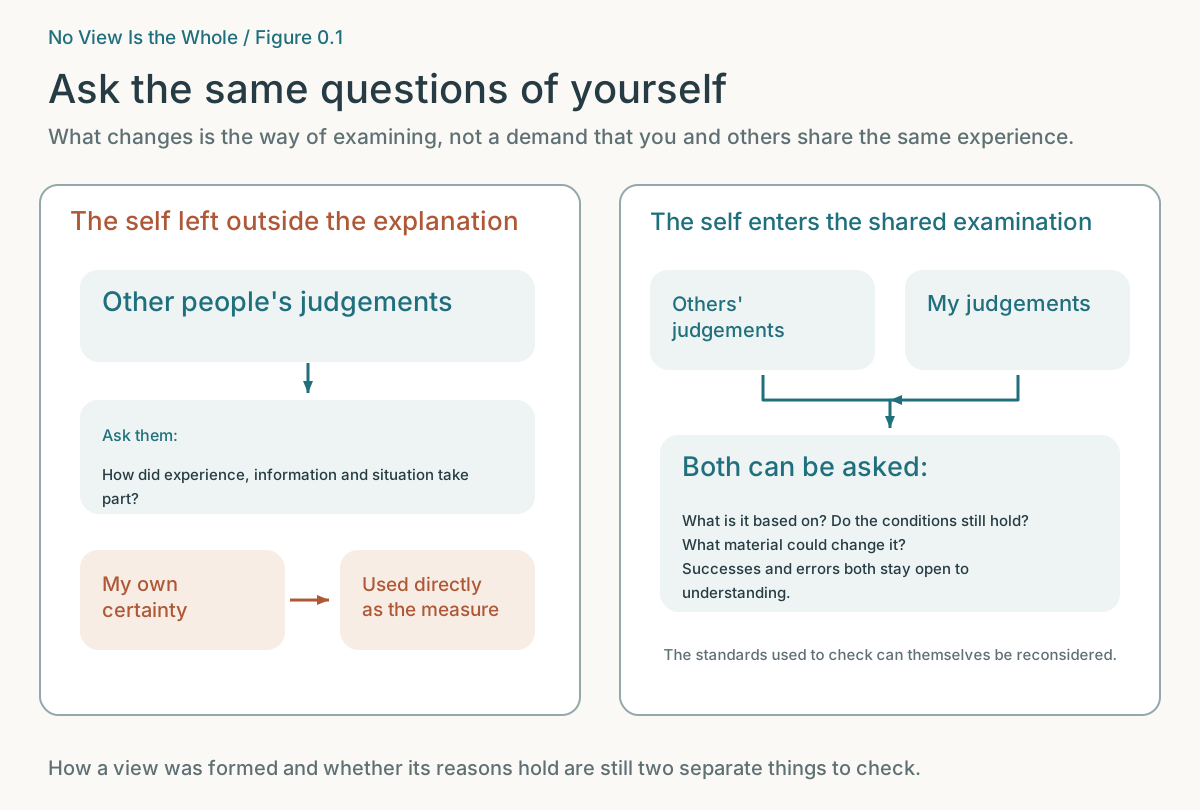
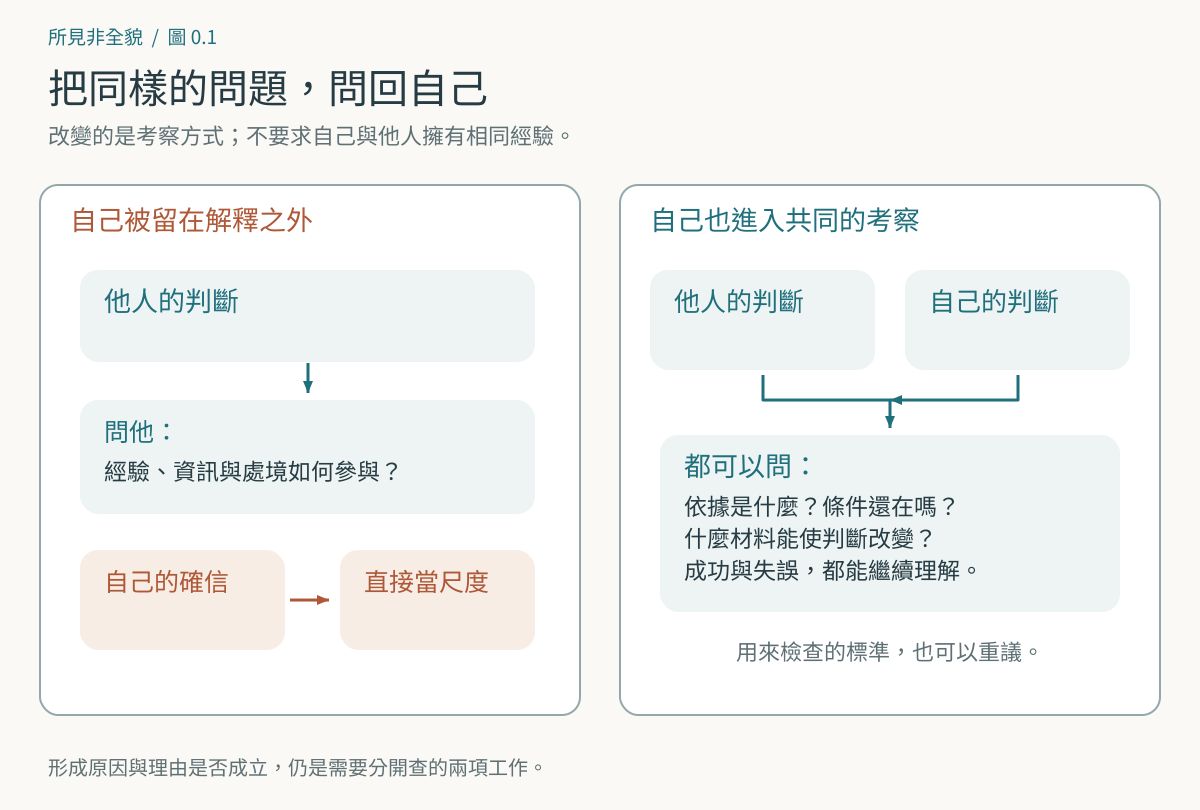
Seeing ourselves this way also changes what we ask of thinking. At work we know time is limited, yet in reflection we may demand that every matter be thought through before we allow ourselves to stop. How much time a piece of reasoning had, what data it obtained, whether a method worked out by earlier people was available: all of these affect what it can accomplish. Asking only whether we have thought deeply enough is not yet a complete understanding of what thinking is.
Sometimes it is even that feeling we cannot put into words that first notices a detail the analysis never obtained. The experienced hand feels the sound is wrong; the novice hears only that the machine is still running. Putting both in front of the same written description has not necessarily given them the same information. To know when that feeling deserves trust, we need to trace how it was learnt and how it was checked.
None of these questions can be handed to someone else for good. To consult an expert, we still have to know whom our question is suited to; to decide that liking something is enough, we have already judged that this matter allows a choice made on liking alone. Life keeps requiring us to choose how to judge, even though most of the time we do it naturally, without giving it a name.
Fortunately, this capacity need not be invented from scratch. Earlier people have already tried many ways of understanding evidence, responsibility, conflict and living together, and have left reasons that can be learnt and criticised. We can draw on them, then recognise where they need to be revised. The coherence that gradually builds up comes from having reasons to follow when choosing a method as well: the same demands cannot be used only to scrutinise others, and exceptions must arise from differences in circumstance, not from who happens to benefit.
This is the layer I hope the book will help readers see more of. Faced with a highly persuasive answer, one can understand what it says and also see how it came to be possible; faced with difficulty, one can doubt the answer and also recognise whether what is needed is a different way of asking, another kind of information, or other people's participation.
Some questions only appear at that point. The original answer still runs smoothly, yet we begin to notice that the understanding we have been using all along has left no room for certain things.
這樣看自己,也會改變我們對思考的要求。我們在工作上知道時間有限,卻可能在反省時要求每一件事都想透,才准自己停下來。推理用了多少時間、拿到了什麼資料、是否有前人研究好的方法,都會影響它能完成什麼。只問自己想得夠不夠深入,還沒有把思考這件事了解完整。
有時甚至是那份說不清的感覺,先注意到分析沒有取得的細節。熟練者覺得聲音不對,新手只聽見機器仍在運轉。把兩人都放到相同的文字說明前,未必已經給了他們相同的資訊。想知道何時值得相信那份感覺,需要追到學習和查驗的經過。
這些問題沒有一個可以永遠交給別人代辦。請教專家,仍得知道自己的問題適合問誰;決定喜歡就好,也已經判斷了這件事容許只按喜歡來選。生活一直需要我們選擇怎樣判斷,即使大部分時候做得很自然,沒有把它叫出名字。
所幸,這份能力不必從頭發明。前人已經試過許多理解證據、責任、衝突與共同生活的方法,留下能學、能批評的理由。我們可以借助它們,再辨認哪些地方需要修改。逐漸建立的連貫,來自選擇方法時也有理由可循:同樣的要求不能只用來審查別人,例外需要出於情況的差異,而不是誰剛好得利。
我希望這本書能讓讀者多看見的,正是這一層。遇到一個很有說服力的答案時,除了理解它說了什麼,也能看見它怎樣成為可能;遇到困難時,除了懷疑答案,還能辨認是否需要換一種問法、取得另一種資訊,或讓別人參與。
有些問題要到那時才會出現。原先的答案仍然很順,我們卻開始發現:一直使用的那種理解,沒有替某些事情留下位置。
Part One
What Belief Rests On
第一部
我們憑什麼相信
1 — How a Fact Becomes a Sentence
第一章 事實如何成為一句話
In the early years of the twentieth century, a horse in Berlin called Clever Hans drew people who came to watch him answer questions. His owner, Wilhelm von Osten, had been a schoolteacher and believed that animals could be educated. He would set an arithmetic problem, and Hans would tap with a forehoof, seeming to stop at the right count. The spectators counted the taps as they fell and saw him, with their own eyes, get the answer right time after time.
The explanation that comes to mind first is cheating: was the owner secretly giving a signal? Investigation ran into trouble here. When the owner was asked to step away and someone else put the questions, Hans could still answer correctly. Simply accusing the owner of fraud did not account for everything that was happening in front of people.
The psychologist Oskar Pfungst devised a special kind of addition problem. The owner would first lean close to Hans's ear and whisper a number that no one else could hear; Pfungst would then say another number, keeping it from the owner in the same way. Hans was then asked to add the two together.
This time each of the two men knew only one number, and neither knew the sum. If Hans had understood both numbers and could do addition, he would have been the only one present who might know the answer. After each trial, the researchers repeated it with the answer known to them, to see whether the result changed.
Of the thirty-one trials Pfungst recorded in which no one knew the answer, Hans got only three right; of the thirty-one in which the questioner knew, he got twenty-nine. Other tests found that blocking his view of the questioner also affected his answers. These differences turned Pfungst's attention towards the people. What exactly was the horse seeing in them?
A questioner would often lean slightly forward, watching the horse's foot and waiting for the taps to reach the answer. At the expected tap, the head would lift very slightly and the body would gradually return to a more upright posture. For the person, this may have been nothing more than an unconscious easing as the wait came to an end; for Hans, it was the signal to stop tapping. When Pfungst deliberately altered these movements, he could also affect when the horse stopped.3
Hans really could stop at the right count. What needed re-examining was why people took this performance as a capacity for arithmetic. "He tapped five times" records a result; "he worked out that it was five" goes further and explains how he arrived at that result. The first sentence being true is not enough to prove the second.
二十世紀初,柏林有一匹名叫漢斯的馬,吸引人們來看牠回答問題。主人威廉・馮・奧斯滕原是教師,相信動物可以接受教育。他提出一道算術題,漢斯便敲動前蹄,似乎能在正確次數停下。觀眾當場數著蹄聲,親眼看見牠一次次答對。
最容易想到的解釋是作弊:主人是不是暗中給了訊號?調查卻遇到麻煩。把主人請開,改由其他人提問,漢斯仍可能答對。只指責主人騙人,並不能解釋眼前全部的結果。
心理學家奧斯卡・普封斯設計了一種特別的加法題。馬主人先貼近漢斯的耳朵,輕聲說出一個數字,不讓其他人聽見;普封斯再說另一個數字,同樣不讓主人知道。然後,請漢斯把兩個數相加。
這一次,兩個人各自只知道一個數字,都不知道總和。假如漢斯聽懂了兩個數字,也會做加法,牠反而是現場唯一可能知道答案的。每做完一次,研究者便在知道答案的情況下重做,看看結果有沒有差別。
普封斯記下的三十一次不知答案測試,漢斯只答對三次;三十一次知情測試,牠答對二十九次。另一些測試又發現,擋住牠看向提問者的視線,也會使作答受到影響。這些差異使他把注意力移向人:馬究竟從人身上看到了什麼?
提問者常會略向前傾,望著馬腳,等待敲蹄次數達到答案。到了預期的那一下,頭部會出現很小的上抬動作,身體也逐漸回到較直的姿勢。對人而言,這可能只是等待結束時不自覺的放鬆;對漢斯而言,卻是停止敲蹄的訊號。普封斯刻意改變這些動作,也能影響牠何時停下。3
漢斯確實能在正確次數停下。需要重新檢查的,是人們為什麼把這種表現當成算術能力。「牠敲了五下」記下了結果;「牠算出了五」則進一步解釋,牠如何得到這個結果。前一句成立,還不足以證明後一句。
What is in front of you has already been selected
眼前已經經過選擇
What a video recording of a street keeps depends on where the camera points, how the light falls and how often a frame is captured. Human observation selects as well. On the same street, a driver may attend to the traffic, an architect to the fronts of the houses, while a child is drawn to a dog by the kerb. They face the same street, yet what they remember may differ.
Choosing what to notice and interpreting what has been seen can be separated further still. "He did not reply to my message today" can be checked against the message log; "he is distancing himself from me" needs more to be known. He may have been busy, may have missed it, or may in fact be pulling away. If the second sentence is taken straight away as something confirmed, the other causes are easily overlooked.
"He is distancing himself from me" may also be true. The difficulty is that once we believe it, we pay more attention to the replies that do not come and remember less often the times he got in touch first. The idea that began as an interpretation of the record starts choosing the next batch of records for us.
一段街景錄影會留下什麼,取決於鏡頭朝哪裡、光線如何、多久記下一個畫面。人的觀察也有選擇:在同一條街上,駕駛可能留意車流,建築師留意房屋外觀,孩子則被路邊的狗吸引。他們面對同一條街,記得的事情卻可能不同。
選擇要注意什麼,和解釋看見的事情,還可以再分開。「他今天沒有回訊息」能由訊息紀錄核對;「他在疏遠我」則需要更多了解。對方可能忙碌、漏看,也可能確實在拉開距離。若直接把後一句當成已確認的事,其他原因便很容易被忽略。
「他在疏遠我」也可能是真的。難處在於,一旦相信它,我們會更留意沒收到的回覆,較少記得對方主動聯絡的時候。原先用來解釋紀錄的想法,開始替我們挑選下一批紀錄。
Can an observation be found that involves no interpretation at all?
能不能找到完全沒有解釋的觀察?
And yet even "he did not reply to my message" requires the record to be read. We have to know what sending and replying mean, fix the period we are counting, and notice whether he responded by some other route. If observation too depends on concepts, is the distinction drawn above still of any use?
Kant placed this difficulty of knowing at the centre of his thought. In the Critique of Pure Reason, published in 1781, he argued that our experience is organised by the forms of sensibility and the categories of the understanding; we cannot remove all of these conditions of knowing and then compare what remains with a world never presented through them. He also tried to show that it is precisely because experience has these shared conditions that certain knowledge can possess necessity. Space, time, causation and geometry each have a role in this account.4
This pushes the problem further. If knowing always passes through human faculties and methods, how are we to judge that one claim is more reliable than another? The geometry of Chapter 7 will bring a new problem to one piece of knowledge on which Kant relied heavily.
For now, a more concrete comparison can be made. To check whether someone interrupted a speaker, a recording that can be replayed usually offers more detail than the sentence "his attitude was bad". We can count the interruptions, hear clearly the sentences before and after, and point to where our memories do not agree. The recording still has the limits of its framing and its sound pickup, but those limits can be established one by one.
The recording an event leaves behind can be edited, described in words, and then understood as an act of contempt. That understanding in turn changes what is recorded next time and how questions are asked. We can follow these changes back to the disputed step, but it is hard to arrange them as a fixed staircase that leads only forward.
可是,連「他沒有回訊息」也需要解讀紀錄。我們得知道發送與回覆的意思,選定計算的時間,還要留意對方是否透過別的方式回應。既然觀察也依靠概念,前面的區分還有用嗎?
康德曾把認識的這項困難放在思想的中心。在一七八一年出版的《純粹理性批判》中,他主張,我們的經驗經過感性形式與知性範疇組織;我們無法把這些認識條件全部拿開,再與一個完全未經它們呈現的世界比較。他也試圖說明,正因經驗具有這些共同條件,某些知識才可能具有必然性。空間、時間、因果與幾何在這套解釋中各有角色。4
這把問題推得更遠:認識始終經過人的能力與方法,我們又如何判斷某個說法比另一個更可靠?第七章的幾何會使康德所倚重的一項知識,遇到新的問題。
眼前則可以先做一個較具體的比較。要核對某人是否打斷發言,能重播的錄影,通常比一句「他態度很差」提供更多細節。我們可以計算插話次數、聽清前後句子,指出彼此記憶不符之處。錄影仍有取景與收音的限制,但這些限制可以逐項查明。
事件留下的錄影,可以被剪輯、用文字描述,再被理解為一次輕視。這個理解又會改變下一次錄什麼、怎樣發問。我們可以沿著這些變化追查有爭議的一步,卻很難把它們排成一條只往前走的固定階梯。
Making an accusation something that can be answered
讓一句指責可以被回應
In a high-conflict setting, repeatedly reminding everyone "not to be subjective" is almost useless. What helps more is changing the shape of the sentence.
Turn "he simply does not respect me" into: "He interrupted me twice just now, and he did not respond to the risk I raised; I read those two actions as disrespect, though I do not yet know what he was thinking at the time."
Turn "customers have no need for this feature at all" into: "None of the seven people interviewed so far brought it up unprompted, which makes me lower my estimate of how strong the need is; but the sample and the way the questions were put may both have affected this result."
A dispute that matters is worth a few more sentences to set out the behaviour seen and one's own reading of it. Only then does the other person know which point they can answer: admit to having interrupted you, explain why they did not respond, or point to a stretch of conversation you failed to note. Everyday exchanges that are familiar and undisputed naturally need not be unfolded like this at every sentence.
在高衝突的場合,一直提醒大家「不要主觀」幾乎沒有用。比較有用的是換一個句型。
把「他就是不尊重我」改成:「他剛才打斷我兩次,也沒有回應我提的風險;我把這兩個行為解釋成不尊重,不過我還不知道他當時在想什麼。」
把「客戶根本不需要這個功能」改成:「目前七位受訪者都沒有主動提到它,這讓我把需求強度往下調;不過樣本和提問方式都可能影響這個結果。」
重要的爭執值得多花幾句話,交代看見的行為與自己的理解。對方才知道可以回應哪一點:承認打斷過你、解釋為何沒有回應,或指出你漏記的一段對話。平常熟悉而沒有爭議的交流,自然不必每句都如此展開。
Memory goes on writing too
記憶也會接著寫下去
In 1974, Elizabeth Loftus and John Palmer had participants watch films of car accidents and then estimate the speed of the vehicles. The questions used different verbs for the collision, and the stronger wording produced higher estimates of speed. The researchers then pressed a further question: were participants simply adjusting the number upward to fit the wording as they answered, or had the memory itself been affected afterwards?
A second experiment recruited a fresh set of participants. After watching the film, some received the speed question with one wording or another, and some were not asked it at all. A week later, the researchers asked them whether they had seen any broken glass. There was no broken glass in the film, yet the group that had earlier met the stronger collision word more often answered that they had.5
The wording had already changed the later answers. The speaker need not have meant to mislead, and the person remembering need not have felt they were adding anything, yet broken glass appeared in an account that originally had none.
The researchers could still replay the film and know which answers did not match the picture. Everyday conflicts rarely have so complete a point of comparison: we rely on memory to say what happened, and other people's accounts take part in how we remember afterwards. We begin to need records, and to need other people; and both come with selections of their own.
一九七四年,伊莉莎白・洛芙特斯與約翰・帕爾默讓參與者觀看車禍影片,之後估計車速。問句使用不同的碰撞動詞,較強烈的用字使估計速度變高。研究者接著追問:是回答時順著用字調高數字,還是連事後記憶也受到影響?
第二個實驗另找一批參與者。看過影片之後,有人收到不同用字的速度問題,也有人沒有收到這項問題。一週後,研究者問他們有沒有看見碎玻璃。影片裡並沒有碎玻璃,先前接觸較強烈碰撞用字的一組,卻更常回答看見了。5
用字已經改變了後來的回答。說話者未必想誤導,回憶的人也未必覺得自己正在增加什麼,碎玻璃卻出現在原本沒有它的敘述裡。
研究者還能重播影片,知道哪些回答與畫面不符。日常衝突很少有這樣完整的對照:我們靠記憶說明發生了什麼,別人的說法又參與了往後的回憶。我們開始需要記錄,也需要別人;而兩者同樣帶著自己的取捨。
2 — You Do Not Have to Know Everything Yourself
第二章 你不必親自知道每一件事
In 1854, cholera broke out in Soho, London. The disease can cause severe diarrhoea and dehydration, and in the neighbourhood people died one after another. The influential view of the day linked disease with foul air: stinking surroundings often went together with sickness, and for people at the time the explanation was not without appeal.
The physician John Snow suspected instead that an important route of transmission was contaminated drinking water. He had already put forward claims to that effect before this outbreak; now he needed to find out whether what was happening in this district could lend them support. He looked into where the dead had lived, where their water came from and how they had lived, and he also drew the data onto a map.
Look at the map first. Around Broad Street, short black bars are stacked thickly along the edges of the houses. Each mark points to one death, and the positions labelled PUMP, the water pumps, are scattered among the streets.
一八五四年,倫敦蘇活區爆發霍亂。這種疾病可能造成嚴重腹瀉與脫水,街坊之間接連有人死亡。當時有影響力的看法把疾病與污濁空氣連在一起:惡臭的環境常與疾病相伴,這個解釋對當時的人並非毫無吸引力。
醫師約翰・史諾卻懷疑,傳播的重要途徑是受污染的飲水。他在這次疫情以前就已提出相關主張,現在需要追查,這個街區發生的事能否提供支持。他調查死者住址、飲水來源與生活情況,也把資料畫成一張圖。
先看這張地圖。布洛德街附近,黑色短線密密排在房屋邊上。每一道記號都指向一個死亡,而標著 PUMP,也就是水泵的位置,散落在街區之間。
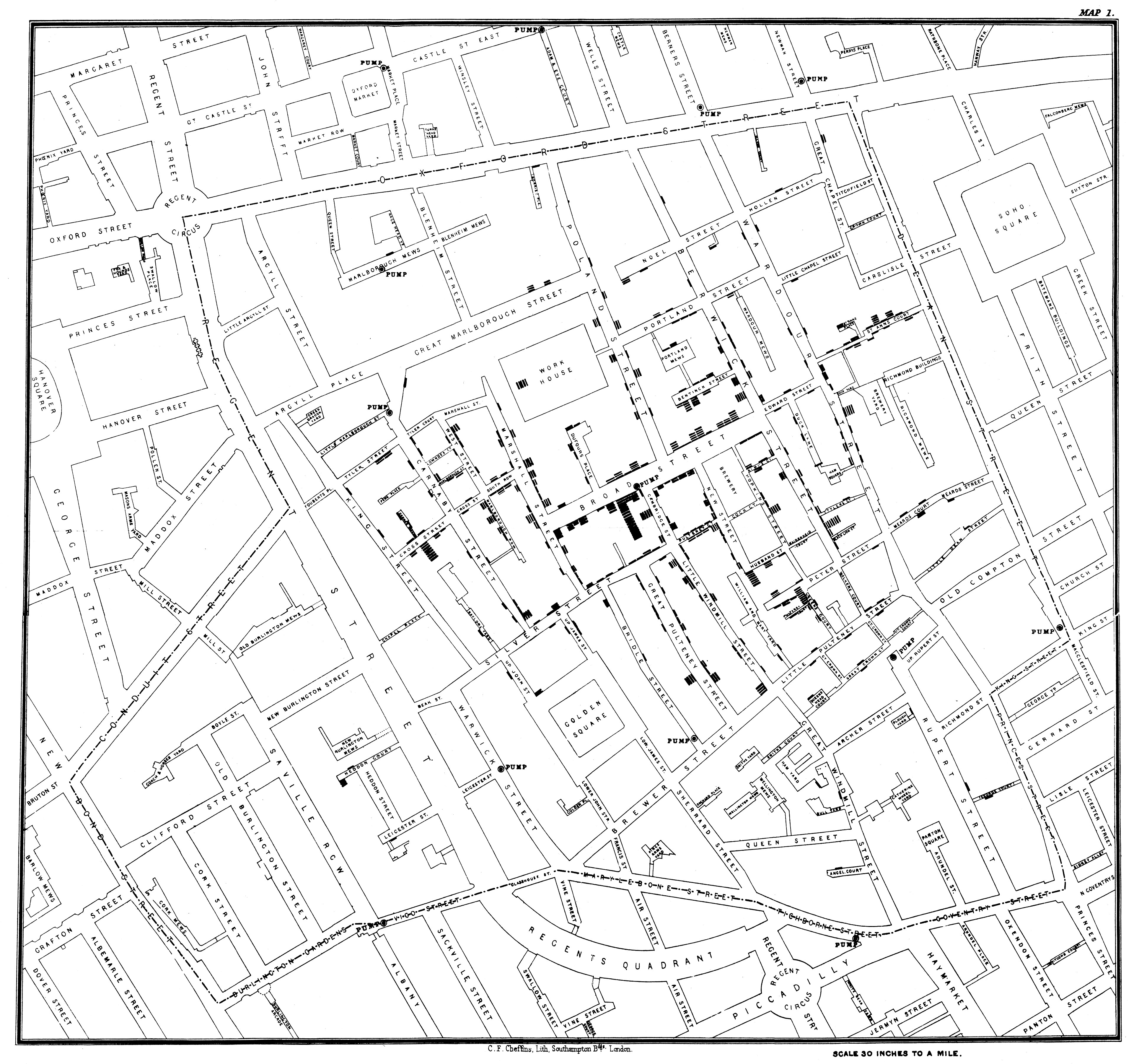
On the map the deaths cluster around the Broad Street pump. But does living close by mean having drunk its water? Some people drank water at home, some at their place of work, and some may have had it brought from a distance by someone else. To connect an address with a source of drinking water, each person's circumstances still had to be looked into.
Snow's record preserves a few places that especially invite further questions. In the surrounding streets people died one after another, yet the workhouse had relatively few deaths; the brewery, not far from the pump, had no deaths registered among its workers either. Why were the people in these places different?
The workhouse had 535 inmates already living there, and five of them died of cholera; it had its own well and its own supply, and sent nobody to Broad Street for water. For the brewery, Snow went and asked the proprietor, Mr Huggins. He said the workers had an allowance of malt liquor to drink. He believed they did not drink water at all, but he was clear about one thing he could be certain of: they did not take water from the pump in the street. The brewery also had a deep well and other supplies of its own.
The opposite kind of clue came from far away. A woman living in Hampstead died of cholera, though she had not been near Broad Street for several months. Only after Snow asked her son did he learn that she liked the water there, and that a cart regularly brought a large bottle of it to her house. A niece who came to visit drank it too, and after returning to her own home she fell ill and died. The two fell ill and died in places far apart, yet the water they had drunk came from one source.
On the evening of 7 September, Snow took his drinking-water inquiry to the local governing body; the next day the pump handle was removed. Before it was removed, the outbreak had already been declining and many residents had already left. The later fall in deaths therefore cannot tell us on its own how much the removal of the handle achieved. To assess the explanation of transmission by drinking water, we still have to look at the places that were close by yet suffered few deaths, the people who lived far away yet drank the same water, and the comparison between different sources of supply.7
地圖上的死亡密集分布在布洛德街水泵周圍。但住得近是否等於喝過那裡的水?有人在家裡喝水,有人在工作的地方喝,也可能請別人從遠處送來。要把住址與飲水來源聯繫起來,還得查每個人的生活情況。
史諾的記錄保留了幾個特別值得追問的地方:周圍街道接連有人死亡,救濟院卻相對少;離水泵不遠的釀酒廠,也沒有工人的死亡登記。這些地方的人為什麼不一樣?
救濟院有五百三十五名原有住民,其中五人死於霍亂;它另有自己的井與供水,不派人到布洛德街取水。釀酒廠的情況,史諾則去問了老闆哈金斯。老闆說,工人有配給的麥酒可喝。他相信工人甚至不喝水,但明確表示自己能確定的一件事:他們不從街上的水泵取水。廠內另有深井與其他供水。
相反的線索來自遠處。一名住在漢普斯特德的婦人死於霍亂,已經好幾個月沒到布洛德街一帶。史諾向她的兒子詢問後,才知道她喜歡那裡的水,日常有車把一大瓶水送到她家。來訪的姪女也喝過,回到自己住處後病發死亡。兩人發病與死亡的地方相隔甚遠,喝過的水卻有共同來源。
九月七日晚,史諾把飲水調查帶到地方管理機構;隔天,水泵把手被拆下。在拆除以前,疫情已經下降,許多居民也已離開。因此,後來死亡減少,不能單獨告訴我們拆把手造成多少影響。要評估飲水傳播的解釋,還得看住得近卻少有傷亡的場所、住得遠卻喝到相同水的人,以及不同供水來源的比較。7
How many people a map depends on
一張地圖要靠多少人
During the same epidemic, Snow was also comparing the customers of two water companies in south London. The two companies' pipes ran through the same streets, and sometimes next-door neighbours took water from different companies; the Lambeth company had moved its intake upstream to cleaner water, while the intake of the Southwark and Vauxhall company was still affected by the city's sewage. People who lived very close together, in similar conditions, might therefore be drinking water from different sources.
To make the comparison, he first had to find out which company supplied each household. Tenants did not necessarily know, since the water rate was paid by the landlord, so after asking the tenant the search had to go on; some people had been moved elsewhere after falling ill, and the record had to be traced back to their original address. Snow set the deaths in the first seven weeks of the epidemic against the number of houses each company supplied. The death rate per house for the Southwark and Vauxhall company came to roughly eight to nine times that of the Lambeth company.7
This inquiry had to check what residents and landlords said against the original addresses of the dead and the records of supply before it could compare deaths among households under different conditions of supply. Snow could not learn everything simply by walking into a street himself; the memories of residents, the papers landlords kept and the official records each answered part of the question. Anyone who later wanted to check his conclusion also had to know how he confirmed addresses, told the sources of supply apart and counted the deaths in each group.
Because Snow wrote down how the inquiry was carried out, we can examine his reasoning many years later without interviewing those residents again. Research teams often divide their work in the same way: some people measure, some organise the data, some analyse; and the instruments and mathematical methods each of them uses carry the results of earlier researchers inside them. If everyone had to invent their own instruments and rebuild all knowledge personally before beginning their own research, far less would get done.
Knowledge left behind in this way already exceeds any one person's memory. The residents knew only about their own households, the water companies remembered their pipes, and Snow placed the two in a single inquiry. Their knowledge did not have to become the same first; together they could still answer a question that nobody had been able to answer before.
We can still read today about the cases that do not fit the first impression easily: the works close by with few deaths, the woman far away who drank water from the same source. Snow kept them, so that those who accepted his conclusion could go on asking questions. If all we remembered was one brave physician who stood against the majority, the most useful part of this knowledge would be the part that never got handed down.
An engineer who has handled bridge structures well many times gives us reason to value his judgement on such matters. That record also rests on measurements, colleagues and the original conditions on site; when he is brought to a new site, that support does not necessarily come with him. As for his opinions on education policy, the old record offers even less reason. What needs checking there is a different kind of knowledge, and how he obtains and compares evidence in that field.
How much a reader can check also depends on how the material is presented. If a report sets out its methods, the limits of its data and its later corrections, others can redo the calculations or question the conclusion. A screenshot with author, date and context cut away may leave us unable even to confirm what the original words were answering. Even when both speak with equal certainty, we have reason to trust them to different degrees.
Sometimes the cheapest effective next step is precisely to recover the source that was left out. To check a quotation, find the original first; to assess a method, first see what kind of problem it handles and where it fails. Guessing on your own that 'this ought to make sense' may take more time and still never touch the material that is actually missing.
同一場疫情期間,史諾還在倫敦南部比較兩家供水公司的用戶。兩家公司的管線穿過相同街道,有時隔壁住戶就用不同公司的水;蘭貝斯公司已把取水口移往較乾淨的上游,南華克與沃克斯豪爾公司的取水處則仍受城市污水影響。住得很近、生活環境相似的人,因此可能喝到來源不同的水。
要作比較,先得查出每戶用哪家公司的水。租客不一定知道,因為水費由房東支付,問完租客還得繼續找;有人病發後被移到別處,紀錄也得追回原來的住址。史諾把疫情最初七週的死亡數與各公司的供水戶數相比,南華克與沃克斯豪爾公司的每戶死亡比例,約為蘭貝斯公司的八至九倍。7
這項調查要把住戶與房東的說法、死者原來的住址和供水紀錄核對起來,才能比較不同供水條件下家庭的死亡情況。史諾無法只靠自己走進一條街就知道全部;住戶的記憶、房東保留的資料與官方紀錄,分別回答了其中一部分問題。後來的人若要檢查他的結論,也得知道他如何確認地址、區分供水來源,以及計算各組的死亡情況。
史諾將調查經過寫下來,我們才能在多年以後檢查他的推論,無須重新訪問那些住戶。研究團隊也經常這樣分工:有人量測,有人整理資料,有人分析;每個人使用的儀器與數學方法,又包含先前研究者的成果。若人人都得親自發明儀器、重建全部知識,再開始自己的研究,能完成的事情便會大幅減少。
這樣留下的知識,已經超過任何一個人的記憶。住戶只知道自己家裡的事,供水公司記得管線,史諾把兩者放在同一項調查裡。彼此的認識不用先變得一樣,仍能共同回答一個原先沒有人答得出的問題。
我們今天還能讀到那些不容易符合最初印象的個案:近處少有傷亡的工廠,遠處喝同一來源水的婦人。史諾留下它們,使接受他結論的人也能繼續追問。若只記住一位勇敢反對多數的醫師,這份知識最有用的部分反而沒有傳下來。
一位工程師多次妥善處理橋梁結構,是我們重視他相關判斷的理由。成績也依靠測量、同事與原來的施工條件;把他請到新的工地時,這些支援不一定跟著過去。至於他對教育政策的意見,原有成績能提供的理由更少。需要查的已是另一種知識,以及他在那裡如何取得和比較證據。
讀者能查到多少,也受資料呈現方式影響。一份報告若交代研究方法、資料限制與後來的更正,別人就能重查計算或追問結論。一張刪去作者、日期與上下文的截圖,則可能連原話在回答什麼都無法確認。即使兩者都說得很肯定,我們也有理由給予不同程度的信任。
有時,最省力而有效的下一步,正是找回那個被省掉的來源。核對引文,先找原文;評估方法,先看它處理哪類問題、在哪些地方失敗。靠自己推測「這應該說得通」,可能花了更多時間,仍沒碰到真正缺少的材料。
Which part, exactly, is unknown
不知道的,究竟是哪一部分
'I don't know' does not always admit the same kind of lack. Return to Snow's inquiry: the death records could be quite definite, while which water a particular household actually drank still needed a visit. Once the source of supply was established, whether the two were causally related required in turn a comparison with other households and with the possible explanations. What is already known does not all become void because questions remain.
Stating your doubt specifically makes it easier to decide the next step. If you do not know whether something happened, you can look for records or witnesses; if the cause is unclear, you can compare what several explanations would predict; if the facts are largely clear but a certain cost is unacceptable to you, then the trade-off has to be discussed, rather than the same batch of data checked over and over.
Suppose you are considering a job in another town. The salary can be confirmed with the company, the actual commute can be tried out, but whether you are willing to spend less time with your family cannot be settled by another salary report. Keeping the three questions apart avoids gathering data without end, and it also stops you from calling everything a matter of personal values when some of it can still be checked.
You can even go to the interview and try the commute first, without yet agreeing to move. Action brings back the information that was missing. By the time the decision really has to be made, the salary and the post may still be attractive, while the commute you have actually measured has changed how you see the job.
「我不知道」並不總是在承認同一種缺乏。回到史諾的調查,死亡紀錄可以相當明確,某一戶究竟喝哪裡的水卻還需要訪問。供水來源查清後,兩者是否具有因果關係,又需要比較其他家庭與可能的解釋。已經知道的事情,不會因為還有疑問就全部失效。
把自己的疑問說得具體,便比較容易決定下一步。如果不知道事情是否發生,可以找紀錄或目擊者;如果不清楚原因,可以比較幾種解釋的預期;如果事實已大致清楚,卻無法接受某種代價,就得討論取捨,而非不斷重查同一批資料。
例如,你在考慮接受一份外地工作。薪資可以向公司確認,實際通勤時間可以試走,自己是否願意減少與家人相處的時間,卻不能靠另一份薪資報告決定。把三項疑問分開,既能避免無止境蒐集資料,也不會把仍查得清的事一概說成個人價值觀。
你甚至可以先去訪談、試走通勤路線,暫不答應搬家。行動會帶回原先缺少的資訊。等到真正要作決定時,薪資與職務或許仍很吸引人,實測的通勤卻改變了你對這份工作的看法。
Experts who wait for time to check them
等時間來核對的專家
Listening to an expert's analysis, what you feel most immediately is how fluently he speaks. A prediction, though, requires waiting. Whether a certain regime changes, whether an economic indicator crosses a threshold, will not hand in its answer when the programme ends.
From the mid-1980s, Philip Tetlock tracked the predictions of experts in politics and economics over a long period. He asked participants to make checkable judgements about specific events and to state their degree of confidence, then set these against the later outcomes and against comparison baselines.8
Performance in the study varied by person, by question and by method of assessment, and some did worse than simple comparison methods. Expertise that could previously be felt only in conversation now had a record that accumulated over time. Judging a person no longer had to start afresh from the impression left each time he spoke.
The record has to keep the prediction's deadline, its outcome and the confidence held at the time, or there is nothing to compare later. A prophecy with no time limit and no explicit conditions may be described as not yet wrong for a very long time; those waiting on it have no way of knowing at what point it actually deserves their trust.
聽一位專家分析,最容易立即感受到的是他說得順不順。預測卻需要等候。某個政權是否改變、一項經濟指標是否跨過門檻,不會在節目結束時就交出答案。
菲利普・泰特洛克從一九八〇年代中期開始,長期追蹤政治與經濟領域專家的預測。他要求參與者對具體事件提出可核對的判斷,並交代把握程度,再將它們與後來結果及比較基準對照。8
研究中的成績因人、題目與評估方式而異,有些表現不如簡單的比較方法。原先只能在談話中感受的專業,現在多了一份會隨時間累積的紀錄。評價一個人,也不必靠每次聽他發言時留下的印象重新開始。
紀錄得留下預測的期限、結果與當時的把握,日後才有東西可比。一句沒有時限、沒有明確條件的預言,或許長久都能被說成尚未出錯;等待的人卻無從知道,它究竟在什麼時候值得採信。
Putting trust where it fits
把信任用在合適的地方
A record of predictions can reveal another difference that is easily confused: a person whose stated probabilities match the actual frequencies still may not help us tell which situations are more likely to happen. A set of hypothetical weather forecasts shows the difference.
Suppose it rains on fifty days out of a hundred. The first forecaster gives a fifty per cent chance every day. The second gives twenty per cent on fifty of the days and eighty per cent on the other fifty; it turns out to rain on ten days in the first group and forty in the second.
Both forecasters' confidence matches the frequency of rain, but the second supplies one more piece of information useful to anyone going out: which days are more likely to be wet. This simplified data separates calibration from discrimination. Calibration deals with whether the stated confidence has a matching frequency; users usually also care how far the different days can actually be told apart.
To check whether 'eighty per cent sure' is reliable, we at least have to say clearly what is being predicted, what counts as its happening, and which outcomes it will be checked against. In everyday exchanges where estimating probabilities does not suit, we can still state our grounds: 'This part I have done myself, that part rests on a report, and for the new situation there is no data yet.' The listener then knows which claims come from experience and which still need separate confirmation.
There is also a limit that no amount of extra effort removes. After checking the expert, you can go on to check the people who assess experts, and then the institutions those people belong to. Every check draws on other knowledge. This road never suddenly delivers you to a position where you need trust nobody at all.
When you find that several reports were all copied from the same source, what looked like the agreement of many people loses some of its weight. Discovering that a prediction never left a checkable deadline has a similar effect. We can check only some of these things, but such specific findings are already enough to change our trust, without waiting until the whole body of knowledge has been examined.
Nor can the responsibility for checking be pushed entirely onto the user. If only the service provider can obtain the original records, yet the user is required to prove for themselves which step of the system went wrong, many problems can never be raised. The provider should give an intelligible account, suitable data for checking and a channel for handling disputes; otherwise 'check it yourself' merely asks people to complete a task without the information it requires.
預測紀錄可以揭露另一個容易混淆的差別:一個人報出的機率與實際頻率相符,仍未必能幫我們區分哪些情況比較可能發生。用一組假設的天氣預報,就能看見這個差別。
假設一百天裡有五十天下雨。第一位預報者每天都報五成機率。第二位把其中五十天報為兩成,另外五十天報為八成;結果前組下雨十天,後組下雨四十天。
兩人的把握程度都對得上發生頻率,第二位卻多提供了一項對出門有用的資訊:哪些日子比較可能下雨。這份簡化資料分開了校準與區辨能力。校準處理「報出的把握有沒有相應頻率」;使用者往往還關心不同日子究竟能被分開多少。
要檢查「八成把握」是否可靠,至少得說清楚預測的是什麼、何時算發生,以及用哪些結果核對。在不適合估計機率的日常交流中,也可以交代自己的根據:「這部分我親手做過,那部分依據報告,新情況還沒有資料。」聽的人因此知道哪些說法來自經驗,哪些還需要另行確認。
還有一個無法靠更努力消除的限制。查過專家之後,你可以繼續查評估專家的人,再查那些人的制度。每一次查證都用到其他知識。這條路不會忽然把你送到一個再也無須信任任何人的位置。
查到幾份報告都抄自同一來源時,原來看似很多人的同意,就少了幾分分量。發現預測從未留下可核對的期限,也有類似影響。我們只能查其中一些事情,但這些具體發現已足以改變信任,無須等到把整個知識體系查完。
查證的責任也不能全推給使用者。假如只有服務提供者能取得原始紀錄,卻要求使用者自行證明系統哪一步出錯,許多問題便無法被提出。提供者應給出可理解的說明、適當的核對資料與處理爭議的管道;否則,「自行查證」只是要求人完成一件缺乏必要資訊的事。
Knowledge left for the next person
留給下一個人的知識
When a judgement passes into someone else's hands, it can arrive as a bare conclusion, or it can be left together with its data, its methods and the questions still unresolved. The second kind of handing on takes more trouble, but it makes it possible for the next person to discover that the answer no longer suits a new situation.
This also changes how we picture relying on others. In accepting a piece of research we do more than borrow the little that the researcher knows beyond us; we also connect ourselves to the records, instruments, methods and subsequent corrections. Individuals forget, leave, and even refuse to admit mistakes, yet the material they leave behind may still let others carry the work on.
A book carries this responsibility too. Readers cannot redo every study on the author's behalf, so the author must give the important claims their sources and make the key steps of the reasoning findable. Trust does not release the author from giving that account. It is worth placing, often, precisely because others can still ask questions after it has been placed.
一項判斷傳到別人手上時,可以只剩一句結論,也可以連同資料、做法與仍待解決的疑問一起留下。後一種傳遞比較費事,卻使下一個人有可能發現,這個答案已經不適合新情況。
這也改變了我們對「依靠別人」的想像。接受某項研究,並不只是借用研究者比我們多懂的一點東西;我們還接上了記錄、儀器、方法與後續更正。個別的人會遺忘、離開,甚至拒絕承認錯誤,留下來的資料仍可能讓別人把工作做下去。
一本書也有這份責任。讀者無法替作者重做每項研究,作者便得讓重要的主張有來源,讓推論的關鍵步驟能被找到。信任不能免除這些交代。它之所以值得交付,往往正因為交付之後,仍有別人可以追問。
3 — Who Decides What Is Worth Looking At
第三章 誰決定什麼值得看
In Lewis Carroll's Alice's Adventures in Wonderland, Alice and a crowd of animals climb out of a pool of tears, soaked through. Everyone needs to get dry, and the Dodo proposes a race.
The course is roughly a circle, though the shape does not matter. There is no starting signal for the field; whoever wants to run runs, and whoever wants to stop stops. After a while the Dodo declares the race over, and everyone crowds round to ask who has won.
It thinks for a long time and decides that everybody has won, and that everybody must have a prize. Who is to provide the prizes? The Dodo points at Alice. She hands round the sweets from her pocket, and there is exactly one each. But she is to have a prize too, so she brings out a thimble that was already hers. The Dodo solemnly presents it back to her, and everyone cheers. Alice finds the whole thing absurd, and takes the prize all the same.9
By the end of the run, everyone is dry. If all the Dodo has to show is that running like this helps to dry a body, it has a result to report. Should Alice press it on why the prizes all had to come from her, pointing once more at the dried feathers would be an answer to a different question.
How much "it achieved its purpose" can say in defence of an arrangement depends on what we are evaluating. An examination mark can help a teacher see whether a student is ready for the next course; using it to decide who deserves respect calls for reasons to be given separately. A mark that has been calculated without error cannot, on its own, show that the second use is justified.
We can set the question down in a park. First decide what is to be surveyed: shade in summer, maintenance costs, or whether a wheelchair can get through. The purpose settles which tools the surveyor picks up, where they linger and when they come back for a second look. One of the things expertise does is help people recognise the differences that work of this kind needs to see.
Then the facts begin to constrain the answers. A gradient has its own way of being measured, shade has its hours, and the upkeep of a material cannot be filled in to suit a position. Caring about different things makes for different surveys; once two people are answering the same question, it is still possible to compare which measurement is the more reliable.
A difficulty of another kind surfaces only when the manager has to divide limited space and a limited budget. Keeping more trees, widening the paths and holding down maintenance may not all reach their best at once. However precise the gradient data, it will not decide on everyone's behalf who should bear a little more of the inconvenience.
If an overall score multiplies shade, access and cost each by a weight, then whoever sets the weights is shaping which needs are met first. The formula may compute very exactly; the choice of weights still has to be explained to the people it affects. On the other side, if the gradient really was measured wrongly, the figure should be corrected. Whether a measurement is accurate, and how a limited budget should be shared out, are two different disputes.
Stating the use first also lets us judge, in concrete terms, whether an omission is a problem. A running route map that leaves out rest stops may still be enough for planning distances; if the same map is used to guide wheelchair users, the stairs along the way must be marked. The strongest ground for criticising such a map is to point to the omission that gets in the way of what it claims to help with.
路易斯・卡洛爾的《愛麗絲夢遊仙境》裡,愛麗絲與一群動物從淚水形成的池子爬上岸,渾身濕透。大家需要把身體弄乾,渡渡鳥提議辦一場比賽。
路線大致是個圈,形狀不重要。沒有統一的起跑號令,誰想跑就跑,想停就停。過了一陣子,渡渡鳥宣布結束,大家圍上來問誰贏了。
牠想了很久,決定人人都贏,人人都該有獎。獎品由誰出?渡渡鳥指向愛麗絲。她把口袋裡的糖果分給大家,正好一人一份。可是她自己也要得獎,於是又拿出一枚原本屬於自己的頂針。渡渡鳥鄭重地把它頒還給她,大家歡呼。愛麗絲覺得荒謬,還是接過了獎品。9
跑完之後,大家的身體乾了。若渡渡鳥只要證明這種跑法有助於弄乾身體,牠有成果可交代。愛麗絲要是追問為什麼獎品都由她出,牠再指一次乾掉的羽毛,就答非所問了。
「達成目的」能替一項安排說明多少,取決於我們正在評價什麼。一份考試成績,可以幫老師了解學生是否準備好修下一門課;拿它判斷誰值得被尊重,卻還需要另外提出理由。分數計算無誤,也無法自行證明後一種用途合理。
我們可以把這個問題放進一座公園。先決定要調查什麼:夏天的遮蔭、維護費,還是輪椅能不能通行。目的決定調查員拿什麼工具、在哪裡停留、什麼時候再來一次。專業的作用之一,就是幫人辨認這類工作需要看見的差異。
接著,事實開始約束答案。坡度有坡度的測量,遮蔭有遮蔭的時段,材料的維護費也不能憑立場任填。關心不同事情,使調查內容不同;一旦正在回答同一個問題,仍然可以比較哪種測量更可靠。
等到管理者必須分配有限空間與預算,另一種困難才浮現。多保留樹木、擴大通行空間、壓低維護費,可能無法同時達到最好。再精確的坡度資料,也不會自行替所有人決定誰該多承擔一點不便。
如果總分把遮蔭、通行與費用各乘上一個權重,誰設定權重,便在影響哪些需要優先得到滿足。公式可以算得很準,權重的選擇仍需要向受影響的人說明。另一方面,若坡度確實測錯了,也應更正數字。測量是否準確,與怎樣分配有限預算,是兩項不同的爭議。
先說明用途,也能讓我們具體判斷一項省略是否有問題。跑步路線圖沒有標休憩設施,可能仍足以幫人安排里程;若同一張圖被用來指引輪椅使用者,沿路的樓梯就必須標明。要批評這張圖,最有力的理由是指出哪項遺漏妨礙了它聲稱能協助的事情。
Which differences are worth keeping
哪些差異值得留下
When we organise information for a given use, we usually leave some details out. A financial statement does not record every conversation in the office, and a route map does not mark the position of every window. Whether a detail is kept depends on whether it would affect the judgements the user has to make.
A model can be used to record the features we care about and the relations between them. Recording a cup as a capacity, a material and a degree of heat resistance, for instance, helps someone judge whether it is fit for hot water; if the task is to arrange shipping, weight, dimensions and fragility matter more. Four uses can be compared here:
為某項用途整理資訊時,我們通常會省略一些細節。財務報表不記辦公室裡的每一場對話,路線圖也不標出每一扇窗的位置。是否保留某項細節,要看它會不會影響使用者需要作出的判斷。
模型可以用來記錄我們關心的特徵,以及特徵之間的關係。例如,把杯子記成容量、材質與耐熱程度,能幫人判斷它適不適合裝熱水;若要安排運送,重量、尺寸與易碎程度就更重要。這裡可以比較四種用途:
| Purpose | Kept | Set aside for now | Possible error |
|---|---|---|---|
| Drinking | Capacity, heat resistance, safety | Exact shape | Overlooking heat resistance |
| Logistics | Dimensions, weight, fragility | Feel in the hand | Overlooking breakage |
| Design | Proportion, texture, manufacturing process | Some logistics details | Looks displacing use |
| Forensics | Residue, fingerprints, timing | Whether it is pleasant to drink from | Destroying evidence |
| 目的 | 留下 | 暫時不看 | 可能的失誤 |
|---|---|---|---|
| 飲用 | 容量、耐熱、安全 | 精確外形 | 忽略耐熱 |
| 物流 | 尺寸、重量、易碎 | 握持感 | 忽略損耗 |
| 設計 | 比例、觸感、製程 | 部分物流細節 | 美感取代使用 |
| 鑑識 | 殘留、指紋、時序 | 好不好喝水 | 破壞證據 |
Each of these sets of data is useful, and they cannot be swapped about at will. Knowing that a cup withstands heat does not tell the shipper how large a box is needed; the person lifting fingerprints may have to finish recording them before someone else washes the cup. By the time the inquiry begins, the purpose has already shaped what is kept.
這些資料各自有用,卻不能任意互換。知道杯子耐熱,不會讓運送者知道需要多大的箱子;採集指紋的人,則可能得在別人清洗杯子以前完成紀錄。目的在調查開始時,就已影響要留下什麼。
What the work is meant to get us
完成工作以後,想換來什麼
The task in front of us usually has a further reason standing behind it. A customer service department that wants shorter calls may want them so that people waiting to be answered wait a little less. If staff transfer complicated problems away quickly, the call figures improve while customers queue again and again and retell their story; the service has not improved because of it.
When the call ends, the customer may join another queue for another line. The original record stops at the moment the phone is put down, but his problem carries on. To know whether the service has improved, the record has to follow him a stretch further.
Time also sets different purposes against one another. A project may skip necessary maintenance in order to launch on schedule; a department may push pending problems into next quarter in order to hit this quarter's target. The progress in hand still has value, but the assessment has to count in the cost that has been deferred.
眼前的任務通常還有更後面的理由。客服部門希望縮短通話時間,可能是為了讓等待接聽的人少等一點。若員工把複雜問題迅速轉接出去,通話數字變好了,客戶卻得反覆排隊、重說經過,服務並未因此改善。
通話結束後,客戶可能又進入另一條等待接聽的隊伍。原來的紀錄到掛電話為止,他的問題卻繼續存在。要知道服務有沒有改善,記錄就得跟著他多走一段。
時間也會使不同目的發生衝突。專案為了準時上線,可能略過必要的維護工作;部門為了本季達標,可能把待處理的問題推到下季。眼前的進度仍有價值,評估時卻要把延後付出的代價一併算入。
Abstraction has more than one direction
不只有一種抽象的方向
To class a cup as a "container" is to attend to the fact that it holds things; to class it as a "fragile item" is to attend to the risk of a knock. The two classifications keep different features, and there is no need to rank one above the other first.
The distinction also helps in assessing records that have been reduced to numbers. If an employee's performance score counts only the cases he has closed himself, it cannot show how much time he spent training colleagues; sorting test results into normal and abnormal may no longer show how near a value came to the threshold; drawing a rectangular box round a pedestrian in an image keeps mainly position and size. When the next step is to judge long-term contribution, track how a value changes or understand where the pedestrian intends to go, other records may be needed.
Whether an omission causes a problem still depends on the later use. Some representations mainly rearrange information so that calculation or lookup becomes easier, and do not necessarily delete any of the original content. Chapter 4 compares this case using road networks and numerals. Judging whether a representation is good means actually looking at what it preserves, what it makes convenient, and what the present question needs.
把杯子歸為「容器」,是在注意它能盛裝東西;把它歸為「易碎物」,是在注意碰撞造成的風險。兩種分類保留不同特徵,沒有必要先排出哪一種更高級。
這個區分也能幫助評估數字化的紀錄。若員工的績效分數只包括個人完成件數,就看不出他花多少時間培訓同事;把檢查結果分成正常與異常,可能不再顯示數值距離門檻有多近;用矩形框標出影像中的行人,則主要留下位置與大小。接下來要判斷長期貢獻、追蹤數值變化或了解行人的意圖,就可能需要其他紀錄。
省略是否造成問題,仍取決於後續用途。有些表示方式主要是在重排資訊,使運算或查找更容易,未必刪除了原來的內容。第四章會用路網與數字比較這種情況。判斷一種表示好不好,要實際看它保存了什麼、方便做什麼,以及目前的問題需要什麼。
Purposes are changed by understanding too
目的也會被理解改變
If a purpose could be fixed once and for all, the difficulties that followed would mostly be a matter of finding the means. But people often find that, having learnt a few things, what they want to accomplish has changed as well.
Someone who first understood caring as doing everything for the other person, and who then heard that person's own account, begins to value leaving him his choices. At that point the new understanding has changed what "doing it well" means. Pursuing the old goal more efficiently might, if anything, intrude on him more deeply.
In learning a craft, this kind of change is especially hard to explain in advance. A beginner may want only to get the job done fast, and only later comes to pick out details he could not hear or see before. Those details make him willing to slow down, even to stop being satisfied with work he was once proud of. Had he been asked at the outset whether he wanted to put in all those hours, he would not necessarily have known what he would be putting them in for.
We learn because we value something, and what we learn alters the reasons we valued it. Purpose takes part in inquiry, and inquiry takes part in forming purpose. Draw the two as sharply sequenced steps and this whole stretch of experience has nowhere to go.
A change of wishes is itself worth looking back on. Learning may lead a person to a new interest; advertising, rewards and group pressure may also set him chasing things he never cared about before. One way to evaluate such a change is to ask whether he had the chance to encounter other options, to understand the cost, and to refuse when he no longer wished to go on.
Public decisions carry one further practical requirement. A wheelchair user points out that the ramp cannot be used, and the information has certainly entered the room; if the designer can still pass over it because it is not among the established metrics, the intervention has had no effect on the judgement. The value of more viewpoints has to be judged by whether they can change the scope of the problem and what is done about it afterwards.
Institutions run into difficulty at this same point. An institution needs a goal before it can begin to survey and to allocate resources, yet the survey may bring back lived experience capable of changing the goal. What began as a count of how many people could walk through the park turns up the fact that some people cannot get in at all; if the original scoring is still used to show that everything is in order, the added understanding becomes a marginal note that cannot touch the decision.
We cannot guarantee that every wish becomes better for being understood. But an arrangement that permits only the improvement of means, and never permits the question "what does doing it well actually mean" to be asked afresh, has already set an end point to what people may learn.
如果目的可以一次訂好,往後的困難主要就是找到辦法。但人常在學會一些事以後,連想完成什麼也變了。
原先把照顧理解成替對方做完所有事情,後來聽見他的經驗,才開始重視讓他保留選擇。這時,新的理解改變了「做得好」的意思。繼續把舊目標做得更有效率,反而可能更深地干涉他。
學一門技藝時,這種改變尤其難以預先交代。初學者可能只想把事情做快,後來才辨認出原先聽不見、看不見的細節。那些細節使他願意慢下來,甚至不再滿意曾經引以為傲的成果。若一開始就問他要不要付出這些時間,他未必知道自己會為什麼付出。
我們因為重視某件事而學習,學到的東西又改變了重視它的理由。目的參與了求知,求知也參與了目的的形成。把兩者劃成先後分明的步驟,會使這一大段經驗無處可放。
願望的改變也值得回顧。學習可能讓人發現新的興趣,廣告、獎勵與群體壓力也可能使人開始追求原先不在意的事。要評價這種改變,可以看他是否有機會接觸其他選擇、理解代價,以及在不願繼續時拒絕。
公共決策則多了一項實際要求。輪椅使用者指出坡道無法通行,資訊確實進入了會場;若設計者仍可以因它不在既定指標裡而略過,這次發言對判斷就沒有發生作用。更多觀點的價值,須看它們能否改變問題的範圍與後續處置。
制度也是在這裡遇到困難。它需要一個目標才能開始調查和分配資源,調查卻可能帶回足以改變目標的生活經驗。原來只計算多少人能走過公園,後來發現某些人根本沒辦法進來;若仍用最初的計分方式證明一切順利,新增的了解就成了無法影響決策的旁註。
我們不能保證每個願望經過了解都會變得更好。可是,一套只准改善手段、從不准改問「做得好究竟是什麼意思」的安排,已經替人的學習設了終點。
Part Two
Models, Their Uses, and Where They Apply
第二部
模型、用途與適用範圍
4 — A Different Representation Makes Thinking Possible
第四章 換一種表示,才有辦法思考
Look first at the centre of each of these two maps, then follow one line out to the suburbs.
請先把目光放在這兩張圖的市中心,再沿著其中一條線走到郊外。
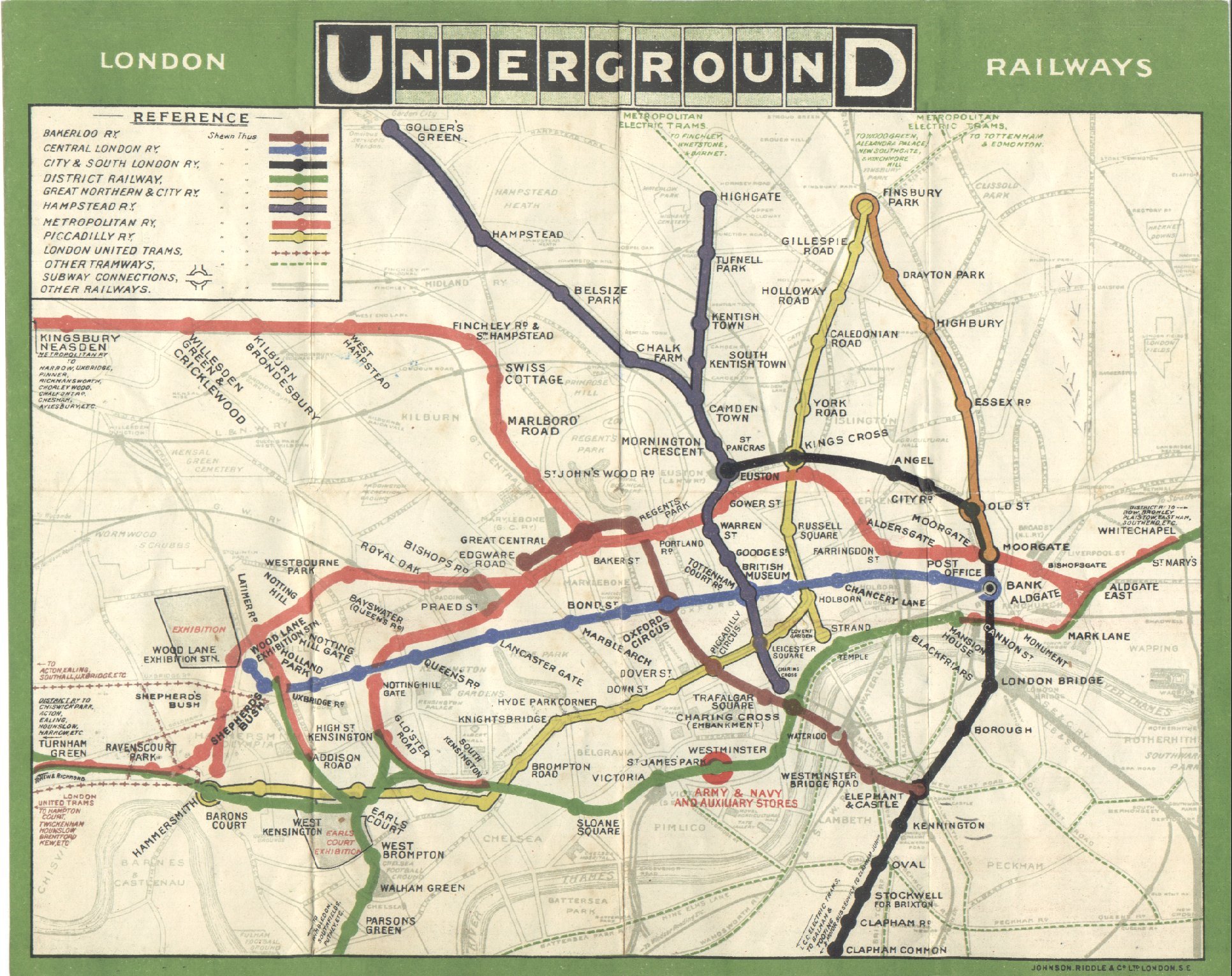
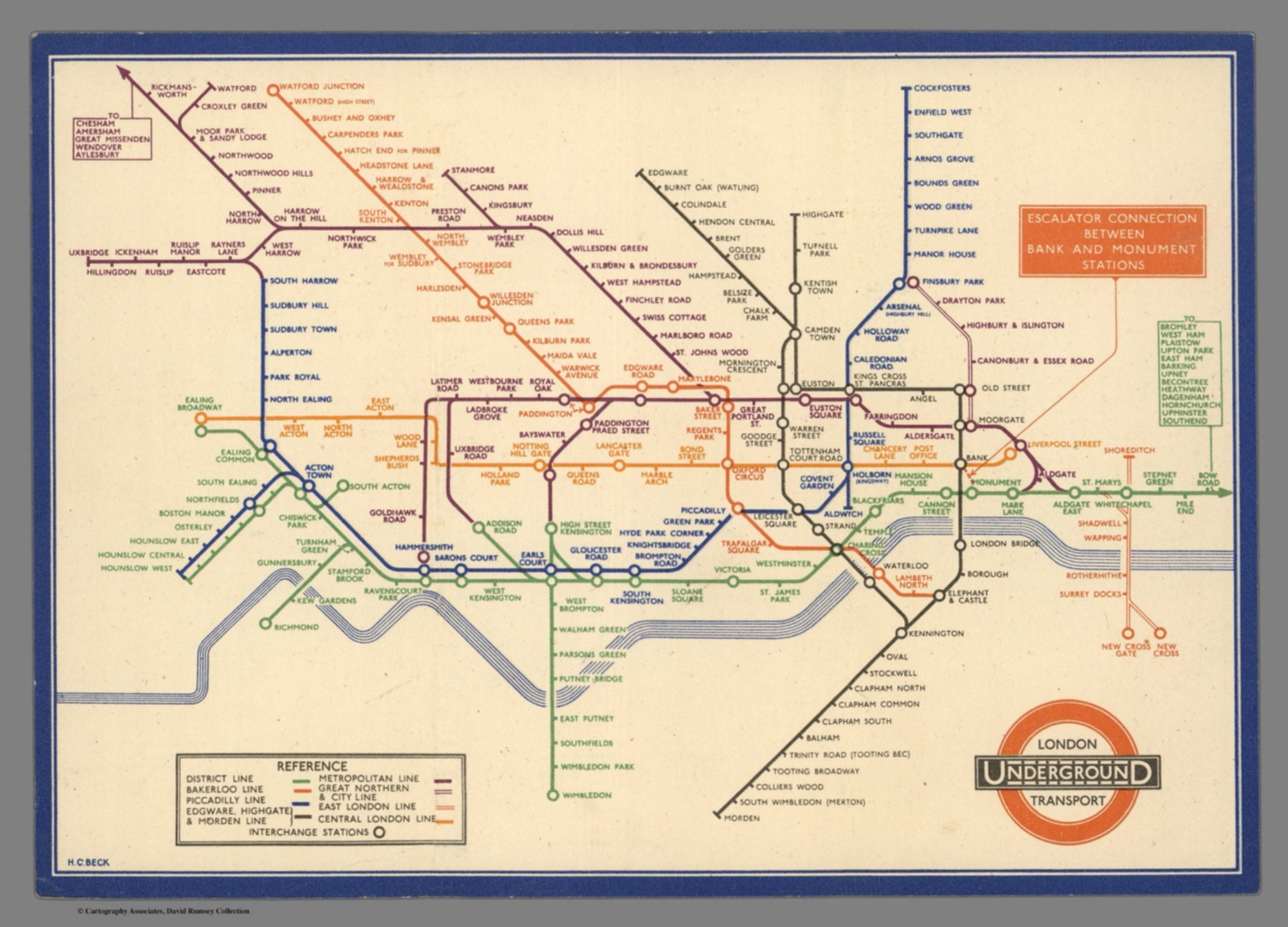
In the left-hand map the railway still clings to a city in which streets, riverbanks and parks can be recognised. Suburban distances stretch the lines out, while the centre is crammed with station names and bends. The right-hand map keeps the connections between stations, straightens the lines into regular directions and makes room for the names. The London you see has been stretched, compressed and rearranged.
When Harry Beck put the design forward in 1931, the publicity department turned it down. Could passengers really read a map that strayed so far from geography? By 1933 the design was at last printed as a pocket folder, and demand brought further printings.12
A passenger holding the map mainly wants to know which line to take, which stations it passes in order, and where to change. Beck opened out the crowded centre and shortened the suburban gaps so that station names and interchanges were easier to pick out. Distances on the map therefore no longer follow geographic scale, while the connections between stations and their sequence still have to be accurate.
When you ask instead how long it takes to walk between two stations, the spacing on the right-hand map is no longer enough to answer. The purpose has changed, and so has the information that needs to be put back. An omission has concrete gains and losses, and these can be compared.
A visitor arriving in London for the first time may not yet be familiar even with the line colours and the interchange symbol. He needs a key to tell him how to read the map, and then station names to confirm his direction. A map that someone who knows the network can take in at a glance is not necessarily as simple for him. As for the engineers who maintain the track, they also need actual positions and equipment data, and the pocket travel map does not supply these.
How long an explanation should be therefore also depends on what the reader has already learnt. Cut the key that a newcomer needs and the page is cleaner, but he has to go about asking people what the symbols mean. A concise explanation should spare people irrelevant work while keeping the explanation needed to finish the task in hand.
A digital map can show the travel route first and let people tap open exit and walking information; a printed one can separate the main map, the key and supplementary pages. Users ordinarily read only the part they need, and when a new question arises they can still find further explanation.
左圖裡,鐵路仍貼著一座可以辨認街道、河岸與公園的城市。郊外的距離拉長了線路,市中心則擠著站名和轉折。右圖保住車站的連接,把線路整理成規則的方向,替站名騰出空間。你看到的倫敦被拉開、壓縮,重新排過。
哈利・貝克一九三一年提出這項設計時,宣傳部門曾經拒絕它。離地理太遠的圖,乘客真能看懂嗎?到一九三三年,設計終於印成口袋折頁,需求帶來後續加印。12
乘客拿著路線圖,主要想知道該搭哪一條線、依序經過哪些站、在哪裡轉乘。貝克拉開擁擠的市中心、縮短郊外的間距,讓站名與轉乘點更容易辨認。圖上的距離因此不再按地理比例呈現,車站的連接與先後順序則仍須準確。
當你改問兩站之間步行要多久,右圖上的站距便不足以回答。目的變了,需要補回的資訊也變了。省略有具體的得失,可以拿來比較。
第一次到倫敦的旅客,可能連路線顏色與轉乘符號都還不熟悉。他需要圖例告訴自己怎樣讀,再用站名確認方向。熟悉路網的人一眼就能讀懂的圖,對他未必同樣簡單。至於保養軌道的工程人員,還需要實際位置與設備資料,口袋裡的乘車圖並不供應這些資訊。
說明的長短,因而也要考慮讀者已經學會什麼。刪掉新手需要的圖例,頁面雖然更乾淨,他卻得四處找人問符號的意思。簡明的說明應幫人少做無關的事,同時保留完成眼前任務所需的解釋。
電子地圖可以先顯示乘車路線,再讓人點開出口與步行資訊;紙本則可以用主圖、圖例與附頁分開呈現。使用者平常只讀需要的部分,遇到新問題時,仍找得到進一步的說明。
Compare on the same network first
先用同一張網來比較
The two historical maps are twenty-five years apart, and the lines themselves were added to and removed. To see on its own what the redrawing brings, it is best to hold the connections fixed. The figure below therefore constructs a separate one-way network of eight places: in both drawings, A to H, the arrow directions and the links are exactly the same, and only the placement of the coordinates changes.
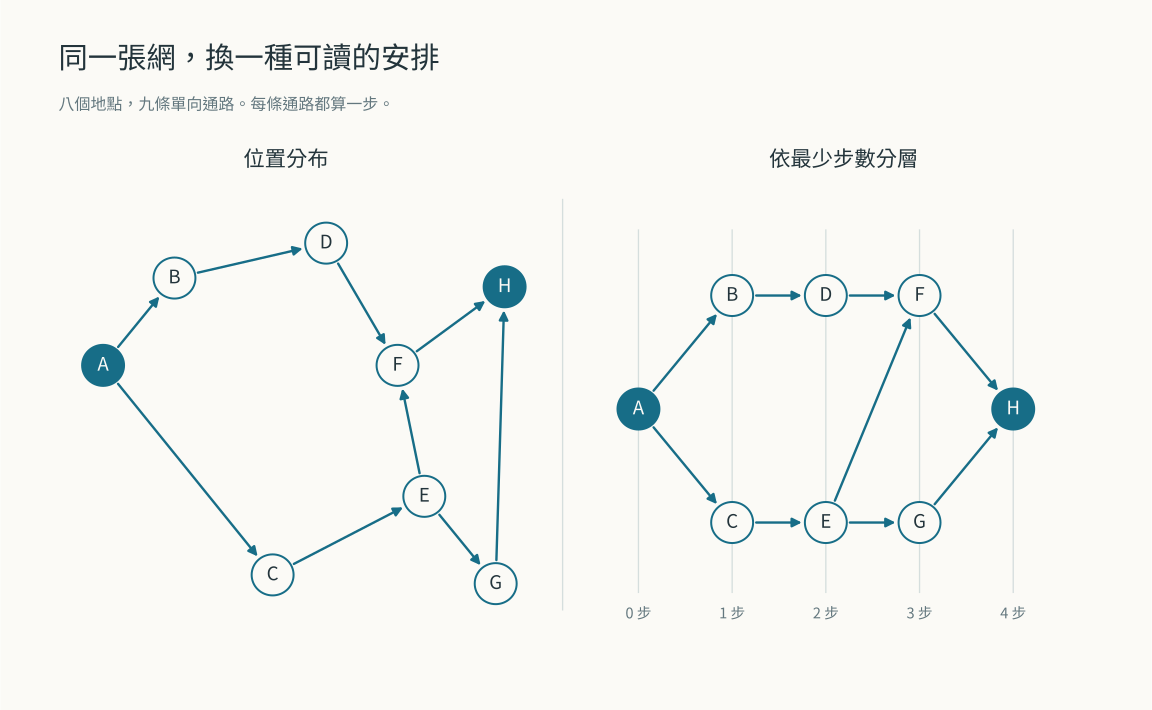
歷史圖面隔了二十五年,路線本身也有增減。要單獨看出改畫帶來什麼,最好把連接關係固定住。下圖因此另造一張八個地點的單向通路網:兩幅圖的 A 到 H、箭頭方向與連線完全相同,只改座標安排。
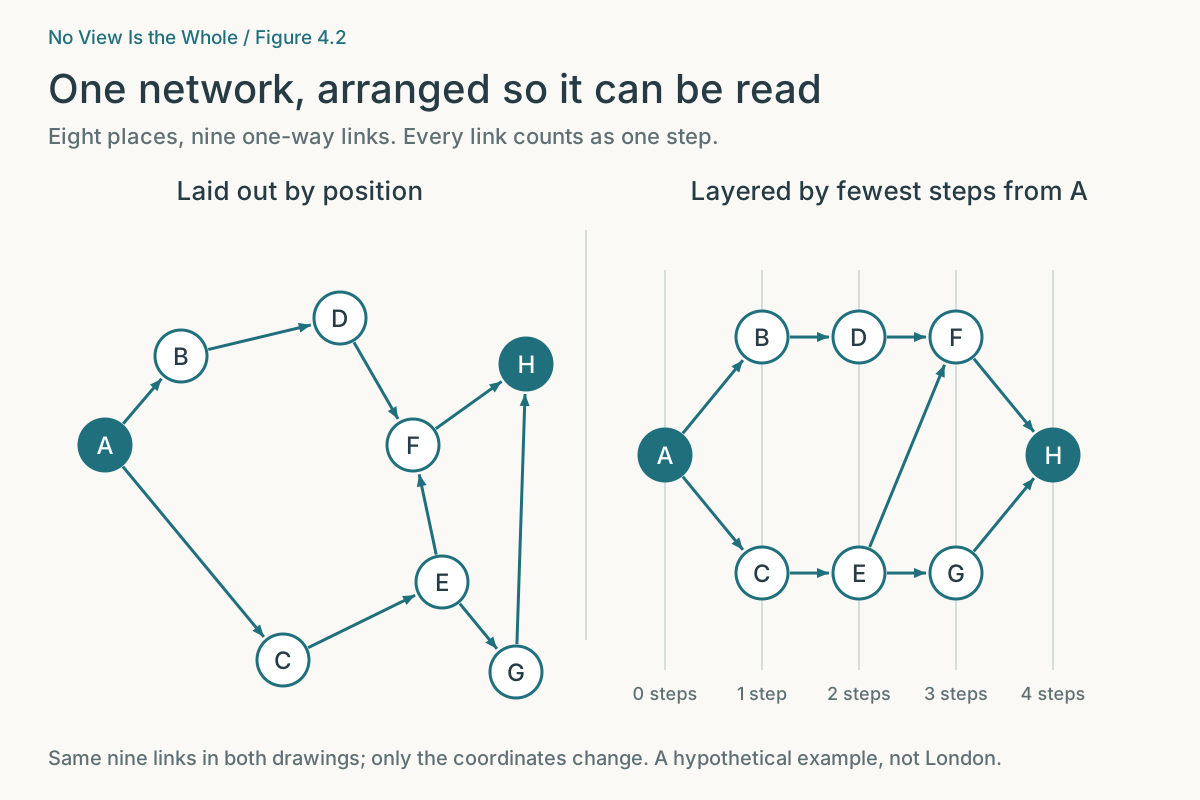
What is the smallest number of steps from A to H? Each arrow counts as one step, and you may travel only in the direction of the arrow. If you pick any route on the left-hand drawing and follow it to the end, what you get may be only one route among several, and you still have to compare the others before you can confirm it is the shortest. The right-hand drawing searches in a different order: first list every place reachable in one step, then every place reachable in two, and work outwards layer by layer. When a place turns up a second time, you already know that the earlier route reached it in no more steps than this one, so there is no need to start again from here.
Starting from A, one step reaches B and C, two steps reach D and E, three steps reach F and G, and only the fourth step finds H. The search has already listed every place reachable in fewer than four steps, and H is not among them, so four steps is at once one route that has been found and the smallest number of steps required.
This method is called breadth-first search. It supplies an order of searching, and it also supplies the reason for being sure the answer is the shortest. As the network grows, following the same method and recording the places already reached and the steps taken avoids trying complete routes over and over. What learning an algorithm that others have worked out saves is exactly this kind of repeated fumbling.
Now suppose some links take one minute and others ten, and we want the quickest route. Taking one step fewer no longer necessarily takes less time; three links of ten minutes each may be slower than five links of one minute each. Breadth-first search can still find the route with the fewest steps, but to find the route that takes the least time, the time of every link has to enter the calculation, and a method suited to differing costs has to be used.
從 A 到 H 最少需要走幾步?每支箭頭算一步,只能順著箭頭走。若沿左圖任選一條路走到底,得到的可能只是其中一條路,還得比較其他路線才能確認最短。右圖依另一種順序搜尋:先列出一步能到的全部地點,再列出兩步能到的地點,逐層往外找。同一地點再次出現時,先前那條路用到的步數不會更多,就不必從這裡重做一次。
由 A 出發,一步到 B、C,兩步到 D、E,三步到 F、G,第四步才找到 H。搜尋已經列出所有少於四步能到的地點,H 都不在其中,所以四步不只是找到的一條路,也是最少所需的步數。
這個方法叫廣度優先搜尋。它提供了搜尋順序,也提供了確認答案最短的理由。路網變大時,照著同一套方法記錄已到過的地點與步數,可以避免反覆試走完整路線。學會前人整理好的演算法,省下的正是這類重複摸索。
現在假設有的通路耗時一分鐘,有的耗時十分鐘,我們想找最快抵達的路。這時少走一步,未必花較少時間;三條各需十分鐘的通路,可能比五條各需一分鐘的通路更慢。廣度優先搜尋仍能找到步數最少的路,但要找耗時最少的路,就得把每條通路的時間納入計算,採用適合不同成本的方法。
Write it differently and the calculation changes
換一種寫法,計算就不同了
One hundred and five is written 105. The zero in the middle seems to stand for nothing, yet it keeps the units apart from the hundreds. Write 15 and the two digits that carry value are still there, but the quantity has changed. Place-value notation lets the same symbol stand for different magnitudes in different positions, and it lets addition, subtraction, multiplication and division proceed step by step along those positions.
Write twenty-three times fourteen as 23 × 14 and you can split fourteen into ten and four, work out two hundred and thirty first, then ninety-two, and put them together to make three hundred and twenty-two. Long multiplication sets these relations out on paper, so that all the intermediate results need not be held in the head.
The Roman numerals XXIII and XIV also stand for twenty-three and fourteen. The quantities have not changed, but the decimal long multiplication above cannot conveniently be applied to them directly. The person calculating can switch to a tool such as an abacus, or first rewrite the numbers in a notation suited to the operation. Recording a quantity and being able to work out a product easily are two different requirements.
When the Underground map was redrawn, some geographic detail was omitted. The numerical example shows another possibility: the quantity is kept unchanged, and certain operations still become easier because of the representation. When Larkin and Simon discussed diagrams and reasoning in 1987, they distinguished two things: that the content of two representations can be derived from each other does not mean that finding a given answer takes the same amount of work.13
A diagram can present relations such as adjacency, crossing and sequence directly on the page, easing the reader's burden of cross-checking in memory while reading. But two objects drawn close together do not necessarily have a causal relation, and an arrow may indicate nothing more than order. When using a diagram, it is still necessary to say what the points and lines stand for, lest the drawing hint in addition at conclusions that have not yet been established.
An arrangement on paper has a further effect that is easily overlooked: someone else can carry on from it. Long multiplication leaves its intermediate results, and another person can see which column carried wrongly; a network with its links drawn lets someone who took no part in the original discussion still look for another route. A representation preserves relations that people can operate on, and thinking can therefore be interrupted, handed over and resumed.
We often think of tools as things picked up only after the thinking is done. Here the order is not so tidy. Only after learning how to lay quantities out on paper can people reliably complete calculations that were hard to complete in the head; only after drawing out the dependencies among tasks does it become possible to notice a wait that had never been spoken of. A new representation also takes part in forming the ability.
一百零五寫成 105,中間的零看似什麼也沒有,卻把個位與百位隔開。寫成 15,兩個有值的數字仍在,數量已經變了。位值記數法使同一個符號放在不同位置時代表不同大小,也使加減乘除可以沿著位置逐步進行。
把二十三乘以十四寫成 23 × 14,你可以把十四拆成十與四,先算二百三十,再算九十二,合起來是三百二十二。直式乘法把這些關係排在紙上,不必在腦中保存全部中間結果。
羅馬數字 XXIII 與 XIV 也表示二十三與十四。數量沒有改變,卻不方便直接套用前面的十進位直式乘法。計算者可以換用算盤等工具,也可以先改寫成適合運算的記法。把數量記下來,與容易算出乘積,是兩種不同的要求。
地鐵圖改畫時省略了一部分地理細節。數字例子顯示另一種可能:數量保留不變,某些操作仍然能因表示方式而變容易。拉金與賽蒙在一九八七年討論圖像和推理時,區分了兩件事:兩種表示的內容可以互相推出,不代表找出某個答案要花同樣多的工作。13
圖能把相鄰、交叉與先後等關係直接呈現在紙面上,減少讀者一邊閱讀、一邊在記憶中對照的負擔。但畫得近的兩個物件不一定有因果關係,箭頭也可能只是表示順序。使用圖解時,仍要說明點與線代表什麼,免得圖面額外暗示了尚未證實的結論。
紙上的安排還有一個容易被忽略的作用:別人也能接著做。直式乘法留下中間結果,另一個人看得出哪一位進錯了;路網把連線畫出來,沒參與最初討論的人仍能找另一條路。表示方式保存了供人操作的關係,思考因而可以中斷、移交,再繼續。
我們常把工具想成已經想好之後才拿來使用的東西。這裡的次序卻沒有那麼整齊。學會怎樣把數量排在紙上,人才能穩定完成原先很難在腦中完成的計算;把工作依賴畫出來,才可能發現一直沒被說出的等待。新的表示方式也參與了能力的形成。
What can be carried elsewhere
能搬到別處的是什麼
Roads, the passing of messages and dependencies between tasks can all be represented with points and lines. Before carrying the same method of calculation across, the meaning of the points and lines has to be confirmed: is a point a place, a recipient or a task? Does a line mean that one can pass, that something can be sent, or that something must be finished first? If costs are being calculated, it also has to be made clear which costs increase as a line is traversed, and whether they may be counted more than once.
For example, when water flows through pipes, the amount entering and leaving a point can be calculated; when a message is forwarded, it may be copied to many people at once. That both sides use the word "flow" is not enough to justify carrying over the same conservation relation. Only when the differences are set out explicitly can one see which step of the original calculation needs changing.
Borrowing a story needs the same comparison. Someone who went for years without results and then succeeded can let readers feel how hard the waiting was. To use this to urge another project to hold on for one more year, one has to establish: what has the past investment accumulated? Which thing might one more year of waiting change? What signs show that results are drawing near? A failed project may also have a long history of investment, and length of time by itself cannot tell the two apart.
道路、訊息傳遞與工作依賴,都可以用點與線表示。沿用同一種計算方法以前,要先確認點與線的意思:點是地點、收件人還是任務?線表示可通行、可傳送,還是必須先完成?如果算的是成本,也要說清楚沿線經過時,哪些成本會增加、能否重複計入。
例如,水在管路裡流動時,可以計算進出某處的水量;訊息被轉寄時,卻可能同時複製給很多人。兩邊都使用「流動」這個詞,還不足以沿用相同的守恆關係。把差別明列出來,才能看出原來的計算中哪一步需要修改。
故事的移用也需要這樣比較。一個人多年沒有成果,最後成功了,可以讓讀者感受等待的艱難。要據此勸另一項計畫再撐一年,卻得查清:過去的投入累積了什麼?多等一年可能改變哪一件事?有哪些跡象顯示正在接近成果?失敗的計畫也可能有漫長的投入,時間長短本身不能區分兩者。
What a simple action needs behind it
簡單的操作,背後需要什麼
A few taps on a phone and a food order is sent. The user does not have to contact the kitchen, arrange the order of deliveries or sort out delivery addresses; these are shared among the platform, the restaurant and the courier. The simple action lets him place the order without understanding all the details.
But if the delivery address cannot be made out, or the order status does not match what the restaurant received, the process that was hidden behind the screen becomes important. Finding where the error lies may require comparing the order record, the address and the delivery status. If these data were never kept, the user can press the same button a few more times and still get no answer.
The folder icon on a computer presents the operations of storing and organising files on the screen. The user can copy, move and open files without having to know each time where the data are actually held. A representation of this kind, made for people to operate, is called an interface.
Some concepts work in a similar way. To say that a company's profit has risen lets us discuss revenue, costs and investment first, without immediately reading through every transaction. If, however, profit on the books rises while cash keeps falling, it becomes necessary to look into receivables, the timing of payments or other relevant details. The summary that was useful before cannot, on its own, answer the new question.
"He is very conservative" is also a summary. If this person suddenly supports a proposal that would greatly change the present state of affairs, rather than concluding straight away that he has contradicted himself, one can ask what exactly he is protecting: an existing process, a certain value, or the interests of a group of people? A word that is convenient for everyday description needs to be spelt out afresh when it meets a counter-example.
手機上按幾個按鈕,就能送出一筆餐點訂單。使用者不用親自聯絡廚房、安排送餐順序或整理配送地址,這些事情由平台、店家與外送者分擔。簡單的操作,讓他不必了解全部細節也能完成訂餐。
但若送餐地址無法辨認,或訂單狀態與店家收到的內容不符,先前藏在操作畫面之外的流程就變得重要。要找到錯在哪裡,可能需要比對訂單紀錄、地址與配送狀態。若這些資料從未保存,使用者再按幾次同一個按鈕,也不會得到答案。
電腦上的資料夾圖示,把儲存與整理檔案的操作呈現在畫面上。使用者不必每次都了解資料實際存在哪裡,也能複製、移動和開啟檔案。這種供人操作的表示,就稱為介面。
一些概念也有類似作用。說某家公司獲利增加,我們能先討論收入、成本與投資,不必立即逐筆讀完所有交易。然而,若帳上獲利增加,現金卻越來越少,就有必要查應收款、付款時點或其他相關細節。原來有用的總括說法,這時無法單獨回答新問題。
「他很保守」也是一種概括。若此人忽然支持一項大幅改變現況的提案,與其直接認定他前後矛盾,可以查他究竟在保護什麼:既有流程、某種價值,還是一群人的利益?平常便於描述的詞,遇到反例時需要重新說明。
The boundary can be redrawn, yet the consequences remain real
邊界可以重畫,後果仍然真實
Some decisions need a clear threshold. The law fixes the day on which a person comes of age, a monitoring system sets the value that triggers an alarm, a screening procedure lays down when further tests are arranged. People have to act at some moment, and so they divide a continuously changing situation into a few categories.
Take a hypothetical risk score: seventy or above is classed as high risk, and sixty-nine falls short. That one point can decide whether additional review is triggered, yet the actual risk does not necessarily jump between sixty-nine and seventy.
Choosing the threshold requires reference to the relation between risk and score, and consideration of the respective consequences of missing someone at high risk and of misjudging someone at low risk, as well as how much review capacity can be committed. The data limit which choices are well founded; the decision-maker still has to explain why the line is drawn here.
Once the threshold is adopted, what was only one point in a calculation changes how a particular person is treated. Discussion of whether the line is drawn reasonably therefore cannot stay inside the formula.
Classification changes how people are treated, yet the power of renaming has places it cannot reach.
When a traveller finds the way by the map, the actual streets test whether the route exists. Draw a short cut on the map and the wall will not let anyone through on that account; write a higher permitted load for a bridge and the bridge does not become any stronger because of the number.
We can choose how to describe, but whether a description is useful is still limited by the thing described. This book calls this situation "the constraint of reality": some outcomes cannot be changed by changing the words alone; the understanding of the causes, or the actual practice, has to be adjusted.
This gives different models a place where they can be compared. When two maps give opposite directions for the same road, the discussion cannot be closed with "a difference of viewpoint"; when two maps guide travel by train and on foot respectively, each may be accurate. Only after confirming whether they answer the same question does one know which kind of difference to check.
有些決定需要明確門檻。法律規定到哪一天取得成年資格,監測系統設定哪個數值觸發警報,檢查流程訂下何時安排進一步檢驗。人們要在某個時刻採取行動,因而把連續變化的情況分成幾類。
以一套假設的風險評分為例,七十分以上列為高風險,六十九分則尚未達標。這一分可以決定是否啟動額外審查,實際風險卻未必在六十九與七十之間突然跳升。
門檻的選擇,需要參考風險與分數的關係,也要考慮漏掉高風險者、誤判低風險者各有什麼後果,以及能投入多少審查資源。資料限制了哪些選擇有根據,決策者仍須說明為什麼在這裡劃線。
門檻一旦被採用,原先只是計算中的一分,就會改變某個人受到的待遇。討論線畫得合不合理,因而不能只停在公式裡。
分類會改變人的待遇,改名字的力量卻有它到不了的地方。
旅客依圖找路時,實際街道會檢驗路線是否存在。圖上畫了一條捷徑,圍牆不會因此讓人穿過去;把橋的容許載重寫高,橋也不會因為這個數字而變得更堅固。
我們可以選擇用什麼方式描述,但描述是否有用,仍受所描述的對象限制。本書用「實在約束」稱呼這種情況:有些結果無法只靠改用詞語來改變,必須調整對原因的理解或實際做法。
這讓不同模型有了可以比較的地方。兩張圖對同一條路給出相反指引,不能只用「觀點不同」結束討論;兩張圖分別指引乘車和步行,則可能各自準確。先確認它們回答的是不是同一個問題,才知道該檢查哪種差別。
When both maps can be used
兩張圖都能用的時候
A city can have a transit map, a relief map, a population map and a house-price map all at once. A company, too, can be understood through its balance sheet, its operating procedures and its division of labour. Each of these representations helps answer a different question, and which to choose depends on what needs to be known this time.
Faced with the same question, several maps sometimes correct one another, and sometimes each still carries its own cost. Someone in a hurry may accept a rough estimate of time, while someone studying the causes of congestion has to keep several more variables. Comparing how the maps predict new data, what they assume and what it costs to check them can help with the choice; no single requirement can always come first for every use.
Organisations also meet another situation: two analyses are both quite reliable, yet they cannot combine themselves into a decision. The safety assessment points to a danger, the revenue forecast looks favourable, and the arithmetic in neither is wrong. If the two are converted into a single overall score, someone has to decide how much revenue offsets how much danger; if it is ruled that a certain kind of danger is enough to halt the project, reasons have to be given for that too.
Drawing more maps means this discussion need not proceed in a vacuum. The lines and numbers on the maps, though, will not take on the choice for the people at the table.
一座城市可以同時有捷運圖、地形圖、人口圖與房價圖。一家公司也可以透過資產負債表、作業流程與人員分工來了解。這些表示分別有助於回答不同問題,選擇哪一種,要看這次需要知道什麼。
碰到同一個問題時,幾張圖有時會互相糾正,有時仍各有代價。趕路的人可能接受較粗的時間估計,研究壅塞原因的人卻得多留幾種變數。比較新資料的預測、假設與查驗成本,可以幫助選擇;沒有一個要求能永遠替所有用途排第一。
組織還會遇到另一種情況:兩份分析都相當可靠,卻無法自行合成一個決定。安全評估指出危險,營收預測看好收益,算術並沒有出錯。若把兩者換成一個總分,需要有人決定危險能被多少收益抵銷;若規定某種危險足以暫停計畫,也需要說明理由。
畫出更多圖,能讓這場討論不必憑空進行。圖上的線和數字,卻不會替桌前的人承擔選擇。
5 — What Was Left Out Is Still at Work
第五章 被省略的,仍在起作用
On the evening of 31 May 2009, Air France flight AF447 left Rio de Janeiro for Paris with two hundred and twenty-eight people on board. By the early hours of 1 June the aircraft was cruising over the Atlantic. The captain had handed over and left the cockpit to rest, leaving the two co-pilots in their seats, one flying, the other monitoring and assisting.
The airspeed readings suddenly became inconsistent for a short time, and the autopilot disconnected. The investigation concluded that the probes used to obtain airspeed information had most likely been obstructed for a while by ice crystals. The co-pilot flying took control and pulled back on the sidestick, raising the nose; the aircraft began to climb and, as it did so, to lose speed.
The other co-pilot noticed that the aircraft was climbing and asked several times for it to descend. The pilot flying did make nose-down inputs, and the climb eased for a moment, but then the nose came up again and stayed up. As the climb went on, the stall warning sounded continuously; the altitude reached about thirty-eight thousand feet at one point, some three thousand feet above the original cruising level. The monitoring co-pilot called repeatedly for the captain to come back.
A stall, here, is a matter of the wings. The angle at which the wing meets the airflow becomes too steep, the flow begins to separate from the wing surface, and lift falls away. With its nose pointing upwards the aircraft can still be dropping fast. Holding the nose up does not end that state merely because it looks like flying upwards.
Although some of the airspeed readings had come back, the crew still failed to recognise the stall and recover from it. After the captain returned to the cockpit the airspeed readings became invalid again and the stall warning stopped; when the nose was briefly lowered and the readings became valid once more, the warning sounded again. Whether the warning was on or off did not correspond directly to whether the aircraft was now any safer. It had to be read together with whether the airspeed data was valid, what attitude the aircraft was in, and how it was descending. The three men did not arrive at a correct judgement in time. The aircraft went into the sea, and no one on board survived.14
The French accident investigators traced the event through the control records, the logic of the warnings, the training, and the way the crew worked together. In ordinary flight the systems handle a great deal on the pilots' behalf; once something goes wrong, details that normally need no individual attention suddenly become part of a judgement that has to be made at once.
A person can have the controls back without having, at the same moment, the ability to understand the situation. "When the system meets something it cannot handle, it hands over to a human" sounds like a thorough arrangement: the machine does the routine work and the human keeps the final decision. When the handover actually comes, what is left to the human may be exactly the situation that is least familiar and leaves least time to think.
二〇〇九年五月三十一日晚,法國航空 AF447 從里約熱內盧飛往巴黎,機上有二百二十八人。到了六月一日凌晨,飛機正在大西洋上空巡航。機長已交接離開駕駛艙休息,由兩名副駕駛留在座位上,一人操縱,一人監看與協助。
空速讀值突然出現短暫不一致,自動駕駛隨之解除。調查認為,用來取得空速資訊的探管,很可能暫時受到冰晶阻塞。操縱中的副駕駛接手後,向後帶動側邊操縱桿,使機頭抬高;飛機開始爬升,同時失去速度。
另一名副駕駛發現飛機正在上升,多次要求下降。操縱者曾作出使機頭降低的輸入,爬升一度緩和,之後卻又持續抬頭。在繼續爬升的過程中,失速警報持續響起;高度一度達到約三萬八千英尺,比原先巡航高度高了約三千英尺。監看的副駕駛多次呼叫機長回來。
失速在這裡是機翼的問題:機翼迎向氣流的角度過大,氣流開始與翼面分離,升力因而下降。機頭指向上方,飛機仍可能快速下墜。繼續抬頭並不會因為看起來像要往上飛,就解除這種狀態。
部分空速讀值雖已恢復,機組仍未能辨認並解除失速。機長回到艙內後,空速讀值又變得無效,失速警報停止;短暫壓低機頭、讀值重新有效時,警報又響起。警報的有無並沒有直接對應「現在是否更安全」,而要結合空速資料是否有效、飛機姿態與下降狀況來理解。三人未能及時建立正確判斷,飛機最後墜海,無人生還。14
法國事故調查機關沿著操縱紀錄、警示邏輯、訓練與機組協作追查這場事故。平常,系統替飛行員處理許多事情;異常發生以後,那些平常不必逐項注意的細節,突然參與了一個必須立刻作出的判斷。
人已經拿回操縱權,卻不一定同時拿回理解狀況的能力。「系統遇到處理不了的情形,再交給人」是一個看似周全的安排:機器做日常工作,人保留最後決定。真正到了交接時,留給人的可能恰好是最陌生、最沒有時間想清楚的情況。
A simple action still rests on many things
一個簡單操作,仍由許多事情支撐
Putting a file into a folder on your own computer and putting a file into a folder on a remote server can be the same drag on screen. The first may finish almost at once; the second has to wait for the transfer. If the connection drops part-way, no amount of resemblance to a local folder will keep that communication alive.
The user only drags an icon; the program takes care of storing and transmitting, which is why the folder view can be so simple. Whether the file arrives still depends on whether the disk can be written to, whether the connection holds, and whether the remote device responds. These details do not normally need to be shown one by one, yet when they fail they bear on the very same action.
In 2002 the programmer Joel Spolsky gave this kind of situation a name, the "leaky abstraction", and offered a generalisation about engineering that has travelled widely since: any abstraction with real substance will, to some degree, expose the details it set out to hide.15
Take TCP, the set of rules for network transmission that lets applications work with a reliable, ordered stream of data, and that can cope with some packets going missing or arriving out of order. A connection may still fail, and there is no fixed guarantee of how long transmission will take.16 Someone working with remote files who loses the connection may need to check whether the transfer completed, wait for it to recover, or reconnect.
Delay and disconnection may have been set out in the protocol's specification all along; the trouble sometimes lies in an interface that gives the user no reminder, and in a user who mistakes everyday convenience for a guarantee of success at any moment. Once we are clear about what the specification actually promises, we can tell whether the tool has failed to deliver or whether we expected a capability it never agreed to provide.
This book keeps the term "leaky abstraction" to name that relationship: some of the differences that a representation or interface left out or hid can still affect the outcomes the user cares about; once they come to matter, working only within the original representation may no longer be enough to understand or deal with what is in front of us.
把檔案放進電腦的資料夾,和把檔案放進遠端伺服器的資料夾,畫面上可以是同一個拖曳動作。前者可能很快完成,後者卻要等待傳輸。若途中斷線,畫面再像本機資料夾,也不能使那段通訊繼續存在。
使用者只需拖曳圖示,程式會處理儲存與傳輸;資料夾的畫面因此很簡單。但檔案能否送達,仍取決於磁碟是否可寫、連線是否持續,以及遠端裝置能否回應。這些細節平常不必逐項顯示,失效時卻會影響同一個操作。
程式設計師喬爾・斯波斯基在二〇〇二年把這類情況稱為「抽象洩漏」,並提出一項廣為流傳的工程概括:具有實質內容的抽象,總會在某些程度上露出它原先想遮蔽的細節。15
以 TCP 為例,這套網路傳輸規則讓應用程式使用可靠、有順序的資料流,可以處理某些資料封包遺失與順序顛倒的情況。連線仍可能失敗,傳送時間也沒有固定保證。16使用遠端檔案的人遇到斷線,就可能需要確認是否傳完、等待恢復,或重新連接。
延遲或斷線可能在協定的規格中早已列明;問題有時出在操作畫面沒有提醒使用者,而使用者把平常的方便誤以為隨時都能保證成功。釐清規格實際保證什麼,便能分辨是工具沒有做到承諾,還是我們期待了它原本沒答應的能力。
本書沿用「抽象洩漏」來指認這種關係:某些原先被表示或介面略去、隱藏的差異,仍能影響使用者在意的結果;一旦它們變得重要,只在原有表示裡操作,就可能不足以理解或處理眼前的事。
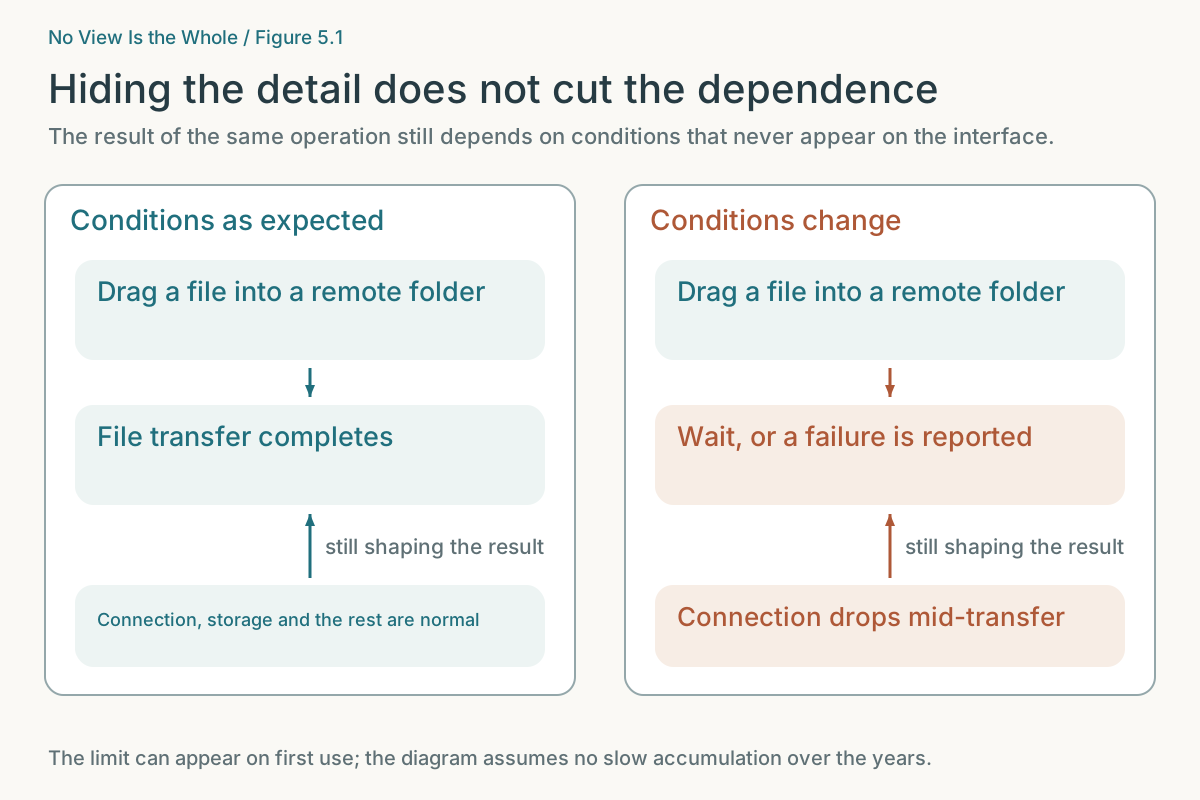
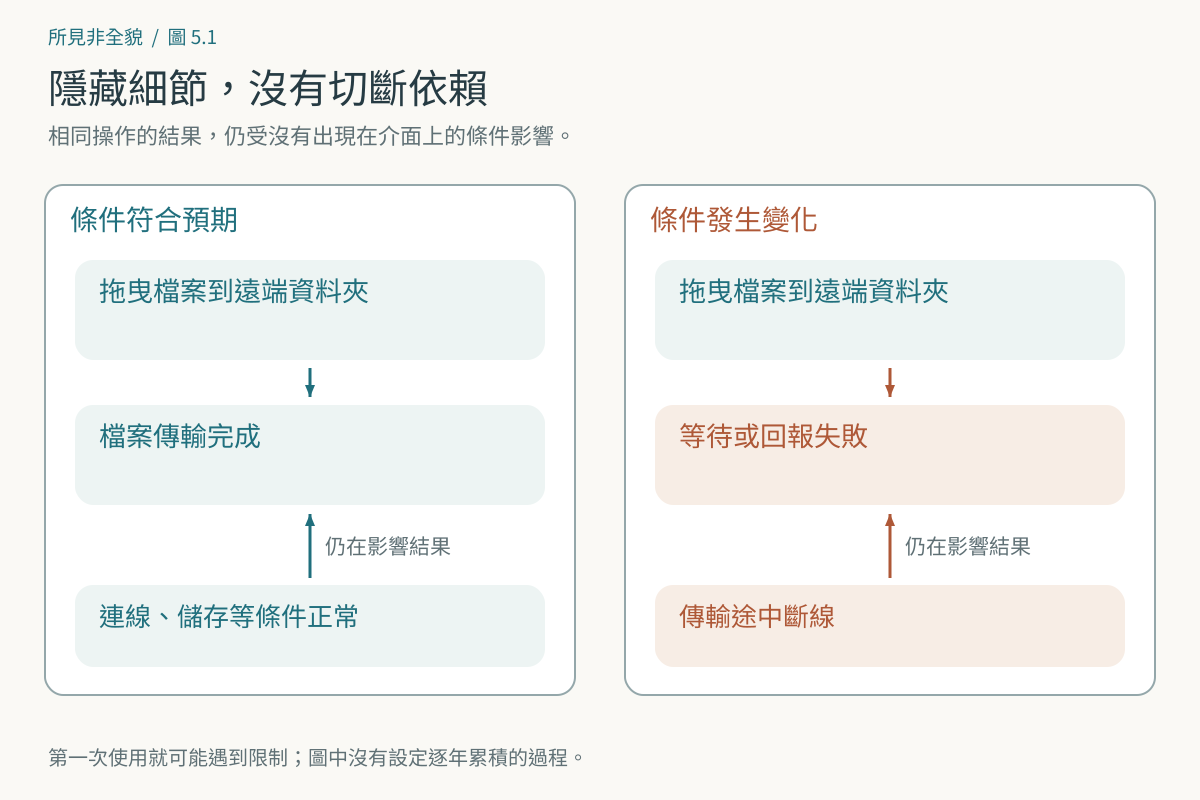
This kind of limit can show up on the very first use. A newly set-up remote folder, for example, can no longer supply files the way a local folder does once the connection drops. The loss of skill over years of use, documentation going out of date, the difficulty of replacing the tool: these are a separate set of risks. Even if none of them ever arises, a connection remains a condition for any remote operation.
這種限制可能在第一次使用時就出現。例如,新裝好的遠端資料夾一旦斷線,就不能像本機資料夾那樣繼續取得檔案。長年使用造成的技能流失、文件過時或更換困難,是另一組風險;即使這些問題都未發生,連線仍是遠端操作所需的條件。
Why some gaps cannot be filled from within the original representation
為什麼有些缺口不能在原表示裡補好
Suppose two sets of data survive only as their averages. One set was forty and sixty; the other was zero and one hundred. Both average fifty, and there is nothing wrong with that calculation.
Now someone asks whether either set contains a value below twenty. The first does not; the second does. If the average really is all that is left, there is no way to tell from it which set was which. However precisely the fifty is computed, however long it is analysed, the difference that has been lost will not grow back out of it.
假設兩組資料都只留下平均值。一組是四十與六十,另一組是零與一百。它們的平均都是五十,這個計算沒有錯。
現在有人問:組內是否存在低於二十的數值?第一組沒有,第二組有。若手上真的只剩那個平均數,就無法由它辨認原來是哪一組。把五十算得再精確、分析得再久,也不會從中長回已經失去的差異。
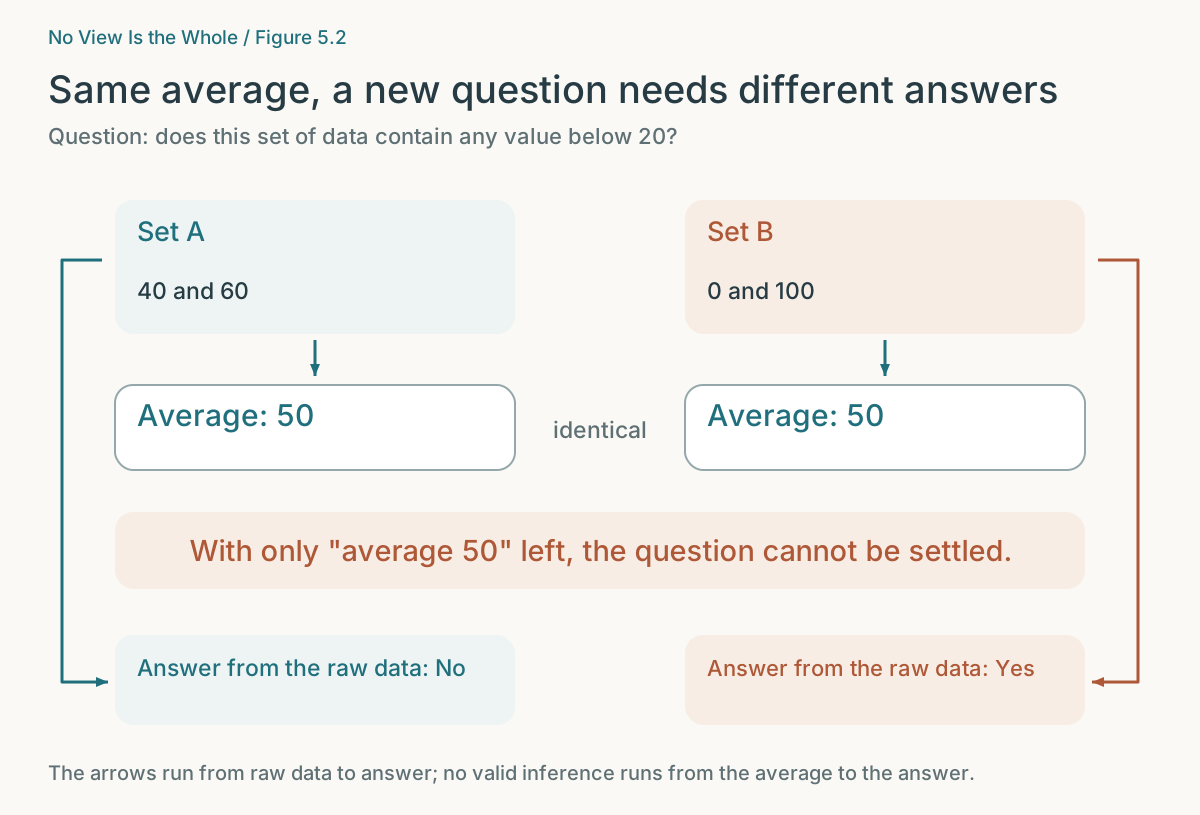
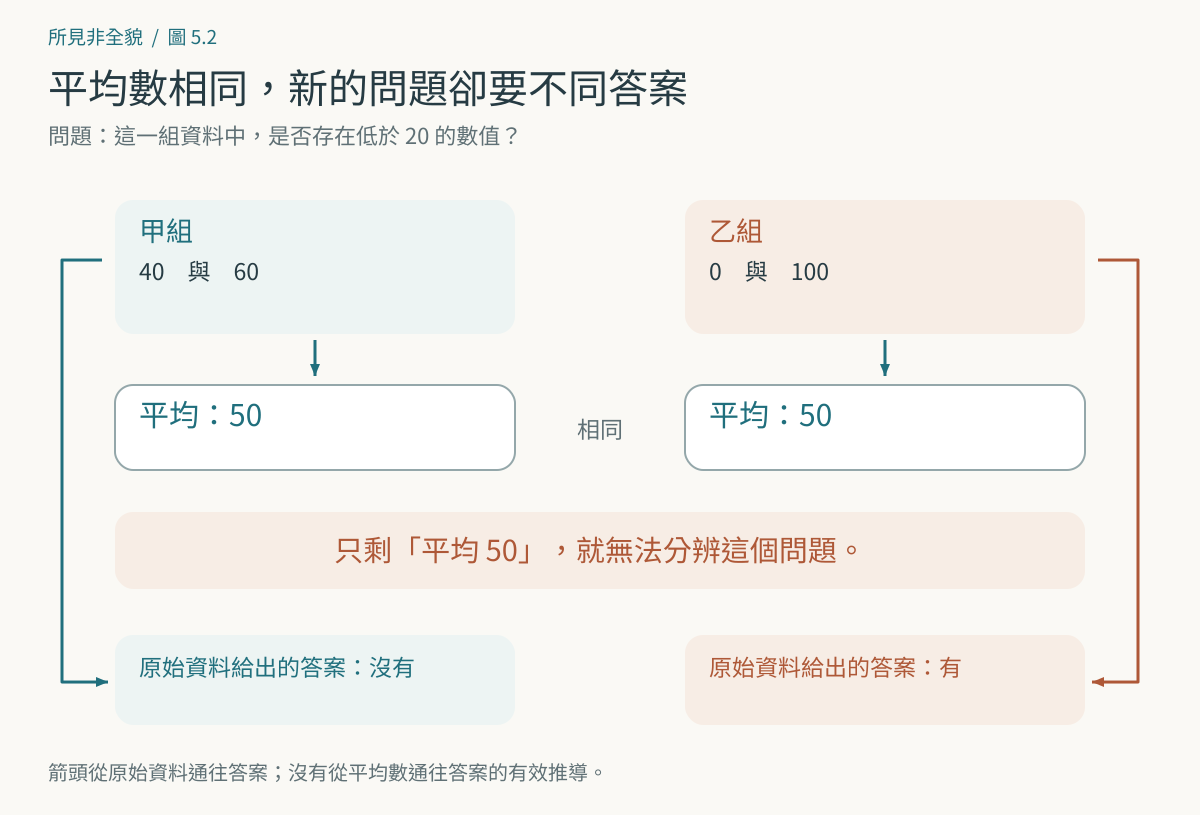
The reason can be stated quite plainly. If a representation records two actual situations as the same content, and some question demands different answers for the two, then any fixed way of judging that relies on this representation alone cannot answer correctly in both cases. At the least, one piece of information that separates them has to be added, or it has to be admitted that for now they cannot be told apart.
When the task is only to compute the average of the two numbers, either summary is entirely sufficient. An abstraction can stay accurate on a well-defined question; leaving something out does not automatically amount to being wrong. The difficulty is that we so often take a representation built for one kind of question and go on to answer other questions with it.
So long as the omitted difference stays irrelevant to the question, we can safely spare ourselves the effort of handling it. Once the question changes, more computation may be no help at all. The difficulty at that point may not even be one the person using the representation can resolve: the original data may be kept somewhere else, or it may never have been kept.
這裡可以把理由說得很清楚。如果一種表示把兩個實際情況記成相同內容,而某個問題要求對兩者給出不同答案,那麼,只依靠這份表示的固定判斷方式,就無法在兩種情況下都答對。至少要補入一項能把它們分開的資訊,或承認目前無法區分。
當任務只有計算這兩個數的平均時,兩份摘要卻都完全足夠。抽象可以在界定好的問題上保持準確;有所省略,不自動等於已經犯錯。困難在於,我們經常把為一種問題建立的表示,接著拿來回答別的問題。
被省略的差異若一直與問題無關,我們便可以放心省下處理它的力氣。一旦問題改了,更多運算也未必有用。此時的困難甚至可能無法由正在使用的人解決:原始資料可能存於別處,也可能根本沒有留下來。
Having a limit, and leaving the limit nowhere to be found
有限制,與讓限制無從查找
Consider two hypothetical systems for reporting faults. In both, the user presses "report fault" once. One of them also saves the relevant raw data from that moment and allows situations outside the existing categories to be written in; the other keeps only the result once it has been sorted into the existing categories. The screens are equally simple; what can be looked up afterwards is not.
考慮兩套假設的異常通報系統。使用者都只按一次「回報異常」,其中一套另存當時的相關原始資料,容許補寫未分類的情況;另一套只留下按既有分類整理的結果。操作畫面同樣簡單,日後能查到的內容卻不同。
| Point of comparison | Version A | Version B |
|---|---|---|
| Everyday operation | One press to report a fault | One press to report a fault |
| Background record | Keeps the relevant raw data; allows uncategorised situations to be added | Keeps only the result after sorting into existing categories |
| When something must be traced | Raw records and supplementary notes are available | Discarded differences cannot be recovered from the result |
| 要比較的部分 | 版本甲 | 版本乙 |
|---|---|---|
| 日常操作 | 一次按鍵回報異常 | 一次按鍵回報異常 |
| 背景紀錄 | 保存相關原始資料,容許補充未分類的情況 | 只留下歸入既有分類後的結果 |
| 需要追查時 | 可取得原始紀錄與補充說明 | 被丟棄的差異無法從結果還原 |
If it later turns out that faults filed under one category in fact had different causes, Version A can go back to the saved data and see which differences the original classification failed to record; Version B, having discarded the relevant details, cannot reconstruct them from the categorised results alone. Ease of operation, and the keeping of data for catching errors later, can be handled separately by different parts of the design.
Choosing between them also means reckoning the cost of storing data and weighing privacy and use. There is no need to keep everything against every remote possibility. But once we have reason to expect a particular failure that matters, whether to leave an adequate path for tracing it becomes a practical choice.
In the same way, a checkout rule that supports a single currency can refuse other currencies outright, or it can quietly treat figures in different currencies as if they were in the same unit. The first tells the user that another method is needed; the second may cover the problem with an answer that looks normal. Every abstraction has limits, and the ways of handling those limits can differ enormously.
Once the data has been kept, someone still has to be able to read it and act on it. That ability, too, has to be maintained.
When a system has run smoothly for a long time, people usually check it less often and spend their time on other things. That saves effort, but it can also let certain abilities go rusty. Someone who rarely handles faults by hand, for example, may need more time to recognise the situation when suddenly asked to take over.
Writing about automation in 1983, Lisanne Bainbridge pointed to a contradiction in practice. Once automation has taken over routine operation, what remains for the human may be the rare and difficult abnormality; yet the operator, lacking daily practice, finds it hard to grasp the situation quickly when suddenly required to. Keeping a person at the last gate does not by itself guarantee that the person is still able to complete the handover.17
Keeping people able to take over is therefore work that has to go on continuously in ordinary times. The practice required, the status information that must be available, and the time needed to act all have costs. The more smoothly the automation runs, the more easily these investments come to look superfluous: if they are so seldom used, why keep paying for them? Only when the abnormality arrives does the cost that was saved reappear in another form.
A remote file can lose its connection on the very first use; proficiency in a rare operation can decline after long disuse. These are difficulties from different sources, and design has to face both. Knowing that an abstraction cannot take care of everything does not, on its own, tell us how much capacity to hold in reserve, day to day, for an exception that has not yet arrived.
如果後來發現,原本歸入同一類的故障其實有不同原因,版本甲可以回查保存的資料,看看哪些差異未被原分類記下;版本乙若已丟棄相關細節,就無法只靠分類結果還原。方便操作,與保留日後查錯的資料,可以由不同的設計分別處理。
選用哪一版,還得計算資料保存的代價,考慮隱私與用途。沒有必要為每個遙遠的可能性保存一切。不過,一旦我們有理由預期某種重要失效,是否留下適當的追查途徑,就成了一項實際選擇。
同樣地,一套只支援單一幣別的結帳規則,可以明確拒絕其他幣別;也可以默默把不同貨幣的數字當成同一單位計算。前者讓使用者知道需要換方法,後者卻可能用一個看似正常的答案遮住問題。抽象都有限制,處理限制的方式可以相差很遠。
資料留下來以後,還得有人會讀、會處理。這項能力也需要維持。
系統長期順利運作,人們通常會減少重複查驗,把時間用在其他事情上。這能節省心力,卻也可能使某些能力逐漸生疏。例如,平常很少手動處理異常的人,突然接手時可能需要更多時間辨認情況。
麗莎妮・班布里奇在一九八三年討論自動化時,指出一個實務上的矛盾:自動化接手日常操作之後,留給人的可能是罕見而困難的異常;操作者卻因缺少日常練習,難以在突然需要時迅速理解情勢。把人留在最後一關,並不自動保證他還有能力完成接手。17
讓人能夠接手,因而是一份平時就得持續做的工作。需要的練習、可取得的狀態資訊和足夠的處理時間,都有成本。自動化越順利,這些投入反而越容易顯得多餘:既然很少用到,為什麼還要維持?直到異常發生,節省下來的成本才以另一種形式出現。
遠端檔案第一次使用就可能斷線;罕見操作的熟練程度,則可能在長期不用以後下降。這是不同來源的困難,設計時都得面對。知道抽象不能包辦一切,並沒有立刻告訴我們,平常該為那個尚未到來的例外保留多少能力。
More and more reports, and the war no clearer
報表越來越多,戰爭卻沒有變清楚
In 1961 Robert McNamara arrived at the United States Department of Defense. He came from wartime statistical work and corporate management, and he valued decisions supported by quantities, costs, and comparisons. These methods could reveal differences that had previously been hard to set side by side, and they gave analysts an important place in the running of defence.
The Vietnam War is often described afterwards as a war lost because the only thing anyone looked at was the enemy body count. The historian Gregory Daddis's research complicates that story. What was collected at the time went well beyond kill counts: weapons captured, local security, the state of control over territory, a great mass of data. Part of the problem lay precisely in there being too much of it, and too little of a consistent way of telling which numbers actually meant progress.18
Political legitimacy, local networks, popular attitudes, and the opponent's mobilisation could all shape the course of the war. To use figures for casualties, captured weapons, or local control, one had to understand under what conditions each of them reflected strategic progress. Adding another batch of numbers, if their relation to the strategic aims still could not be spelt out, did not necessarily add to anyone's understanding of how the war was going.
When those reports were also used to allocate resources and assign responsibility, looking into what lay outside the numbers mattered all the more. Could observations from people on the ground supplement the existing reports? When someone found that an indicator did not match the actual state of control, could that prompt decision-makers to reassess? Gaps in measurement can persist because the decision process accepts only certain numbers.
一九六一年,羅伯・麥納馬拉進入美國國防部。他有戰時統計工作與企業管理的背景,重視以數量、成本與比較支持決策。這些方法能揭露過去難以對照的差異,也使分析者在國防管理中取得重要位置。
越戰後來常被說成一場因只看敵軍擊殺數而打輸的戰爭。歷史學家格雷戈里・戴迪斯的研究,使這個故事變得更複雜:當時蒐集的不只有擊殺數,還有武器繳獲、地方安全與控制情況等大量資料。問題的一部分恰恰在於資料太多、缺少足夠一致的方式,辨認哪些數字真正意味著進展。18
政治合法性、地方網絡、民眾態度與對手的動員,都可能影響戰爭的發展。要使用傷亡、武器繳獲或地方控制等數字,必須了解它們各自在什麼情況下能反映戰略進展。再增加一批數字,若仍說不清楚它們與戰略目標的關係,就未必增加了對戰局的理解。
當這些報表又被用來分配資源、評定責任,調查數字以外的情況就更重要了。地方人士提出的觀察,能否補充現有報表?有人發現某項指標與實際控制情況不符時,能否促使決策者重新評估?衡量的缺漏,可能因決策程序只接受某些數字而持續存在。
Those who find a way round also know something
繞得過去的人,也知道一些事
Sometimes a user can deal with a tool's limits without first working out the full principle behind them.
Suppose an image tool consistently fails to pick out the edges of objects in a certain kind of photograph. After a few comparisons the user finds that adjusting the contrast first gives a selection closer to what is wanted. He may have no idea how the selection algorithm computes its result, yet he has learnt a useful technique: on this kind of photograph, changing the input first improves what follows.
This can be called a local workaround. It solves the immediate difficulty first, and lets repeated use and comparison confirm its scope of use afterwards. If it stops working on another kind of photograph, the rule has to be narrowed or the cause looked into afresh.
Success after success, though, can make people forget the scope. What was first written down was "on this kind of photograph, adjust the contrast first; the result is better". After a few handovers only "always raise the contrast before selecting" remains. Those who come later follow the rule without knowing that some photographs never needed the treatment, and may even be made worse by it. The technique has become a general rule, and what has vanished is the set of comparisons that originally supported it.
We rely on this kind of limited grasp with a great many tools. A writer does not have to understand how a typeface is rendered on screen before writing; a maintenance engineer may, from years of comparison, hear an abnormal sound first and only then ask someone to test for the cause. Whether such a competence is reliable should be judged by what the person recognises, under what conditions it works, and whether he can improve after a miss.
If the technique keeps failing, the user may have to ask someone to examine the inputs and the environment, or switch to another measurement to cross-check. That takes time; overhauling the whole classification takes far more, and after the change there will be new limits to meet. Sometimes the only option is to narrow the use, or even suspend it, and bear the loss of not being able to do that thing for a while.
Each of these responses has its own price, and no single action can be called "dealing with the leak" once and for all. Still, whoever takes over can at least be spared some wasted effort: if the original user leaves behind the kinds of photograph the technique applies to, the cases where it failed, and the original files, the successor need not start guessing again from the single line "always raise the contrast".
Leaving a record of how something was used can also, at times, let those who come later ask questions that no one had asked before.
Some unknowns can already be put as definite questions. Was a particular error caused by a change of camera? One can compare old and new images, rerun the recognition, and eliminate possibilities one by one.
Harder are the cases where the system has not yet recorded the difference that caused the error. Suppose an engineer keeps only the recognition results, with no original images and no record of when the camera was changed. When he sees accuracy falling, he is short of several clues he might have used to propose and test a cause. The original report had no fields for them, and an error does not sprout its own explanation.
We cannot list every surprise in advance, but we can give new findings somewhere to be written down: allowing faults outside the existing categories to be entered, letting operators add what they saw on the spot, or keeping the raw data connected to important results. Once a new pattern is found, one can then decide whether to add a category, change the measurement, or test again.
Which data to keep, and who may add to it, still have to be weighed against cost and privacy. The aim of the design is to give problems no one has yet foreseen a chance to be noticed and investigated, rather than to require every system to hoard everything in advance.
有時,使用者並不需要先查清完整原理,就能處理工具的限制。
假設影像工具總是選不好某類照片中物件的邊緣。使用者經過幾次比較,發現先調整對比,選取結果就較符合需要。他可能不知道選取演算法如何計算,仍學會了一項有用的技巧:在這類照片上,先改變輸入,能改善後續結果。
這種做法可稱為局部補償。它先解決眼前的困難,再由反覆使用與比較確認適用範圍。若換成另一類照片就失效,便需要收窄規則或重新查原因。
不過,一次次成功也可能使人忘記範圍。原先記下的是「這一類照片先調整對比,效果較好」,交接幾次以後,只剩「選取前一定要調高對比」。後來者依規定做,卻不知道有些照片原本就不需要這項處理,甚至會因此變差。技巧成了通用規則,消失的是它原來靠哪些比較才獲得支持。
我們使用許多工具時都依靠這種有限掌握。作家不必先懂字型如何呈現在螢幕上,才能寫作;設備維護者也可能憑長期比較,先聽出某種異常聲音,再請人檢測原因。能力是否可靠,應看他辨認了什麼、在什麼情況下有效,以及失手後能否改進。
若技巧反覆失效,使用者可能得請人查輸入和環境,或換一種量測來核對。這要花時間;改造整套分類又更費事,轉換之後也會遇到新的限制。有時只好縮小用途,甚至暫停使用,承受暫時做不了那件事的損失。
這些做法各有需要付出的代價,沒有一個動作能一勞永逸地叫作「處理洩漏」。不過,接手的人至少可以少走一段冤枉路:原來的使用者若留下技巧適用的照片類型、失效例子與原始檔案,他便不必從一句「一定要調高對比」重新猜起。
留下使用經過,有時還能讓後來的人提出原先沒有的問題。
有些未知已經能明確提問:某次錯誤是否由攝影機更換造成?可以比較新舊影像、重跑辨識,再逐項排查。
更難的是,系統尚未把造成錯誤的差異列入紀錄。假設工程師只保存辨識結果,沒有留下原始影像,也沒有記錄攝影機何時更換。他看到準確率下降時,就少了幾項用來提出和檢查原因的線索。原先的報表沒有這些欄位,錯誤本身不會自動長出說明。
我們無法事先列出所有意外,但可以讓新發現有地方被記下。比如容許填寫既有分類之外的異常、讓操作人員補充現場情況,或保存與重要結果有關的原始資料。發現新的規律後,再決定是否增加分類、修改量測或重新測試。
保留哪些資料、讓誰能補充,仍要考慮成本與隱私。設計的目的,是讓尚未被預想的問題有機會被發現和調查,而不是要求每套系統預先收藏一切。
How science differs from a temporary fix
科學與臨時補救有什麼不同
A tool can stay in use on the strength of local techniques, and scientific theories, too, are frequently revised in the face of new phenomena. The difference between the two can be seen in what checks the revision must then submit to.
The photograph technique above claims only that it improves selection on one kind of input, and repeated comparison on that kind of photograph gives it partial support. To go further and explain how features of the image affect the algorithm, one would have to put forward expectations that can be checked on new photographs; and when others repeat the work with different data, they should be able to see corresponding results. As the claim grows, so does the evidence it requires.
New concepts in science need the same kind of checking. The discussion of dark matter concerns the problem of mass in phenomena such as the motion of galaxies and gravitational lensing; dark energy concerns the explanation of the universe's accelerating expansion. Each is constrained by several sets of observations, and each still has open questions and ongoing research.19 To assess them, one compares how the whole explanation fits the different lines of evidence, and what further observable results it leads us to expect.
If every discordant result were met only with an added explanation that cannot be checked separately, any theory could be kept safe. What gives us reason to trust a theory more is its ability to anticipate new situations from its principles and to submit to checking against independent data.
Does the fact that knowledge is still limited mean that "ultimate truth must be unattainable"? That step cannot be taken from present shortcomings alone. We can establish that a given representation cannot answer a given question without thereby establishing the limits of every future method.
Scientific realists care whether a theory describes structure the world actually has; instrumentalists lay more stress on a theory's use in organising experience and making predictions. They understand theories differently, yet they can still jointly check what assumptions a claim uses, what evidence it fits, and what kind of finding would demand its revision.
工具可以靠局部技巧繼續使用,科學理論也經常因新現象而修改。兩者的差別,可以從修改後需要接受哪些檢查來看。
前面的照片技巧,只聲稱在某類輸入上能改善選取結果,反覆比較這類照片便能提供部分支持。若要進一步說明影像特徵如何影響演算法,就得提出能在新照片上檢查的預期;其他人使用不同資料重做時,也應能看出相應結果。主張擴大,所需證據便跟著增加。
科學中的新概念同樣需要這種檢查。暗物質的討論涉及星系運動、重力透鏡等現象中的質量問題;暗能量則涉及宇宙加速膨脹的解釋。兩者各自受到多組觀測限制,仍有未解問題與持續研究。19評估它們時,要比較整套解釋如何符合不同證據,以及還能預期什麼可觀測的結果。
如果每次遇到不符的結果,只增加一句無法另外檢查的說明,任何理論都可能被保護下來。能根據原理預期新情況、接受獨立資料的查驗,才讓我們有理由提高信任。
知識目前仍有限,是否意味著「終極真理必然不可得」?這一步並不能只由現有的不足推出。我們可以確認某種表示無法回答某個問題,卻沒有因此確認所有未來方法的界限。
科學實在論者關心理論是否描述了世界實際具有的結構;工具主義者較強調理論組織經驗與預測的用途。兩者對理論的理解不同,仍可共同檢查一項主張用了哪些假設、符合哪些證據,以及哪種發現會要求修改。
Some limits call for a different road
有些限制,需要換一條路
When a leak appears, the existing system does not necessarily have to be repaired until it can handle everything. Giving up a category, stopping a scoring scheme, or retiring a process may be better.
If a form keeps squeezing out important experience, the answer need not be to add fields without end; perhaps decisions of this kind need interviews and case-by-case judgement to take part as well. If a method shifts its maintenance costs onto its users, keeping it running is not necessarily a goal worth putting first.
Choosing how to handle a limit also involves how the costs are distributed. A form that saves managers time in review may make it hard for the people filling it in to describe their real difficulties; keeping an old tool in service may leave frontline workers patching things by hand again and again. In weighing whether to keep it, the burden on these people and the alternatives should be compared together.
A form kept originally to save trouble may leave another group of people forever making up for what it failed to record. Whether it is worth keeping can no longer be judged by how efficiently the form organises things.
洩漏出現時,不一定要把原有系統修到能包辦所有事情。放棄某個分類、停止某項評分、讓一個流程退場,也可能更好。
如果一張表單始終把重要經驗擠掉,不一定要無限增添欄位;也許這類決定需要訪談與個案判斷一起參與。如果一套方法把維護成本轉嫁給使用者,讓它繼續運轉未必是值得優先追求的目標。
選擇如何處理限制,還涉及代價的分配。表單替管理者節省審閱時間,可能讓填表者難以說明真正的困難;持續使用舊工具,也可能讓第一線人員反覆手動補救。評估是否保留它時,應把這些人的負擔與替代做法一併比較。
原來為了省事而留下的一張表,可能讓另一群人不斷補做它沒記下的事。是否值得繼續用它,已經不能只看表格整理得多有效率。
6 — Useful, True, and Worthwhile
第六章 有用、真實與值得
It was getting dark, and the little girl was still in the street selling matches. Andersen sets the story on the last day of the year. Snow was falling, and from every house came light and the smell of roast goose, while she walked outside barefoot. The oversized slippers she had set out in were lost when she dodged out of the way of a carriage, and all day nobody had bought a match from her or given her a single coin.
She dared not go home. Her father would beat her for bringing back no money, and home was hardly warmer, for the wind still came in through the cracks in the roof. At last she crept into a corner between two houses, her hands stiff with cold. One match, struck, might warm her fingers a little.
The flame caught. She held her hands towards the light, and it was as if she were sitting before a great iron stove. Her body grew warm, and she was stretching out her feet to warm them too when the match went out. The stove was gone, and all that remained in her hand was the burnt stub.
She struck another. Where the light fell, the wall turned as thin as gauze, and behind it stood a table laid with a cloth, a roast goose still steaming on it. The goose jumped down from its dish and waddled towards her, knife and fork and all; then the flame died, and there was nothing in front of her again but the thick, cold, damp wall.
With the third match she found herself sitting beneath a splendid Christmas tree. Many small lights burned on its branches, and she reached up to touch them, and the match went out. The lights of the tree rose higher and higher until they became the stars in the sky, and one of them fell, drawing a long streak of light behind it. She remembered what her grandmother had told her: when a star falls, a soul is going up to God. Her grandmother was the one person who had loved her, and she was dead.
When the next match flared, her grandmother stood there in the light. The little girl begged to be taken with her. She knew by now what happened when the flame went out: the stove had vanished, the goose had vanished, the Christmas tree had vanished, and this time she would not lose her grandmother too. In haste she struck the whole bundle of matches at once, to keep her grandmother there.
Her grandmother lifted her up in her arms, and together they rose to a place where there was no cold, no hunger and no sorrow, and came to God.
The next morning, people in the street found the girl leaning against the wall, frozen to death, a bundle of burnt-out matches beside her. They supposed she had only been trying to warm herself. They did not know what she had seen in the light.20
When an experience really does bring comfort, are we weighing that comfort, or the reality the person was actually standing in?
天快黑了,小女孩還在街上賣火柴。安徒生把故事放在一年的最後一天:雪落著,家家戶戶透出燈光與烤鵝的香味,她卻赤著腳走在外面。原來穿的大拖鞋在躲避馬車時弄丟了,整天又沒有人買火柴,也沒有人給她一枚錢。
她不敢回家,怕父親因她沒有帶回錢而打她;家裡也不暖,屋頂的縫仍會進風。最後,她縮進兩棟房子之間的角落,雙手凍得僵硬。劃一根火柴,也許就能暖一暖手。
火亮起來。她把手伸近火光,彷彿正坐在一座大鐵爐前。身上暖了,腳也想伸過去,火柴卻在這時熄滅。暖爐不見了,手裡只剩燒過的火柴梗。
她又劃了一根。光照到的牆變得像薄紗,牆後鋪著桌巾,烤鵝還冒著熱氣。鵝從盤子跳下來,帶著刀叉向她走近;火光一滅,眼前又只剩厚厚的、冰冷潮濕的牆。
第三次點亮火柴,她坐到一棵華麗的聖誕樹下。枝上亮著許多燈,她伸手想去碰,火柴又熄了。樹燈越升越高,變成天上的星星;其中一顆落下,拖出長長的光。她想起祖母說過的話:星星落下,便有一個靈魂到上帝那裡去。祖母是曾疼愛她、卻已經死去的人。
下一根火柴亮起時,祖母出現在光裡。小女孩求她帶自己走。她已經知道火熄了會怎樣:暖爐消失,烤鵝消失,聖誕樹也消失;這次,她不願再失去祖母。她急忙把整把火柴劃亮,好把祖母留住。
祖母把她抱起,兩人一同升到沒有寒冷、飢餓與憂愁的地方,來到上帝身邊。
第二天早晨,街上的人看見女孩靠著牆,已經凍死,身旁有一把燃盡的火柴。他們以為她只是想取暖,不知道她在火光裡看見過什麼。20
如果一段經驗確實帶來安慰,我們是在評價那份安慰,還是在評價使人身處其中的現實?
A report that seems to be about you alone
一份看起來只屬於自己的報告
Suppose a personality profile reads: "You care a great deal about how others see you, yet at times you wish you did not have to be swayed by them." Reading a sentence like that, you may feel it has caught a contradiction in you exactly. But can that feeling of recognition show that the test has really told you apart from other people?
Bertram Forer asked the students in his class to complete a test. Afterwards he handed each of them a personality description that appeared to have been written from their results, and asked them to rate how well it fitted. The students generally rated it highly.
Only then came the disclosure: they had all been given the same text. Forer's paper of 1949 called the exercise a classroom demonstration. What he was challenging was the practice of validating a diagnostic tool by the assent of the people it was applied to. If one description can make many people each feel "this is exactly me", then the feeling of being seen cannot on its own prove that the description has picked out anything individual.21
A sentence in a personality report may apply to one person; the same sentence may apply to most of the class. To learn whether a test distinguishes between individuals, you have to set different people's results side by side. It is not enough to let each person read their own and then ask, "Does this sound like you?"
Forer's question was whether a test could recognise individual differences, and the subjects' sense that the description fitted was not enough to answer it. Yet when the thing under study is itself a feeling, such as pain or discomfort, how the person describes their own change becomes data that cannot be done without.
The word placebo usually brings to mind a patient who does not know that what they have been given contains no active drug. In 2010, Ted Kaptchuk and his colleagues studied a different situation: if participants are told plainly, does the effect still appear?
The condition they studied was irritable bowel syndrome, an illness whose troubles include abdominal pain and changes in bowel habit. Participants were divided into groups. One group knew that what they were taking was a placebo and were given a positive account of the treatment; the other received a similar degree of contact with the clinicians but not the treatment itself. Over three weeks, the placebo group improved more on some of the self-reported symptom measures.22
What the study compared was an intervention made up of an explanation and a schedule of pills, and the improvement showed up mainly in the symptoms participants reported themselves. They knew which group they were in, and their expectations and the way they answered may also have shaped the measurements. The result is therefore something to go on studying: why did this arrangement help with some symptoms, and which of its ingredients made the difference?
假設一份性格分析寫道:「你很在意別人怎樣看自己,有時又希望不必受他人左右。」讀到這樣的句子,你可能覺得它說中了自己的矛盾。但這份認同,能證明測驗真的分辨出你與別人的不同嗎?
伯特倫・佛勒請課堂上的學生完成測驗,之後交給他們一份看似根據測驗寫成的性格描述,再請他們評估貼不貼切。學生普遍給出很高的評價。
接著才揭曉:他們拿到的是相同的文字。佛勒一九四九年的論文把這項安排稱為一次課堂示範。他要挑戰的,是拿受測者的認同來驗證診斷工具。若一份描述能使許多人各自感到「這正是在說我」,被說中的感覺就不能獨自證明它辨認出了個人的差異。21
性格報告中的句子可能適用於一個人;同樣的句子也可能適用於班上大多數人。要了解測驗有沒有分辨出個人差異,得把不同人的結果放在一起,不能只在各自讀完後問一句「像不像你」。
佛勒問的是一項測驗能否辨認個人差異,受測者覺得貼切,還不夠回答它。若要研究的恰好是疼痛、不適這些感受,當事人怎樣描述自己的變化,又會成為不可少的資料。
安慰劑通常讓人想到,病人不知道自己拿到的東西沒有有效藥物成分。二〇一〇年,泰德・卡普丘克等人卻研究另一種情況:如果清楚告訴參與者,效果還會不會出現?
他們研究的是腸躁症,一種會有腹痛、排便習慣改變等困擾的疾病。參與者被分入不同組,一組知道自己服用的是安慰劑,並獲得正向的治療說明;另一組接受相近醫病互動,但沒有這項治療。在三週期間,安慰劑組在部分自陳症狀指標上的改善較多。22
這項研究比較的是一套包含說明與服用安排的介入,改善主要由參與者自述症狀呈現。他們知道自己分到哪一組,期待與回答方式也可能影響評量。結果因此值得繼續研究:這套安排為什麼對部分症狀有幫助,其中哪些因素造成了差別?
Why planets go backwards in the sky
行星為什麼會在天空倒退
Some successes push the question the other way. When a method predicts things not previously known, and its results agree again and again with new observations, we have reason to believe it. But how much of it should we believe? Astronomers long used a system that could compute the positions of the planets, and the account of how the heavenly bodies actually move was later very substantially rewritten.
Record a planet's position against the background stars over many nights in a row and you will find that it does not always move in the same direction. At times it seems to stop, then to go backwards, then to resume its former course. Ancient astronomy had to explain this retrograde motion, and it also had to calculate when it would occur.
In the second century, Ptolemy of Alexandria set out a geocentric system of astronomy in the Almagest. One of its devices is called the epicycle: the planet moves round a small circle, while the centre of that small circle moves round a larger one. Seen from the earth, the two motions combine to trace a path that sometimes advances and sometimes retreats. The full model had further geometrical arrangements as well, fitted to the observations of the different bodies.
This tradition, with the corrections made to it afterwards, was used for a very long time to compute planetary positions, and it preserved a great body of observations and methods of calculation. Later astronomers were able to compare the old explanation with new ones precisely because these records were there to use.
If the earth also travels round the sun, retrograde motion can be understood in a different way. The earth and an outer planet each move forward, and their relative positions keep changing; when the earth, on the inside track, overtakes the outer planet, the direction in which we look towards it shifts backwards against the background of stars. The retreat seen in the sky can then be explained by the relative motion of observer and planet.
The work Copernicus published in 1543 proposed a heliocentric arrangement, but it still used circular motion, and its computational accuracy left room for improvement. Later, Kepler, working from Tycho Brahe's observations, developed the elliptical orbit and the relations that go with it, and these were then tested against new tables and new observations. The explanation of celestial motion and the improvement of positional prediction passed through distinct stages of research.23
The computational achievements of the old method did not vanish with what came later. It left behind a stock of usable predictions, and also an account of motion waiting to be rewritten. Researchers had to carry on from this mixed inheritance: which calculations to keep, which assumptions to re-examine, and which phenomena remained unexplained.
有些成功又會把問題推向另一邊。當一套方法能預測原先不知道的事情,結果多次與新觀測相符,我們便有了相信它的理由。可是,應該相信其中多少?天文學家曾長期使用一套能推算行星位置的體系,後來對天體如何運動的說明卻大幅改寫。
如果連續很多個晚上記錄一顆行星相對背景恆星的位置,就會發現它並非始終朝同一方向移動。有時,它看起來停住,接著倒退,再恢復原來的方向。古代天文學需要解釋這種逆行,也需要算出它何時發生。
公元二世紀,亞歷山卓的托勒密在《天文學大成》中整理了一套地心天文體系。其中一項安排稱為本輪:行星沿小圓移動,小圓的圓心再沿較大的圓移動。從地球觀察,這兩種運動合起來,便能呈現有時前進、有時退後的路徑。完整模型另有幾何設計,用來配合不同天體的觀測。
這套傳統及其後續修正,長期用來推算行星位置,也保存了大量觀測和計算方法。後來的天文學家能比較新舊解釋,正是因為已有這些紀錄可用。
若地球也繞太陽運動,就能換一種方式理解逆行。地球與外側行星各自前進,兩者的相對位置持續改變;當地球從內側追過外側行星時,望向它的方向會相對背景星空向後移。天空中看到的退後,因而可以由觀察者與行星的相對運動解釋。
哥白尼在一五四三年出版的著作提出日心安排,仍使用圓周運動,計算精度也有待改善。後來克卜勒結合第谷的觀測,發展橢圓軌道等關係,再以新的星表與觀測檢驗。天體運動的說明與位置預測的改進,經過了不同階段的研究。23
舊方法的計算成績並未因後來的變化而消失。它留下一批可用的預測,也留下等待改寫的運動解釋。研究者得從這份混合的遺產接著做:保留哪些計算,重查哪些假設,還有哪些現象尚未解釋。
Some things are worth doing in themselves
有些事情,本身就值得去做
Knowing that a piece of information can be checked still leaves the decision of whether it is worth checking now. Time is limited, and two pieces of information, equally reliable, may bear very differently on the decision in front of you.
An engineer dealing with a fault can begin by confirming which settings were recently changed, when the error appears, and which operations reproduce it. Every one of these details might repay study, but if only half an hour remains, the first thing to get hold of is the information most likely to change what is done next.
An astronomical question with no bearing on today's decisions may still be worth a lifetime of study. Its value does not have to be adjudicated by the half hour spent on the fault.
There are many reasons to pursue the truth, and the same is true of other activities. If the only question asked is whether something makes a person more comfortable, we miss the things people do knowing full well that they will be uncomfortable.
Attending a funeral may include comfort, but a person may also go in order to acknowledge a relationship, to remember the dead together with others, or to complete a farewell they have chosen to take on. Even if the day brings no comfort at all, these reasons do not necessarily disappear.
Consider another hypothetical question. A survey asks you to write down how much you would pay to protect an endangered species. Someone refuses to enter a figure, perhaps because they believe that whether a species deserves to survive should not be settled by how much people are willing to pay.
If every such refusal is recorded as zero, an objection to pricing may be written down as complete indifference. The survey needs to allow people to say why they left the box empty. Conservation in practice still faces the difficulty of limited resources and still has to argue about how to allocate them; but before allocating, one has first to understand correctly what it is that people value.
Reading a novel, a person may enjoy the rhythm of the language, worry over the fate of a character, or feel again some stretch of life that resists being put into words. A passage can fail to persuade us as an argument and still console, or make us notice a problem we had been unwilling to face. Nor does a novel have to teach a transferable method before it deserves the time spent reading it.
The same activity may also make promises about matters of fact. If a novel is taken as an accurate record of a period of history, its history needs checking; if a ritual charges a fee on the promise of certain cure, the evidence for that effect has to be examined. Respecting what reading or ritual means to people does not require exempting these additional promises from checking.
If we intend to use an example we have read to support a decision, we take on an added duty of explanation. Chapter 4 discussed how someone else's plan succeeding after many years cannot by itself show that our own plan should continue. This does not erase the strength the story once gave; it is only that, when the time comes to commit the next year, reasons that bear on our own situation still have to be found.
知道某項資訊可以查清,也還要決定現在是否值得查。人的時間有限,同樣可靠的資訊,對眼前決定可能有不同作用。
工程師處理一項故障時,可以先確認最近改過的設定、錯誤出現的時機,以及能重現故障的操作。每一項細節都有可能值得研究,但眼前若只剩半小時,就應先取得最可能改變處置的資訊。
與今日決定無關的天文問題,仍可能值得花一生研究。研究的價值,無須由眼前這半小時的故障處理來裁定。
追查真相有多種理由,其他活動也是如此。若只問一件事能不能使人比較舒服,便會錯過一些明知不舒服、仍願意去做的事。
參加一場告別式,可以包含安慰,但參加者也可能是為了承認一段關係、與他人共同記住逝者,或完成自己願意承擔的告別。即使當天並沒有比較舒服,這些理由也未必消失。
再看一個假設問題:問卷要求填寫,你願意付多少錢保護一種瀕危生物。有人拒絕填數字,可能是因為他認為,生物是否值得存續,不應只依人願意付多少錢來決定。
若將這種拒絕一律記成零,就可能把反對定價誤寫成毫不重視。問卷需要容許人說明不填的理由。實際保育仍面臨資源有限的困難,也仍須討論如何分配;只是在分配以前,先要正確理解人們重視的是什麼。
閱讀小說時,人可能享受語言的節奏,牽掛人物的命運,或重新感受到一段難以言說的生活。一段文字可以在推論上沒有說服我們,卻仍讓人得到安慰,或注意到原先不願面對的問題。小說也不必教會一項能移用的方法,才值得花時間讀。
同一項活動也可能提出事實上的承諾。小說若被當成某段歷史的精確紀錄,就需要核對史實;儀式若以必然治癒作為收費承諾,就得檢查這項效果是否有證據。尊重閱讀或儀式的意義,並不需要替這些額外承諾省去查證。
若我們打算拿讀到的例子支持一項決定,就多了一份說明的責任。第四章談過,別人的計畫多年後成功,無法單獨證明自己的計畫應該繼續。這不會抹去故事曾帶來的力量;只是到了要付出下一年的時候,仍需找得到與自己處境有關的理由。
When comfort is bound up with a way of life
當安慰連著一種生活
Some beliefs lack sufficient evidence yet make people more hopeful and more willing to look after one another. Acknowledging the good a belief does can be kept separate from accepting its account of the world.
Take the funeral discussed earlier in this chapter. A family uses the ceremony to remember the dead and to express how much the relationship meant, and these actions have reasons anyone can understand. If someone also believes that the dead have found peace in another world, others can respect what has been entrusted to that belief without claiming to have confirmed that such a world exists.
If the same belief is then used to make major decisions on behalf of other people, the question changes. To claim that a certain message is enough to settle someone else's treatment, finances or safety involves effects that can be checked and risks that others will bear. Personal conviction and the experience of being comforted cannot on their own supply the evidence such decisions need.
A religion usually contains, all at once, an account of the origin of the universe, rituals, the norms of a community, ethical practice and a sense of identity. In discussing a particular religion, unless one first says which claim is in question, it is easy for each side to say a great deal without ever answering the same point.
To criticise an origin story for lacking evidence, for example, is not necessarily to deny the value of believers caring for one another; and to affirm the support a community provides is not enough to show that the story really happened. Different claims can receive different assessments, without first passing a single verdict on the whole tradition.
Science, too, comprises many activities: measurement, model-building, collective review and technical application. Its achievements help to show how these methods arrive at reliable knowledge. As for what ought to be pursued and which costs are acceptable, scientific research can supply the relevant facts, and a discussion of values and responsibility is still needed.
Real life, however, does not always lay these things out separately. A community's beliefs about the cosmos may be the very reason its members are willing to care for one another; a line of scientific research is often thought worth pursuing because people already value the lives it might change. Analysis can tell the different reasons apart, but the person living inside them may lose, all at the same time, a certainty, a circle of friends and the direction their life had.
When a practice leaves the community it came from, these relations change again. It may be taken up to answer questions that were never posed in the same way before.
The Four Noble Truths of the Buddhist tradition speak of suffering, the origin of suffering, the cessation of suffering, and the path that leads to that cessation. The arrangement lets the practitioner recognise the predicament, understand how it arose, and then commit to practice. When some of these exercises are carried into a modern hospital, the original religious discipline and the clinical research need to be accounted for separately.
In 1979, Jon Kabat-Zinn began work at a stress reduction clinic at the University of Massachusetts Medical Center, organising exercises in breathing, bodily awareness and attention to present experience into a clinical course. The approach later became widely known as mindfulness-based stress reduction. Once inside the hospital, the practice had to face concrete questions: which complaints it helps with, compared with what, how long the effect lasts, and who it may not suit.24
Clinical research can begin by comparing the effect of the practice on particular complaints, and participants need not accept the whole religious cosmology. How the exercises were selected from the original tradition and adapted, and whether its ethical requirements were retained, belong to another part of understanding this transfer. Kabat-Zinn's own account of the course also includes the attitude of practice and its background.
Take a hypothetical company that uses attention exercises to help its staff cope with stress. Employees may learn useful methods, and the company still needs to check whether the workload is reasonable, which processes create a continuing burden, and who is able to change them. If every discomfort is put down to insufficient personal practice, working conditions that could have been improved may go unaddressed indefinitely.
This is why "useful" has to say for whom, and over what span of time. An explanation may set an employee's mind at rest for the day while allowing an unreasonable workload to continue; a simple classification saves the caseworker a few minutes while the person wrongly classified may spend days on an appeal. Chapter 14 will go on to trace how institutions make some of these results far easier to see than others.
有些信念缺乏充分證據,卻使人較有希望,也較願意照顧別人。承認它帶來的好處,與接受它對世界的解釋,可以分開。
以本章談過的告別式為例,家人藉儀式懷念逝者、表達對關係的珍惜,這些行動有可以理解的理由。若有人同時相信逝者在另一個世界得到安寧,旁人可以尊重這份寄託,而不聲稱自己已經確認那個世界的存在。
如果同一個信念又被用來替別人作出重大決定,問題便不同了。宣稱某種訊息足以決定他人的治療、財務或安全安排,涉及可檢查的效果與他人承擔的風險。個人的確信與得到安慰的經驗,無法單獨提供這些決定所需的證據。
宗教往往同時包含宇宙起源的說法、儀式、共同體規範、倫理實踐與身分認同。討論某個宗教時,如果不先指出哪一項主張有問題,很容易各自說了很多,卻沒有回應到同一件事。
例如,批評一段起源敘述缺乏證據,未必是在否定信徒彼此照顧的價值;肯定共同體提供的支持,也不足以證明那段敘述確實發生。不同主張可以得到不同評價,不必先為整個傳統作一次總判決。
科學也包含多種活動:測量、建立模型、共同審查與技術應用。它的成就有助於說明這些方法如何取得可靠知識;至於應該追求什麼、哪些代價可以接受,科學研究可以提供相關事實,仍需要價值與責任的討論。
實際生活卻不會總把這些事情分開擺好。一個共同體對宇宙的信念,可能正是成員願意彼此照顧的理由;某種科學研究值得投入,也常因為人已經重視它可能改變的生活。分析時可以辨認不同的理由,活在其中的人卻可能同時失去一份確信、一群朋友和原有的生活方向。
一項練習離開原來的共同體,這些關係又會改變。它可能被拿去回答原先沒有以同樣方式提出的問題。
佛教傳統的四聖諦談苦、苦的起因、苦的止息,以及通向止息的道路。這套安排讓修行者辨認困境、理解其形成,再投入實踐。當其中一些練習被帶進現代醫院,原先的宗教修行與臨床研究便需要分別說明。
一九七九年,喬・卡巴金在麻州大學醫學中心開始減壓門診工作,把呼吸、身體覺察與注意當下經驗等練習組織進臨床課程。這個方向後來以正念減壓而廣為人知。進入醫院之後,練習需要面對具體的問題:對哪些困擾有幫助,與什麼相比,效果持續多久,以及哪些人未必適合。24
臨床研究可以先比較練習對特定困擾的效果,參與者不必接受整套宗教宇宙觀。至於練習如何從原傳統被選出、被改編,原有倫理要求是否仍被保留,則屬於理解這種移用的另一部分。卡巴金對課程的說明,也包含了實踐態度與背景。
假設一間公司使用注意力練習協助員工應對壓力。員工可能學到有用的方法,公司仍需要查工作量是否合理、哪些流程造成持續負擔,以及誰能改變它們。若所有不適都被歸為個人練習不足,原本可以改善的工作條件就可能一直未被處理。
這也使「有用」需要交代受益者與時間。一段說明可能使員工當天安心,卻讓不合理的工作量持續下去;簡單分類替承辦者省下幾分鐘,被錯分的人卻可能花幾天申訴。第十四章還會接著追查,制度怎樣讓其中一些成績特別容易被看見。
How the truth reaches a person
真相如何抵達一個人
An important truth can cause pain. Learning that a relationship is over, or that a project of many years has failed, brings no immediate relief. But the choices the person makes next may depend on knowing these things.
There are also different ways of telling. A person may be given time to understand, to ask questions, and to get help with the consequences; or they may be forced to respond at once in front of everyone. The truth of the news is the same; the treatment they receive is very different.
Harder still, we sometimes genuinely do not know how much they can bear at this moment. Fearing their pain may come from care, and it may also lead us to keep deciding on their behalf what they are allowed to know. They need support, and they have their own choices to make; and their response may change what we had understood "support" to mean.
When the little girl struck the whole bundle of matches, the story let her keep her grandmother. The reader who knows the ending can no longer see that blaze as nothing more than a comfort.
重要的真相可能讓人痛苦。知道一段關係已經結束,或一項投入多年的計畫失敗,並不會立刻帶來解脫。但當事人接下來如何選擇,又可能需要知道這些事。
說出來也有不同的做法。一個人可以有時間理解、提問,並得到處理後果的幫助;也可能在眾人面前被迫立刻回應。消息的真假相同,受到的對待卻相差很遠。
更難的是,有時我們確實不知道,他此刻承受得了多少。怕他痛苦,可能出於照顧,也可能使我們一直替他決定什麼可以知道。他需要支持,又有自己的選擇要做;他的反應還可能改變我們原先對「支持」的理解。
小女孩點亮整把火柴時,故事讓她留住了祖母。知道結局的讀者,卻再也無法只把那團火看成一份安慰。
7 — Answers Come with Conditions
第七章 答案帶著條件
What do the interior angles of a triangle add up to?
三角形的內角和是多少?
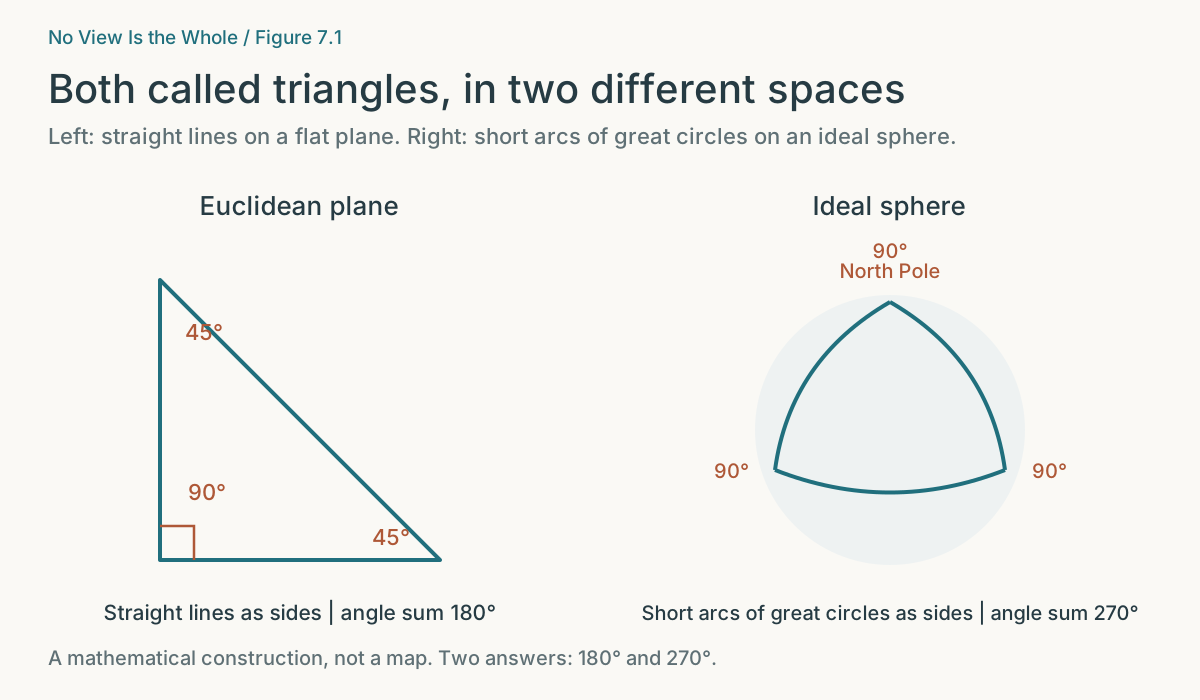
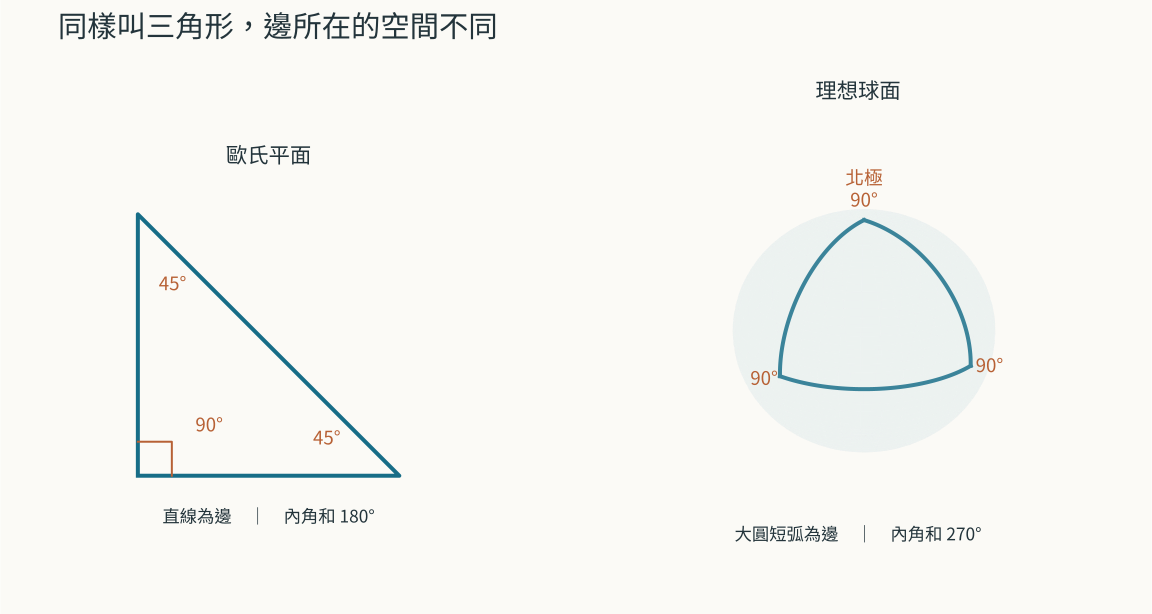
You can walk the right-hand figure as a route. Start at the North Pole and follow a meridian down to the equator, turn ninety degrees, walk a quarter of the way round the equator, then turn ninety degrees again and head back to the North Pole. The two meridians meet at the pole, and the angle between them there is ninety degrees as well. Three angles, two hundred and seventy degrees in all.
A triangle on the plane has interior angles adding up to one hundred and eighty degrees, yet the spherical triangle on the right has three right angles. The difference lies in the space the figure sits in, and in which paths we take as its sides. The example on the sphere uses short arcs of great circles; it does not violate the theorem about straight-sided triangles on the plane.
A mathematical theorem states which axioms and definitions it adopts, and then proves its conclusion. To use it to describe an actual object, one must also confirm that those assumptions match the purpose well enough. When surveying the shape of a small plot of ground, for example, a flat approximation may already be sufficient; a route across a large stretch of the Earth's surface calls for attention to curvature and to the precision required.
右圖可以沿著路徑走一遍。從北極沿一條經線到赤道,轉九十度,沿赤道走四分之一圈,再轉九十度回北極。最後兩條經線在北極相遇,也是九十度。三個角,一共二百七十度。
平面三角形的內角和為一百八十度,右圖的球面三角形卻有三個直角。差別在於圖形所在的空間,以及我們用什麼路徑當作邊。球面上的例子採用大圓的短弧;它並未違反關於平面直線三角形的定理。
數學定理會交代採用哪些公理與定義,再證明結論。要用它描述實際物體,則還得確認那些假設是否足以符合用途。例如,測量小塊地面的形狀時,平面近似可能已足夠;處理跨越大範圍的地表路徑,就需要考慮曲率及要求的精度。
The one they spent two thousand years trying to prove
兩千年裡一直想證明的那一條
Euclid's Elements organises geometrical reasoning by first setting out a number of starting points that may be adopted. The famous fifth postulate says that if a straight line crosses two other lines, and the interior angles on the same side add up to less than two right angles, then those two lines, extended on that side, will meet.
This statement is more roundabout than some of the other starting points. For a long time mathematicians hoped to prove it from the remaining assumptions, so that it would no longer have to be accepted on its own. In 1733 Saccheri tried to reach a contradiction by denying the relevant assumption and following where that led. He obtained a good many results that would later look close to non-Euclidean geometry, and in the end he still tried to rule that road out.
In the nineteenth century Lobachevsky and Bolyai openly developed systems that differed from Euclidean geometry. Riemann, in a lecture of 1854, went further and studied more general spaces and geometries. It gradually became possible to compare geometries built on different assumptions: what each could prove, and whether contradictions arose.25
The spherical example at the start of this chapter gives the difference between geometries a visible shape before anything else. A geodesic on a sphere is the path that runs locally straightest along the surface; the angles at which geodesics meet on the sphere obey a different relation from the angles between straight lines on the plane.
Kant once used geometry to illustrate necessary knowledge that is not obtained from individual experiences alone. The development of several geometries made a distinction more pressing: does a proof within one system also suffice to decide which geometry physical space adopts?4 Answering the second question also requires comparing theory with actual observation.
When general relativity later described gravity through the geometry of curved spacetime, it had to submit to the check of physical observation. Mathematical study of the different possibilities gave physics more representations to draw on; whether they are fit to describe the world is judged by other evidence.
歐幾里得的《幾何原本》整理幾何推論,先列出若干可以採用的起點。著名的第五公設談到:一條直線穿過另外兩條線,如果同側內角的和小於兩個直角,後兩條線向那一側延長就會相交。
這條敘述比其他一些起點曲折。很長一段時間裡,數學家希望把它從其餘假設證明出來,使它不再需要單獨接受。一七三三年,薩凱里嘗試沿著否定相關假設的方向推出矛盾。他得到不少日後看來接近非歐幾何的結果,最後仍試圖否定那條道路。
十九世紀,羅巴切夫斯基與鮑耶公開發展了不同於歐氏幾何的系統。黎曼在一八五四年的演講中,進一步研究更一般的空間與幾何。人們逐漸可以比較採用不同假設的幾何,各自能證明什麼,以及是否存在矛盾。25
本章開頭的球面例子,讓不同幾何的差異先有一個可見的形狀。球面的測地線是沿表面局部走得最直的路徑;它在球面上的交角,與平面直線的交角服從不同關係。
康德曾以幾何說明不單靠個別經驗取得的必然知識。多種幾何的發展,使人更需要區分:一套系統內的證明,是否也足以決定物理空間採用哪種幾何?4對後一個問題,還得比較理論與實際觀測。
廣義相對論後來以彎曲時空的幾何描述重力,便需要接受物理觀測的檢查。數學上研究不同可能,讓物理學有更多能採用的表示;它們是否適合描述世界,則由另外的證據判斷。
The small print the rule leaves off
規則沒有附上的小字
Everyday rules seldom come with their conditions printed alongside. "First come, first served" settles a great many disputes when the matter is buying a drink; used to allocate help that is urgent and important, it raises the questions of who has the chance to arrive first, who can afford to wait, and whose need cannot be put off. The wording of the rule has not changed at all, yet the reasons for choosing it may fall short.
How long a practice is used also bears on whether it is suitable. Postponing a quarrel for a while may let both sides cool down; postponing it every time may leave an important matter unanswered for a long while. An approximate calculation carries only a small error over a short span, and once the errors accumulate through repetition they may exceed what is tolerable. When judging the effect, the length of use has to be reported along with it.
If "it depends" stops there, it is still of limited help. More useful is to point out which difference would change the judgement: whether the urgency is the same, whether the costs of waiting are wildly unequal, whether different stretches of the road take the same time. Once the conditions are concrete, what to check next is also clearer.
日常規則往往沒把條件印在旁邊。「先到先服務」用在買飲料,足以省掉很多爭議;用來分配急迫而重要的協助,便得問誰有機會先到、誰能久等、誰的需要不能延誤。規則的文字完全沒變,選用它的理由卻可能不足。
使用多久,也會影響一種做法是否適合。暫時延後爭執,可能讓雙方冷靜;每次都延後,卻可能使重要問題長期沒有回應。近似計算在短時間內的誤差很小,反覆累積後也可能超過容許範圍。評估效果時,需要把這段使用時間一起交代。
「看情況」若說到這裡就停,幫助仍然有限。更有用的是指出哪項差異會改變判斷。例如急迫性是否相同、等待成本是否懸殊、不同路段是否等時。條件一旦具體,下一步查什麼也比較清楚。
Newtonian mechanics has not vanished from the world
牛頓力學沒有從世界上消失
Newtonian mechanics supports a great deal of reliable work. In describing motion at everyday scales, and in designing many machines and engineering structures, a suitable approximation reaches the precision required. When relativity arrived, this work was not all made obsolete.
Satellite positioning, by contrast, needs extremely precise comparisons of time. Orbital motion and gravitational conditions affect the rate of a satellite's clock relative to a clock on the ground; if these differences are not properly handled, the positioning result suffers. For this reason the system has to incorporate the corresponding relativistic corrections.26
So when using an approximate method, one can first state the precision required and the known error, and then decide whether it is enough. Everyday engineering need not adopt the most elaborate model every time; when higher precision is needed, or a different scale is encountered, the comparison should be made afresh.
牛頓力學能支持很多可靠的工作。描述常見尺度下的運動、設計許多機械與工程結構時,合適的近似可以達到需要的精度。相對論出現以後,這些工作沒有全部作廢。
衛星定位則需要非常精確的時間比較。軌道運動與重力條件,會影響衛星時鐘相對於地面時鐘的速率;這些差異若未妥善處理,就會影響定位結果。為此,系統需要納入相應的相對論修正。26
所以,使用近似方法時,可以先說明精度要求與已知誤差,再決定是否足夠。日常工程不必每次都採用最複雜的模型;需要更高精度或遇到不同尺度時,則應重新比較。
The person who fed it every day
每天餵食的人
In The Problems of Philosophy Russell leaves us a chicken. The person who brings it food every day arrives one day and, instead of feeding it, kills it.27
The ending is so short that it hardly gives anyone time to prepare. Every past feeding was real; had the chicken kept a complete record, it could even have kept one without a single error. But those records did not hand over the keeper's plans for the future along with them.
Those who know the ending find it easy to laugh at the bird. Yet the question Russell leaves behind pursues the reader just as closely: why should what has kept happening in the past go on happening? To answer with regularities that have succeeded before still leaves one having to explain why those regularities will remain in force. Digging further back into the past for a few more successes does not supply this demand with a wholly independent guarantee.
Everyday predictions still differ in how reliable they are. To predict whether the water supply will be interrupted, for example, one can note that there has been water every day in the past, and one can also check the state of the equipment, the maintenance schedule and the source. This information cannot guarantee that nothing will ever go wrong, yet it can identify risks that go unnoticed when only the past record is consulted.
In the same way, a satisfaction survey that interviews only existing customers can tell you about the experience of those who replied. To draw conclusions about everyone who ever came into contact with the service, one also needs to know about those who left, those who did not reply, and those who never managed to get into the service at all. Enlarging the sample of customers of the same kind can make certain estimates steadier; it cannot, on its own, fill in the opinions of those who were never surveyed.
羅素在《哲學問題》裡留下一隻雞。每天帶食物來的人,最後有一天不再餵牠,而是殺了牠。27
這個結尾短得幾乎不給人準備。過去的餵食都是真的,雞若能保存一份完整紀錄,甚至可以保存得毫無差錯。可是那些記錄沒有把飼養者未來的打算一起交出來。
知道結局的人容易笑牠。然而羅素留下的問題同樣追向讀者:過去不斷發生的事情,為何應當繼續?用過去成功過的規律回答,仍然得說明那些規律為何將繼續有效。再往過去多找幾次成功,沒有替這項要求找到一個完全獨立的保證。
日常預測仍有可靠程度的差別。例如,要預測供水會不會中斷,除了記下過去每天都有水,也可以查設備狀況、維修安排與水源。這些資訊不能保證永無意外,卻能辨認單看既往紀錄時沒有注意到的風險。
同樣地,只訪問既有顧客的滿意度調查,可以了解回覆者的經驗。要推論所有曾接觸服務的人,卻還需要知道離開者、未回覆者與未能進入服務者的情況。增加同類顧客的樣本,能讓某些估計更穩定,無法自行補出從未接受調查者的意見。
When the mechanism still has to be traced
什麼時候還要追查機制
Snow did not first acquire complete microscopic knowledge of how cholera spreads before comparing different sources of drinking water. A suitably designed study can provide causal evidence that an intervention affects a particular outcome while the full mechanism is still unclear.
Studying how the effect comes about, in turn, helps in judging what will happen once the setting changes. Knowing which factors the effect depends on lets researchers give priority to testing the differences that might alter it. Comparing actual effects and establishing the mechanism of action can therefore help each other.
An intervention may also produce several effects at once. One of them may be beneficial while another cancels it out, so that the overall result does not necessarily match what was expected. Having explained one pathway of action, then, one still needs to compare the important outcomes directly. The clinical trial in the next chapter will make this difference concrete.
Knowing part of the mechanism may still miss a new situation. Anomalies reported by users, the raw data, and a second kind of measurement sometimes let researchers discover a difference they had not thought of. Chapter 5 discussed how to preserve these ways of catching errors; now the known scope of use can also be recorded more concretely.
史諾沒有先取得霍亂傳播的全部微觀知識,才比較不同飲水來源。適當的研究安排,可以在完整機制尚未清楚時,提供某項介入對特定結果的因果證據。
研究作用如何發生,則有助於判斷換了環境以後會怎樣。了解效果依靠哪些因素,能讓研究者優先測試可能改變效果的差異。比較實際效果與查明作用機制,因而可以互相幫助。
一項介入也可能同時造成多種影響。其中一種作用有利,另一種卻抵消了它,最後的整體結果便未必符合預期。因此,說明某條作用途徑之後,仍需要直接比較重要結果。下一章的臨床試驗會將這個差別具體呈現。
知道一部分作用機制,仍可能漏掉新情況。使用者的異常回報、原始資料與另一種量測,有時能讓研究者發現原先未想到的差異。第五章已討論如何保留這些查錯方式;現在還可以把已知的使用範圍記錄得更具體。
Writing down the scope of use
把使用範圍寫清楚
"This is a retail model" or "this is manufacturing experience" is still too broad. Image models that all serve to inspect the appearance of objects may perform very differently depending on the lens, the lighting, the material of the object, or the angle of the shot. A shared name does not guarantee that the factors affecting recognition are shared too.
Take a hypothetical model used to flag damaged packaging in product photographs, which are then passed to staff for review. It has been tested only under fixed lighting, with a specified lens, and on a few kinds of packaging; backlighting and other reflective materials the team has not yet confirmed. Writing down these circumstances says more about where the result came from than the bare line "ninety-five per cent accuracy".
Later the camera is replaced, while the program stays at the same version. Most of the photographs the team spot-checks are well lit, and the average score looks good, yet misses on the few backlit photographs have increased. If only the total score is kept, it is easy to conclude that the new lens made no difference. Keeping the disputed images, and comparing misses and false alarms separately, is what allows the conditions under which performance worsened to be found, little by little.
At this point "scope of use" has acquired new content. The team had thought of the lens simply as a tool for obtaining photographs of the same kind; now they have to include how it combines with lighting and material in their account. The scope of use is not always something known before the study begins, waiting to be printed as a line of small print beside the product; it also takes shape slowly, through failure and investigation.
If a later version improves performance under backlighting, the old limitation should be updated as well. The record needs to show which version was tested in which environment, and what changed afterwards. Otherwise new users may vouch for a new use with an old score, or may go on avoiding a difficulty that has already been solved.
The conditions in a geometrical theorem must be stated before the proof can begin. The conditions of use for an empirical method, by contrast, often become clear while the work is under way. Demanding that every condition be written down at the outset looks careful, and may in practice demand that people know in advance what the research is about to discover.
「這是零售模型」或「這是製造業經驗」仍太寬泛。同樣用來檢查物件外觀的影像模型,可能因鏡頭、光線、物件材質或拍攝角度不同,而有很不一樣的表現。名稱相同,並不保證影響辨識的因素也相同。
假設一套模型用來從產品照片標出包裝破損,再交給人員覆核。它只在固定照明、指定鏡頭與幾款包裝上測過;逆光和其他反光材質,團隊尚未確認。寫下這些情況,比單寫「準確率百分之九十五」多說明了這個成績從哪裡來。
後來更換攝影機,程式仍是同一版。團隊抽查的照片大多光線充足,平均成績看來很好,少數逆光照片上的漏檢卻增加了。如果只留下總分,很容易以為新鏡頭沒有影響。保存有爭議的影像、分開比較漏檢與誤報,才能逐漸找到變差的條件。
此時,「適用範圍」就有了新內容。團隊原來以為鏡頭只是取得同類照片的工具,現在得把它與光線、材質的配合也納入說明。使用範圍不總是研究開始以前就知道、等著印在產品旁邊的一段小字;它也會在失敗和追查中慢慢形成。
後來的版本若改善了逆光表現,舊的限制也應更新。紀錄需要留下哪一版在什麼環境測過,以及後來改變了什麼。否則,新使用者可能拿舊成績替新用途作保,也可能繼續迴避一項已經解決的困難。
幾何定理中的條件,必須先交代才能開始證明。經驗方法的使用條件卻常在工作進行中變得清楚。要求所有條件一開始就寫完,看似謹慎,實際上可能要求人先知道研究正要發現的事。
When a group of models do not cast the same vote
當一群模型沒有投出同一張票
Studying the future climate means handling processes that act on one another: the atmosphere, the oceans, clouds and ice. Models built by different research teams make different arrangements in certain details. CMIP, the Coupled Model Intercomparison Project, has teams run their simulations under a common experimental design, so that the results are better placed to be compared.
Setting the results side by side helps show which changes are more consistent and where the differences are larger. But the models are not fully independent of one another; they may share data, methods or code. Having many models does not mean that each additional one brings an equally independent ballot of evidence.
Some of the models in CMIP6 give a higher equilibrium climate sensitivity. This quantity asks, roughly: if the concentration of carbon dioxide doubles and the climate reaches a new equilibrium, by how much does the global mean surface temperature change? To assess it, one can also draw on historical warming, palaeoclimate, and research into the relevant physical processes, rather than counting votes among model outputs alone.
The IPCC assessment of 2021 brought together several lines of evidence and described the range of sensitivity with different degrees of uncertainty. The ranges corresponding to "likely" and "very likely" differ; to understand them, the numerical intervals and their accompanying statements of uncertainty have to be read together.28
Climate scenarios, for their part, are projections under specified conditions of development. The familiar RCP8.5 is a high radiative forcing pathway, and the number in its name relates to the level of radiative forcing in 2100 relative to pre-industrial times. It helps researchers ask how the climate might change if development follows this set of conditions; how likely the conditions themselves are to come about has to be assessed separately.
Our grip on the future may therefore come from models and from evidence outside the models constraining one another. When the results do not yet agree, the disagreement can also leave a direction for research: is some physical process poorly understood, or were different development scenarios adopted? Getting to the bottom of these questions often takes far longer than computing an average across all the models.
研究未來氣候,需要處理大氣、海洋、雲與冰等互相影響的過程。不同研究團隊建造的模型,在某些細節上作出不同安排。CMIP,也就是耦合模式比對計畫,讓團隊依共同的實驗設計進行模擬,使結果更有條件被比較。
把結果並排,有助於看見哪些變化較一致、哪些差異較大。但模型並非完全互相獨立,可能共享資料、方法或程式;模型多,也不等於每多一個就取得一張同等獨立的證據票。
CMIP6 中部分模型給出較高的平衡氣候敏感度。這個量大致在問:二氧化碳濃度加倍,氣候達到新的平衡後,全球平均地表溫度會改變多少?要評估它,還能使用歷史升溫、古氣候及對相關物理過程的研究,不必只在模型輸出裡計票。
IPCC 二〇二一年的評估綜合了多條證據,用不同程度的不確定性描述敏感度的範圍。其中「可能」與「非常可能」對應的範圍不同;要理解它們,需要一起看數值區間及其不確定性說明。28
氣候情境則是在特定發展條件下進行推演。常見的 RCP8.5 是一條高輻射強迫路徑,名稱中的數字與二一〇〇年相對工業化前的輻射強迫水準有關。它協助研究者問「若沿這組條件發展,氣候可能怎樣改變」;這組條件本身多可能實現,則要另外評估。
我們對未來的把握,因而可能來自模型與模型之外的證據互相限制。結果尚未一致時,分歧也可以留下研究方向:是對某個物理過程掌握不足,還是採用了不同的發展情境?要把這些問題查清楚,往往比替所有模型算一個平均更漫長。
8 — Giving Error a Chance to Show
第八章 讓錯誤有機會出現
The aircraft came back with bullet holes in them. Ground crews could walk up to the fuselage and inspect where the damage lay; the aircraft that did not come back could not be inspected in the same way.
During the Second World War this was a practical difficulty in adding protection to aircraft. Armour is heavy, and no part of the airframe can be thickened without limit; someone had to decide where a limited weight was best placed.
The damaged airframes that did return looked like the most direct material for deciding where the armour should go. They had also already passed through one round of selection: having taken this damage, they were still able to fly home.
Abraham Wald, working in the Statistical Research Group at Columbia, wrote a set of studies in 1943 that used the number of sorties, the losses, and the damage data from surviving aircraft to estimate the vulnerability of the aircraft.29
Many holes in one part of the returning aircraft might mean that part was hit more often, or it might mean that an aircraft hit there could still return fairly easily. Conversely, few holes might mean fewer hits, or it might mean that an aircraft hit there rarely came back. To estimate where the vulnerable places were, assumptions about being hit and about surviving had to be combined before anything about the lost aircraft could be inferred from the data on those that returned.
The records taken on the apron could be entirely free of error and still fail to represent every aircraft that flew. The problem arose before the data came into being: some aircraft did not return, and so left no damage record of the same kind. However carefully the returning aircraft were inspected, that inspection could not fill the gap on its own.
Hiring records can run into a similar limit. A company can see how the people it hired went on to perform, but it does not know how the people it turned away would have done in the same posts with the same training. Judging a selection method by the results of the first group alone leaves out an important comparison.
Supplying the comparison with those who were not hired also involves real vacancies, real training, and real pay. Seeing from the statistics which piece of data is missing does not make the cost of obtaining it disappear.
A small number of appeals may mean the service is good, or it may mean that appealing is difficult, that appeals go nowhere, or that the most dissatisfied people have already left. If the system records only the appeals that were successfully submitted, counting the same channel again will still miss those who tried and failed. One can instead conduct interviews, observe people using the process, or check how many gave up part-way through submitting.
The number of sources needs checking in the same way. Three reports that all copy from the same set of data do not provide three independent pieces of evidence; three questionnaires with the same too-narrow options may all miss the same kind of experience together. Before adding data, first confirm which of the missing parts this round of collection can supply.
Sometimes the person raising an objection changes the research question as well. Where the question had been the completion rate among participants, they point out that a certain group was never eligible to take part; where it had been user satisfaction, they point out that some people were compelled to accept the service and could not leave it. Questions like these bring people outside the original sample into the evaluation, and only then does it become easier to judge whom an institution has served and whom it has missed.
飛機帶著彈孔回來了。地勤可以走近機身,檢查受損位置;沒有回來的飛機,卻無法接受同樣的檢查。
第二次世界大戰期間,這是增加飛機防護時遇到的實際難題。裝甲很重,不能把每個地方無限加厚;必須決定,有限重量最值得放在哪裡。
那些帶著傷回來的機身,看起來正是決定裝甲位置最直接的材料。它們也已經通過一次篩選:承受這些損傷之後,仍然能夠返航。
在哥倫比亞大學統計研究組工作的亞伯拉罕・沃德,於一九四三年寫下一組研究,使用出勤數、損失及倖存飛機的受損資料,推估飛機的脆弱性。29
返航機某處彈孔多,可能表示那裡較常被擊中,也可能表示擊中那裡之後仍較容易返航。反過來,彈孔少可能是較少受擊,也可能是受擊後很難回來。要推估哪裡脆弱,必須結合受擊與存活的假設,才能由返航機的資料推論失去的飛機。
停機坪上的紀錄可以毫無差錯,仍不足以代表全部出勤飛機。問題發生在資料形成以前:有些飛機未能返航,因而沒有留下同樣的受損紀錄。把返航機檢查得再仔細,也不能自行補上這些缺失。
錄用紀錄也可能遇到類似限制。公司看得到獲錄用者後來的表現,卻不知道未錄用者若在相同職位接受相同培訓,會做得如何。只用前一組人的成績評價挑選方法,便少了一項重要比較。
補上未被錄用者的比較,也涉及真實的職缺、培訓與待遇。從統計上看出缺哪一項資料,並沒有讓取得它的代價一併消失。
申訴數量很少,則可能是服務良好,也可能是申訴困難、處理無效,或最不滿的人早已離開。若系統只記錄成功提交的申訴,再統計一次同一條管道,就仍然看不到嘗試失敗的人。可以另做訪問、觀察使用過程,或查有多少人在提交途中退出。
資料來源的數量也要這樣檢查。三篇報告如果都抄自同一筆資料,沒有提供三份獨立證據;三份問卷使用相同的過窄選項,也可能一起漏掉同一種經驗。增加資料以前,先確認這次蒐集能補上原先缺少的哪一部分。
有時,提出異議的人還會改變研究問題。原來只問參加者的完成率,他指出某群人根本沒有參加資格;原來只問使用者的滿意度,他指出有人被迫接受、無法退出。這些問題讓評估包括原來樣本之外的人,才比較能判斷一項制度服務了誰、漏掉了誰。
After pushing a number down
壓低一個數字以後
Medical research has met a heavier version of the problem: if a number that looks bad is pushed down, will patients live longer?
A myocardial infarction damages the heart muscle, and some patients afterwards develop premature ventricular contractions, an early beat slipped into the rhythm of the heart. The condition is associated with a higher risk of death. Certain drugs can suppress this kind of arrhythmia, and so a conjecture worth testing arose: if it is suppressed, will fewer people die?
The clinical trial known as CAST assigned eligible patients to a drug group or a placebo group and went on comparing what happened to them. The preliminary report published in 1989 showed that the groups taking the two drugs under test, encainide and flecainide, had more deaths from arrhythmia or non-fatal cardiac arrests, and more deaths overall. The trial of these two drugs was therefore stopped early. The rhythm indicator that the treatment had been meant to improve did not bring the expected benefit in survival.30
The trial illustrates the difference between a correlation and the effect of an intervention. That a certain rhythm is associated with a higher risk of death, and that a drug can reduce that rhythm, is still not enough to prove that taking the drug lowers mortality. The drug may have other effects at the same time, and the important outcomes for patients must be compared directly.
Checking has its own costs. Some methods can alter one condition and compare; others can only make use of differences that arise naturally; arrangements that touch other people's interests carry a responsibility for risk and for fairness. Errors that are serious, persistent, and hard to undo are usually worth a fuller check, while small errors that are easy to spot and repair can be handled more lightly.
To test an explanation, look first at where it expects a different result from the other explanations. Clever Hans in the first chapter is an example: that the horse could still count correctly when the questioner did not know the answer, and that it needed to pick up a person's signal to stop, are two expectations that can be compared.
If any result at all can be described as supporting the same theory, it is hard to know what evidence an observation has added. Someone attacks another person, and this is explained as a certain desire; he restrains himself from attacking, and this is explained as the same desire being repressed. Without some separate way of recognising the desire and the repression, these two accounts on their own can absorb opposite behaviours alike.
When the same behaviour, whether it appears or not, can be gathered into the same explanation, the researcher still has to point to some observable difference. Otherwise all we know is that he is able to keep talking.
醫學研究曾遇過一個更沉重的問題:把一個看起來不好的數字壓下去,病人是否就會活得更久?
心肌梗塞會損傷心臟肌肉,有些患者之後出現心室提早收縮,也就是心跳中夾進了提早發生的一拍。這種情況與較高的死亡風險有關。某些藥物能壓低這類心律不整,於是產生了一個值得檢驗的推想:壓低它,能不能減少死亡?
名為 CAST 的臨床試驗,把符合條件的患者分配到藥物或安慰劑組,繼續比較後來的結果。一九八九年公布的初步報告顯示,兩種受測藥物 encainide 與 flecainide 所在的組別,出現較多因心律不整而死亡或非致命心跳停止的事件,整體死亡也較多。這兩種藥物的試驗因而提前停止。原先希望改善的心律指標,沒有帶來預期的存活好處。30
這項試驗說明了「相關」與「介入後的效果」之間的差別。某種心律與較高死亡風險相關,藥物又能減少這種心律,仍不足以證明用藥會降低死亡。藥物同時可能造成其他影響,必須直接比較病人後來的重要結果。
檢查也要付出代價。某些方法可以調整一項條件來比較,另一些只能利用自然出現的差異;涉及他人利益的安排,需要對風險與公平負責。重大、持續、難以挽回的錯誤通常值得較充分的查驗,容易發現和修復的小錯則可以採取較輕的方式。
要檢驗一個解釋,先看它與其他解釋預期什麼不同的結果。第一章的漢斯就是例子:提問者不知道答案時,馬仍能算對,與牠需要察覺人的停頓訊號,是兩項可比較的預期。
若任何結果都能被說成支持同一理論,就很難知道觀測增加了什麼證據。有人攻擊別人,被解釋為某種欲望;他克制自己不攻擊,又被解釋為同一種欲望受到壓抑。如果沒有另外的方法辨認欲望與壓抑,只靠這兩種說法,就能把相反行為都解釋進去。
同一種行為出現和沒有出現,都能被收進同一段解釋時,研究者還得另外指出某種可以觀察的差別。否則我們知道的只是他有辦法繼續說下去。
What they hoped to see on the day of the eclipse
日食那一天,想看見的是什麼
In ordinary daylight the stars near the sun are drowned in its glare. A total eclipse offers a brief opportunity: with the moon covering the sun, observers can photograph the surrounding star field and set it against comparison plates taken at other times.
On 29 May 1919, expeditions organised from Britain went separately to the island of Príncipe off the coast of West Africa and to Sobral in Brazil. Arthur Eddington took part in the former. What the study set out to compare was how far the apparent positions of the stars shifted as their light passed near the sun; general relativity gave a quantitative expectation for this deflection.
The expeditions had to deal with weather, the quality of the plates, the instruments, and measurement error before they could compare whether the shift in the stars' positions matched the expectation. The results published afterwards supported general relativity, and the evidence came from the analysis of the photographs and of the errors.31
When Karl Popper later looked back on the development of his thinking, he set great store by theories that take a risk in advance like this. Compared with the kind of explanation just described, which can add an account for opposite behaviours alike, the expected amount of deflection gave observation a chance to come into conflict with the theory. This was an important reason for his demand that empirical theories possess falsifiability.32
Checks of this kind are aimed at predictions about the empirical world. Mathematical proof, ethical reasons, and literary understanding each have their own ways of being assessed; of a theory that claims to predict what will be observed, we can ask that it first state its expectation clearly and then give observation the chance to disagree with it.
Yet the person who makes this demand also meets moments when his own judgement needs looking at again.
If 'survival of the fittest' is put only as 'whatever survives was well adapted', it does look like going round in a circle. Defining fitness by survival and then explaining survival by fitness has yet to deliver any content that would separate one result from another.
Popper at one time rated Darwinism a valuable metaphysical research programme and had reservations about its testability. In 1978 he revised that assessment in an article, acknowledging that the theory of natural selection has testable content.32
Evolutionary research in practice can measure traits and environment before the outcome appears. Peter and Rosemary Grant and their research team followed the ground finches of Daphne Major in the Galápagos over many years, recording the characteristics of individual birds and whether they survived. A drought in 1977 changed the food supply, and different beak shapes were related to the ability to use the seeds that remained. The researchers could therefore compare which individuals survived and how the characteristics of the population changed afterwards.33
Recording beak shape and food first and comparing survival afterwards makes it possible to check a concrete relationship, rather than simply calling the survivors 'the fittest' after the fact. If the result does not match expectation, researchers can go on to examine their assessment of the food, their measurement of the traits, and other factors bearing on survival.
平常在白天,太陽附近的恆星被強光淹沒。日全食提供了短暫機會:月球遮住太陽,觀測者可以拍下附近星場,再與其他時候的比較照片對照。
一九一九年五月二十九日,英國組織的觀測隊分赴西非外海的普林西比島與巴西索布拉爾。亞瑟・愛丁頓參與前一支隊伍。研究要比較的是,光線經過太陽附近時,星光的視位置偏移有多大;廣義相對論對這項偏折提出了定量預期。
觀測隊需要處理天候、底片品質、儀器與量測誤差,才能比較星光位置偏移是否符合預期。後來公布的結果支持了廣義相對論,證據來自對照片與誤差的分析。31
波普爾後來回顧自己的思想發展時,很重視這種預先冒險的理論。相較於前面那種對相反行為都能追加說明的解釋,偏折量的預期使觀測有機會與理論發生衝突。這是他要求經驗理論具有可反駁性的重要理由。32
這類檢查針對的是關於經驗世界的預測。數學證明、倫理理由與文學理解各有不同的評價方式;對一項聲稱能預測觀測結果的理論,我們則可以要求它先說清楚預期,再讓觀測有機會與預期不符。
不過,提出這項要求的人,也會遇到需要重看自己判斷的時候。
「適者生存」若只被說成「活下來的,就是適應得好」,確實像繞了一圈。用活下來定義適應,再用適應解釋活下來,還沒有交出能區分其他結果的內容。
波普爾一度把達爾文主義評為有價值的形上學研究綱領,對其可檢驗性有所保留。一九七八年,他在文章中修改了這項評價,承認自然選擇理論具有可檢驗的內容。32
實際的演化研究可以在結果出現以前,先測量性狀與環境。格蘭特夫婦與研究團隊長期追蹤加拉巴哥群島達芙妮島的地雀,記錄個體特徵與生存情況。一九七七年乾旱改變了食物條件,不同喙形與利用剩餘種子的能力有關。研究者因而能比較哪些個體存活,以及後續族群特徵如何變化。33
先記錄喙形和食物,再比較存活情況,就能檢查具體的關係,而不必只在事後把活下來的個體叫作「適者」。若結果不符預期,研究者可以進一步查食物判斷、性狀量測及其他影響存活的因素。
One anomaly, several possibilities
一個異常,還有幾種可能
When an observation fails to match expectation, the difference may come from the data, from the procedure, from an auxiliary assumption, or from the theory itself. An anomalous figure may come from a faulty instrument, for instance, and conditions assumed to be fixed may have changed during the test.
The tests on Clever Hans in the first chapter could close in on the cause because they were arranged so that one thing, whether a person knew the answer, varied in a way that could be compared. Had the questions, the place, and the manner of asking all changed at once, a wrong answer would have been hard to attribute to any one of them. Which conditions need to be held constant, and which further situations need comparing, depends on the cause one is trying to rule out this time.
The same difficulty appears in everyday claims. 'Giving people more authority improves team performance': authority for whom, exactly, to decide the schedule, the spending, or the technical approach? A project that runs out of control may show that the claim was too broad, or it may show that the staff could decide but could not get the information, or learnt of one another's decisions too late. Only when these differences have been traced can a hypothesis be framed that the next case can compare: in a team with the relevant skills, information, and timely feedback, does adding a particular decision right shorten the wait for approval?
When a confounding factor is proposed, it too should be open to checking. If the instrument is suspected, look for a way to calibrate or compare it; if the conditions are suspected of changing, consult the records from the time. Adding one uncheckable reason after every failure robs the theory of its chance to meet a counterexample.
觀測不符預期時,造成差異的可能是資料、操作、輔助假設,或理論本身。例如,數字異常可能出自儀器故障;原以為固定不變的環境,也可能在測試期間發生變化。
第一章的漢斯測試之所以能逼近原因,是因為安排讓「人知道答案」這件事有了可以比較的變化。假如題目、場所、提問方式全變了,答錯便很難歸給其中一項。需要控制哪些條件、還要比較哪種情況,取決於這次想排除的原因。
同樣的困難也出現在日常主張裡。「增加授權會提高團隊表現」,究竟是讓誰決定時程、支出,還是技術方案?一次專案失控,可能顯示主張過寬,也可能顯示人員雖能決定,卻拿不到資訊,或者彼此得知決定時已經太晚。查出這些差異,才有辦法提出下一次能比較的假設:在具備相關能力、資訊與及時回饋的團隊中,增加某種決策權,是否能縮短等待核准的時間?
提出干擾因素時,也應讓它接受檢查。懷疑儀器有誤,就找校正或比較的方法;懷疑環境改變,就查當時的紀錄。每次失敗都增加一個無法核對的理由,會使理論失去接受反例的機會。
When to change the frame
什麼時候要換一個框架
A local repair sometimes solves the problem and sometimes makes the explanation harder and harder to use. If the same kind of failure keeps recurring, if each time another exception has to be added, and if the new account can only explain the past and offers no checkable expectation, then it is worth reconsidering how the problem was described in the first place.
Another strong reason is that an alternative explanation already exists which handles the new anomaly and also accounts for the results the old method got right. The comparison should weigh more than the novelty of the new account: how many extra assumptions it needs, which difficulties it resolves, and whether it would throw away reliable results already in hand.
The physics of light went through a change of this kind.
Nineteenth-century physicists knew that light behaves as a wave. Water waves have water, and sound travels through air or some other medium; when light crosses space, what is it that waves? The ether was once an important hypothesis put forward to answer that question.
In 1887 Albert Michelson and Edward Morley used an interferometer to send light out and back along different directions and then compared the interference fringes where the beams rejoined. They were looking for the shift in the fringes that the earth's motion relative to the ether ought to produce, and the effect they measured was far smaller than was then expected. This put the existing arrangement, which used the ether to account for the earth's motion and the propagation of light, in difficulty.34
Researchers went on revising their assumptions and improving the experiments. The work of Lorentz and others developed important mathematical relations that later physics was able to use. The process involved trial and correction, and the alternative account did not appear complete after a single experiment.
Special relativity later restated the relations between time, space, and the speed of light, allowing the phenomena to be handled from different basic assumptions. Change sometimes concerns how the question is asked, and goes beyond correcting a single value; the new theory must still fit the reliable observations already made, and must submit to new checks.
The researchers of the time had no finished history of physics to consult. They had to judge whether the difficulty in front of them could still be handled by the old theory; the new mathematical relations might be used to amend the old explanation, or might be taken up by a theory yet to come. The results we now sort into an 'old frame' and a 'new frame' were tangled together in the same inquiry while they were taking shape.
局部修改有時能解決問題,有時卻讓解釋越來越難以使用。如果同類失誤反覆出現,每次都要另添一個例外,而且新說明只能解釋過去、無法提出可檢查的預期,就值得重新考慮原來如何描述問題。
另一項有力理由,是已有替代解釋能處理新的異常,也能說明舊方法曾經成功的結果。比較時不只看新說法是否新奇,還要看它需要多少額外假設、解決了哪些困難,以及會不會丟掉已有的可靠成果。
物理學對光的研究,曾出現這樣一段轉變。
十九世紀的物理學家知道光具有波動性質。水波有水,聲音在空氣等介質中傳播,那光穿過太空時,波動的是什麼?以太曾是回答這個問題的重要設想。
一八八七年,阿爾伯特・邁克生與愛德華・莫雷使用干涉儀,讓光沿不同方向往返,再比較會合時的干涉條紋。他們尋找地球相對以太運動應造成的條紋位移,測得的效果卻遠小於當時預期。這使原先用以太說明地球運動與光傳播的安排遇到困難。34
研究者隨後繼續修改假設、改進實驗。勞倫茲等人的研究發展出重要的數學關係,成為後續物理學能使用的成果。這段過程包含嘗試與修正,替代說明並非在一次實驗後便完整出現。
狹義相對論後來重新說明時間、空間與光速的關係,使人能採用不同的基本假設處理相關現象。改變有時涉及如何提問,而不只是一個數值的校正;新的理論仍須符合既有的可靠觀測,並接受新的檢查。
研究者當時沒有一本已寫好的物理史可翻。他們必須判斷,眼前的困難還能不能由原來的理論處理;新的數學關係既可能用來修改舊解釋,也可能被後來的理論接走。我們今天分成「舊框架」與「新框架」的成果,在形成時曾經纏在同一場研究裡。
What admitting an error may cost
承認錯誤,可能要失去什麼
In the middle of the nineteenth century, the two maternity clinics of the Vienna General Hospital had different rates of death among mothers. The gap between the clinic where physicians and medical students worked and the one staffed by midwives kept Ignaz Semmelweis on the trail.
In 1847 a colleague died after being wounded during dissection work. Semmelweis connected the lesions found in his body with the disease of the mothers and suspected that medical staff were carrying some contamination from the dissecting room and passing it on when they attended the women. He introduced washing with a chlorine solution, and the death rate afterwards fell. The explanation he used, 'cadaverous particles', was not the complete knowledge of microbes and infection we have today.35
The success of the washing made a possibility that was hard to accept impossible to ignore: the staff had believed they were caring for the mothers, and their daily routine might have been spreading a fatal contamination. Responding to this evidence meant re-examining how the work was done, and perhaps facing the harm that past actions had caused.
The cost of admitting an error of this kind goes beyond changing a rule. Professional identity, relations with colleagues, and one's estimate of oneself may all be affected. These costs help us understand why correction is difficult; whether to accept an explanation should still be decided by the evidence.
Institutions can make admitting error more feasible. They can, for example, allow workers to file records of anomalies and to suspend a practice that is in doubt, and set out clearly who is to check and who is to answer to those harmed. This keeps responsibility in place, and it means people need not abandon a report because the cause has not yet been fully proved, or because they fear being humiliated for making it.
十九世紀中葉,維也納總醫院的兩間產科診所,有不同的產婦死亡情況。醫師與醫學生參與的一間,與助產士工作的另一間,差異使伊格納茲・塞麥爾維斯持續追查。
一八四七年,一位同事在解剖工作中受傷後死亡。塞麥爾維斯把他身上的病變與產婦的疾病連在一起,懷疑醫護從解剖工作帶來某種污染,再於接觸產婦時傳播。他推行含氯洗滌措施,後續死亡率下降。他所使用的「屍體顆粒」解釋,並不是今天完整的微生物與感染知識。35
洗滌措施的成效,使一個令人難以接受的可能性必須受到正視:醫護原以為是在照顧產婦,日常操作卻可能傳播造成死亡的污染。要回應這份證據,需要重新檢查工作方式,也可能需要面對過去行動造成的傷害。
承認這類錯誤,代價不只在更改一條規定。專業身分、同儕關係與對自己的評價,也可能受到影響。這些代價能幫助我們理解修正何以困難;是否接受某個解釋,仍應由證據判斷。
制度可以使承認錯誤比較可行。例如,允許工作者提交異常紀錄、暫停有疑問的做法,並清楚安排由誰查驗和回應受害者。這既保留責任,也讓人不必等到完全證明原因、或擔心自己因此受辱,就放棄報告。
Updating quickly is not necessarily better
更新得快,不一定比較好
The size of a correction should match the evidence. A single anomaly may come from measurement error or a chance event; when several independent studies repeatedly reach the same result, and that result directly contradicts a core prediction, a larger adjustment is needed. Even when the matter cannot yet be settled, the doubt can be noted and the search continued for data that would tell the causes apart.
Before people receive the same new report, they often already carry different experience and different judgements. One person once found a sampling problem in a report of this kind; another has repeatedly made accurate predictions by relying on it. That history may lead them to give the new report different degrees of trust.
Whether either reaction is reasonable depends on how relevant the past experience is to this report. Does it come from the same research team? Does it use the same method? Has the problem found before been fixed? 'I have been misled before' or 'I have always trusted it' does not, on its own, account for how much trust this particular report deserves.
So when people disagree, they can begin by asking what each side believed before and why, and then compare which of those reasons the new report has changed. Someone may have been deeply sceptical, may have raised their trust after reading it, and still fall short of the other person's certainty. Looking only at whether they agree in the end misses an update that actually happened.
Setting out one's earlier judgement lets others see where the disagreement comes from; allowing new and reliable evidence to keep changing it stops past experience from becoming a permanent reason to refuse correction.
That admitting error deserves praise is easy to say. The hard part is that the person concerned still has to judge whether they were in fact wrong. Change too little and people may go on being harmed; change too quickly and a practice that was reliable may be thrown away. The later results have not yet appeared, yet both costs have already begun to fall on someone.
Comparing the evidence, recording the judgement, and bringing others into the inquiry can give a decision grounds. This work still does not guarantee that we will choose the right moment for correction every time. A reliable method must also leave room for this possibility: that a person listens seriously to criticism, checks the data as well as they can, and in the end still makes a judgement that will need changing again.
修正的幅度應配合證據。單次異常可能來自量測誤差或偶發情況;多個獨立研究反覆得到同樣結果,又直接違反核心預測,就需要較大的調整。即使暫時無法判明,也可以記下疑問,繼續尋找能區分原因的資料。
人們拿到同一份新報告以前,往往已有不同的經驗與判斷。一個人曾查出這類報告有取樣問題,另一個人則曾多次依它作出準確預測;這段經驗可能使他們給新報告不同的信任。
兩種反應是否合理,還要比較過去經驗與這份報告有多相關。報告來自同一研究團隊嗎?使用相同方法嗎?以前發現的問題是否已修正?單憑「我以前被騙過」或「我一直信任它」,都還沒有交代這一次該給多少信任。
因此,分歧時可以先問,雙方原本相信什麼、為什麼,接著再比較新報告改變了哪些理由。有人可能原來非常懷疑,讀後已提高信任,卻仍未達到另一人的確定程度。只看最後是否同意,會漏掉這種實際更新。
交代原先的判斷,能讓別人看出分歧來源;讓新的可靠證據持續改變它,則避免過去的經驗成為永遠拒絕修正的理由。
承認錯誤值得稱許,很容易說出口。難的是,當事人還需要判斷自己到底錯了沒有。改得太少,可能繼續傷害人;改得太快,又可能丟掉原來可靠的做法。後來的結果尚未出現,兩種代價卻已經開始由人承擔。
比較證據、記下判斷、讓其他人參與追查,能使決定有根據。這些工作仍不保證我們每次都選對修正的時機。可靠的方法也必須容得下這種可能:一個人認真聽了批評、盡力查了資料,最後仍作出需要再改的判斷。
Part Three
The Finite Mind
第三部
有限的心智
9 — What It Takes to Understand a Person
第九章 理解一個人需要什麼
In heavy rain, the woodcutter and the priest shelter beneath the ruined Rashomon gate, still talking over the testimony they have just heard in a murder case. A commoner comes in out of the rain as well and presses them to say what happened. Akira Kurosawa's film Rashomon then lets him, and the audience with him, hear several versions that cannot be squared with one another.
A samurai travelling through the forest with his wife met the bandit Tajomaru. The samurai died and the wife was raped. The bandit admits the killing, yet casts himself as the winner of a fair duel. In his version it was the wife who demanded that the two men fight, and only then did he cross swords with the samurai.
There is no duel in the wife's account. She says that after the bandit left, her husband looked at her with contempt. She went towards him holding the dagger, then lost consciousness, and when she came round the blade was in her husband's chest. The dead man, speaking through a medium, offers a third account: his wife had asked the bandit to kill him, and in the end he took his own life with the dagger. Did the bandit kill the samurai, or did the samurai kill himself? The two causes of death cannot both be right.
With each telling the film acts the events out again for the audience. The people are the same few people, but what they do in the forest changes. The woodcutter later changes his story too: he did more than find the body, he saw the fight. In his version both men shrink back, and the exchange they finally stumble into is a sorry affair, nothing like the heroic duel of the bandit's telling.
A baby's cry comes from under the gate, and the three men find an abandoned child. The commoner takes the child's clothing; the woodcutter rebukes him, only to be challenged in turn: where did the wife's valuable dagger go? The commoner suspects that the woodcutter stole it, and that this is why he concealed what he saw. The accusation gives reason to question the woodcutter's testimony as well.
The woodcutter nonetheless decides to take the child home and raise it. The priest at first refuses to hand the baby over, and lets go only when he hears what the woodcutter intends.36
When the priest gave him the child, what exactly did he believe?
大雨中,樵夫與僧人躲在破敗的羅生門下,仍在談剛聽過的命案證詞。一名路人也進來避雨,追問發生了什麼。黑澤明的電影《羅生門》,便讓他和觀眾一起聽見幾個無法相容的版本。
武士帶著妻子經過林中,遇上強盜多襄丸。武士死了,妻子遭受侵犯。強盜承認殺人,卻把自己說成在公平決鬥中取勝:依他的版本,是妻子要求兩人決鬥,自己才與武士交手。
妻子的說法沒有這場決鬥。她說強盜離去後,丈夫以輕蔑的目光看著自己;她拿著短刀走近,隨後失去意識,醒來時,刀已插在丈夫胸口。死者又透過靈媒提出第三種說法:妻子曾要求強盜殺他,自己最後以短刀自盡。是強盜殺死了武士,還是武士自殺?兩種死因不可能都對。
電影隨著每一次講述,把事情重新演給觀眾看。人仍是那幾個人,林中的行動卻變了。樵夫後來也改口:自己不只發現屍體,還看見了衝突。在他的版本裡,兩個男人都畏縮不前,最後狼狽地交手,與強盜口中的英勇決鬥不同。
門下傳來嬰兒的哭聲,三人發現被遺棄的孩子。路人拿走孩子的衣物,樵夫出聲責備,卻反遭質問:妻子那把值錢的短刀到哪裡去了?路人懷疑是樵夫偷走,因此才隱瞞所見。這項指控讓樵夫的證詞也有了需要查問的理由。
樵夫仍決定把孩子帶回家撫養。僧人起初不肯交給他,聽見他的打算後才鬆開手。36
僧人把孩子交給他時,究竟相信了什麼?
Leave the unfamiliar word where it stands, for now
把陌生的字先留在原處
In 1947 Thomas Kuhn, then doing research in physics at Harvard, began reading early scientific texts for a course he had been asked to teach. Aristotle's discussion of motion left him deeply puzzled. Looked at from the physics that came after Newton, many of the claims seemed impossible to sustain; yet this was a thinker so acute in other fields. Why should he appear so utterly different here?
Kuhn recalled later that the turn came when he came to understand Aristotle's vocabulary afresh. The motion and change Aristotle discussed took in the movement of bodies, but also growth, alteration of qualities and similar questions. If one reads only with the later physicists' usage in mind, in which motion means a change of position, part of the original meaning is shut out. Once he had recognised this difference, Kuhn was better able to see why each stretch of argument was arranged as it was.37
At first Kuhn was, in effect, marking a piece of physics homework full of wrong answers; later the question itself changed. What had been called motion turned out to include growth and change of quality, which he had not put into the question at all. The progress in reading came when the concepts used to judge the text also began to change.
一九四七年,正在哈佛研究物理的托馬斯・孔恩,因教學工作開始讀早期科學文獻。亞里斯多德關於運動的討論,使他十分困惑。從牛頓之後的物理看回去,很多說法似乎難以成立;可是這位思想家在其他領域又如此敏銳,為什麼在這裡會顯得完全不同?
孔恩後來回顧,轉折出現在他重新理解亞里斯多德的用詞時。亞里斯多德討論的運動與變化,包括物體移動,也包括生長、性質改變等問題。若只按後來物理學對位置改變的用法閱讀,就會把原文的一部分意思排除。認出這項差異後,孔恩才比較能理解各段推論為什麼如此安排。37
孔恩起初像是在讀一份答錯的物理作業,後來連題目也變了。原來叫作運動的事,包括他先前沒放進問題的生長與性質變化。讀懂的進展,發生在用來評價原文的概念也開始改變時。
The reasons Haidt heard in India
海德特在印度聽見的理由
In 1993 the social psychologist Jonathan Haidt went to Bhubaneswar, in eastern India, to do fieldwork. He was used to understanding moral questions in terms of harm, rights and fairness, and when he met certain local demands concerning purity, hierarchy and duty, he found it hard at first to see what they meant in the life around him.
Looking back, Haidt wrote that the daily life of the people there gradually brought him to understand how some of these rules connected with ideas of obligation, care and the sacred. He stopped seeing only restrictions on individual choice, and began to see what those who kept the rules believed they were upholding.38
The hospitality a visitor receives may make him look at community afresh, but it cannot speak for the lives of everyone the rules bind. Those who bear the restrictions have their own experience of them. The more one understands how a rule sustains relationships, the better placed one sometimes is to point out which people within it have always been asked to give more.
Now back to the child under the gate. The priest still does not know everything that happened in the forest, but the woodcutter's readiness to raise the child gives him a reason to hand over its care. The question of the dagger has not gone away, and in front of him is a life that cannot wait indefinitely. Living with other people very often goes on inside this kind of understanding, one that never adds up to a single overall verdict.
Understanding another person also changes our relationship with him. Decide at the outset that someone is making excuses, and every clarification he offers afterwards may turn into further excuses; he senses the distrust and says less. The attitude the one who understands has taken up is already part of the behaviour he is trying to explain.
Only by giving the other person the chance to correct us can we learn from the answer something we did not know before. His account can still be checked against records of what he did and against other people's experience. Mutual understanding takes shape in these exchanges; neither side can complete it alone by guessing more thoroughly.
一九九三年,社會心理學家強納森・海德特到印度東部的布巴內斯瓦爾進行田野工作。他習慣用傷害、權利與公平理解道德問題,遇到當地某些對潔淨、階序及責任的要求時,起初很難看到它們在生活裡的意義。
海德特在回顧中寫道,當地人的日常生活,使他逐漸理解一些規矩如何與義務、照顧及神聖事物的觀念相連。他不再只看見對個人選擇的限制,也開始看見遵守者認為自己正在維護什麼。38
一位訪客感受到的款待,可能讓他重新看待共同體,卻不能替每個受規範約束的人說明生活。承擔限制者也有自己的遭遇。越了解某種規矩怎樣維持關係,有時反而越能指出,其中哪些人一直被要求付出更多。
現在回到門下那個孩子。僧人仍不知道林中的全部經過,樵夫願意撫養孩子的行動,卻給了他交付照顧的理由。短刀的疑問沒有消失,眼前又有一個不能一直等待的生命。與人共同生活,經常就在這種未能合成一個總評的了解中繼續。
理解別人也會改變我們與他的關係。一開始就斷定對方在找藉口,他之後每一句澄清都可能變成更多的藉口;他感受到不信任,話也說得更少。理解者所採取的態度,已經參與了他正在解釋的行為。
給對方機會更正,才能從回答裡學到原先不知道的事。當事人的說明仍可以與行為紀錄、其他人的經驗核對。相互理解就在這些回應裡形成,沒有哪一方能只靠獨自猜得更完整來完成。
After you know his answer
知道他的答案之後
Knowing what a person supports is where understanding starts. Suppose, for example, that a team is discussing whether to trial a new shift rota, and someone is willing to back it because it can be tried for a while and reversed if it proves unsuitable. You know his position, and you also know one condition he leans on: whether the consequences can be undone.
You can then ask: if publishing the new rota would cost some people the care arrangements they now rely on, arrangements not easily restored, would he still support it in the same way? The question tests how much weight "it can be reversed" carries in his judgement, and it helps him notice a cost he may have overlooked.
Once this consideration is understood, it can be watched for in other decisions: where consequences are easy to repair, is there a case for trying first; where they are hard to undo, is more preparation needed? But another person may oppose the rota for quite different reasons, and refuse it even though it can be reversed. To understand him, one has to ask again what his reasons really are.
知道一個人支持什麼,是理解的起點。例如,討論是否試行新的排班方式,有人願意支持,理由是先試一段時間,發現不合適還能改回來。你不只知道他的立場,也知道他倚重的一項條件:後果能否挽回。
接著可以問,如果新班表一旦公布,就會使部分人失去原有照顧安排,無法簡單恢復,他還會同樣支持嗎?這個問題能檢查「可以改回來」在他的判斷中有多重要,也幫他發現自己可能漏看的代價。
理解了這種考量,再遇到其他決定,就能留意:後果容易修復時,是否有理由先試;難以挽回時,是否需要更多準備?但另一個人可能基於其他理由反對排班,即使可以改回來也不接受。要了解他,就得再問其真正的理由。
Is anyone aboard the boat that strikes you
撞過來的船上有沒有人
Zhuangzi, in "The Mountain Tree", shrinks the scene to a single collision. An empty boat drifts into a man's boat and he does not lose his temper; if he sees someone aboard, he shouts at him to steer clear. He shouts and gets no answer, shouts more urgently, and in the end abuse follows.39
The boat still strikes, but the anger now has an object: a person who ought to have answered and did not. The event has been placed within intention and responsibility, and the feeling changes with it.
The parable goes on to speak of the discipline of emptying oneself to wander the world. A reader can first notice something in the collision itself: whether we grow angry often depends on how we read the other person's intention. Did that man see the boat was about to hit? Was he able to steer clear? Until such things have been established, deliberate refusal to give way is only one possible explanation.
Establishing the cause can change the judgement of responsibility. Some people truly cannot control the boat; others know the risk and fail to take an action that was within their power. The damage from the collision still has to be dealt with, but who should answer for it depends on what could be known at the time, what could be done, and what was actually done.
The causes of an action, the reasons the person gives for it, and the reasons that would justify it to those affected should also be kept apart. Stress can help explain why someone lost control, but it has not yet answered how much those in the way should have to put up with. An institution that makes staff afraid to report errors accounts for part of their silence; how responsibility is shared still has to take in authority, risk and the choices that were available.
Public discussion in particular needs to beware of another short cut: treating the calm, fluent account as the more reliable one. A clear account is easier to check, but some people lack the vocabulary, some are frightened at that moment, and some have suffered precisely the kind of harm that makes the composure demanded of them impossible.
If someone says angrily "it happens every time", one can check how many times it has happened while dealing with the one occasion already confirmed. Even if "every time" is inaccurate, the harm that did occur does not go away. Helping him set out what happened improves the quality of the record, and it stops the argument from stalling on an exaggerated word.
Knowing what a person fears can be used to comfort him, and it can be used to threaten him. An accurate understanding of his weakness does not come with a reason to exploit it.
Someone who does not want to go on talking now may simply be exhausted, or afraid of being punished for voicing an objection. Stopping the harm already confirmed, keeping the record, and letting the person rest and speak in safety are often more urgent than further questioning. He does not have to explain himself to our satisfaction before he qualifies for care.
《莊子・山木》把場景縮成一次碰撞。一條空船撞過來,故事裡的人不發怒;看見船上有人,便喊對方避開。喊而不應,越喊越急,最後帶出惡言。39
船仍然撞來,憤怒多了一個對象:一個應該回應、卻沒有回應的人。事件被放進意圖與責任之中,感受也跟著變了。
寓言接著談「虛己以遊世」的修養。讀者也可以先從這次碰撞注意到:我們是否生氣,常與怎樣理解對方的意圖有關。那個人看見船要撞上了嗎?他有能力避開嗎?這些事還沒查清以前,故意不避讓只是可能的解釋。
查清原因可能改變責任判斷。有人確實無法控制船,也有人知道風險卻未採取本可做到的行動。碰撞造成的損失仍須處理,應由誰負責,則取決於當時能知道什麼、能做什麼,以及實際做了什麼。
造成行為的原因、當事人自己提出的理由,以及足以向受影響者說明其行為合理的理由,也應分開。壓力可以幫助解釋為什麼有人失控,卻還沒有回答受波及者應忍受多少。制度使員工不敢回報錯誤,能說明部分沉默;責任如何分配,仍須考慮職權、風險與可用的選擇。
公共討論尤其需要小心另一種捷徑:把平穩流利的話當成比較可靠的話。清楚的說明有利於查驗,但有些人缺少詞彙,有些人正在害怕,有些人受的傷恰好使他無法呈現被要求的冷靜。
如果一個人憤怒地說「每次都這樣」,可以核對事情發生過幾次,同時處理已確認的那一次。即使「每次」不準確,已發生的傷害也不會消失。幫他說清楚經過,既能改善資料品質,也能避免爭論只停在誇大的用字上。
知道對方害怕什麼,可以用來安慰,也可以用來威脅。準確理解他的弱點,沒有一併給我們利用它的理由。
對方現在不願繼續談,也可能已經疲倦,或擔心說出反對就受罰。停止已確認的傷害、保留紀錄,讓人休息和安全表達,常比追加追問更迫切。他不需要先把自己解釋到使我們滿意,才有資格受到照顧。
The same word may be making different demands
同一個詞,可能在提出不同要求
Kuhn's example concerns the meaning of a word. Everyday discussion runs into a further difficulty: even when everyone uses the word "fairness", they may prize different arrangements. Some think whoever arrived first should be served first; others think whoever is in most urgent need should come first. Translating the word into another language has not yet made clear whom they are asking to do what.
Take the redesign of a park. "We see it differently" may contain any of the following questions:
孔恩的例子談的是詞義。日常討論還會遇到另一種困難:即使大家都使用「公平」,也可能在重視不同的安排。有人認為先到的人應先得到服務,有人認為需要最急迫的人應優先。只把字詞翻成另一種語言,還沒有說清楚他們要求誰做什麼。
以公園改建為例,「我們看法不同」可能包含以下幾種問題:
| Where the disagreement lies | What needs clarifying |
|---|---|
| Data | Are both sides using usage records for the same period and the same area? |
| Definition | Does ease of passage mean walking, wheelchairs, or the speed of vehicles? |
| Causation | Which design would cause crowding, and what evidence supports that? |
| Scale | Have short-term disruption from construction and long-term consequences of use been kept separate? |
| Purpose | Is it transport, recreation, or some other need that is being improved? |
| Values and risk | Which costs are hard for which people to accept, and why? |
| Authority | Who is entitled to set the shared goal, and how do those affected take part? |
| 分歧的位置 | 需要釐清什麼 |
|---|---|
| 資料 | 雙方用的是同一段時間、同一範圍的使用紀錄嗎? |
| 定義 | 通行方便指步行、輪椅,還是車輛的速度? |
| 因果 | 哪項設計會造成擁擠,支持它的材料是什麼? |
| 尺度 | 短期施工不便與長期使用後果有沒有分開? |
| 目的 | 正在改善運輸、休憩,還是其他需要? |
| 價值與風險 | 哪種代價對哪些人難以接受,為什麼? |
| 權限 | 誰有資格定下共同目標,受影響者如何參與? |
A single quarrel may be stuck at several of these points at once. More investigation can settle some disagreements over data, but it will not decide for the park's users which kind of life is more worth having; and saying that values differ does not exempt a mistaken usage record from correction.
Put the table back against a concrete proposal. Take a hypothetical case: the park's managers want to add night-time lighting to make it safer to pass through. One user doubts that the lamps, where they are placed, would reach the stretch of path where people most often fall. Another believes the lighting would work, but worries about the effect on the creatures that roost there at night. A third demands that nearby residents be involved in the decision first. All three may say "I object", but the reasons that need answering are different.
The first doubt can be checked against where accidents happen and how well the lighting works. The second calls for more ecological and usage data, and it also involves how the various costs are to be treated. The third asks about entitlement and procedure in the decision; however well the first two studies are done, they have not yet answered who may decide on whose behalf.
同一段爭執可能同時卡在幾處。增加調查能處理某些資料分歧,卻不會替使用者決定哪種生活比較值得;說價值不同,也不能讓錯誤的使用紀錄免於更正。
把這張表放回一項具體提議:假設公園管理者想增加夜間照明,讓通行更安全。一位使用者懷疑,燈的位置未必照得到最常跌倒的路段;另一位相信照明有效,卻在意夜間棲息生物受到的影響。第三個人要求先讓附近居民參與決定。他們都可能說「我反對」,需要回應的理由卻不一樣。
第一種疑問可以查事故位置與照明效果。第二種需要更多生態與使用資料,也涉及怎樣對待各項代價。第三種則在問決定的資格與程序;前兩份研究做得再好,也還沒有回答誰能替誰作決定。
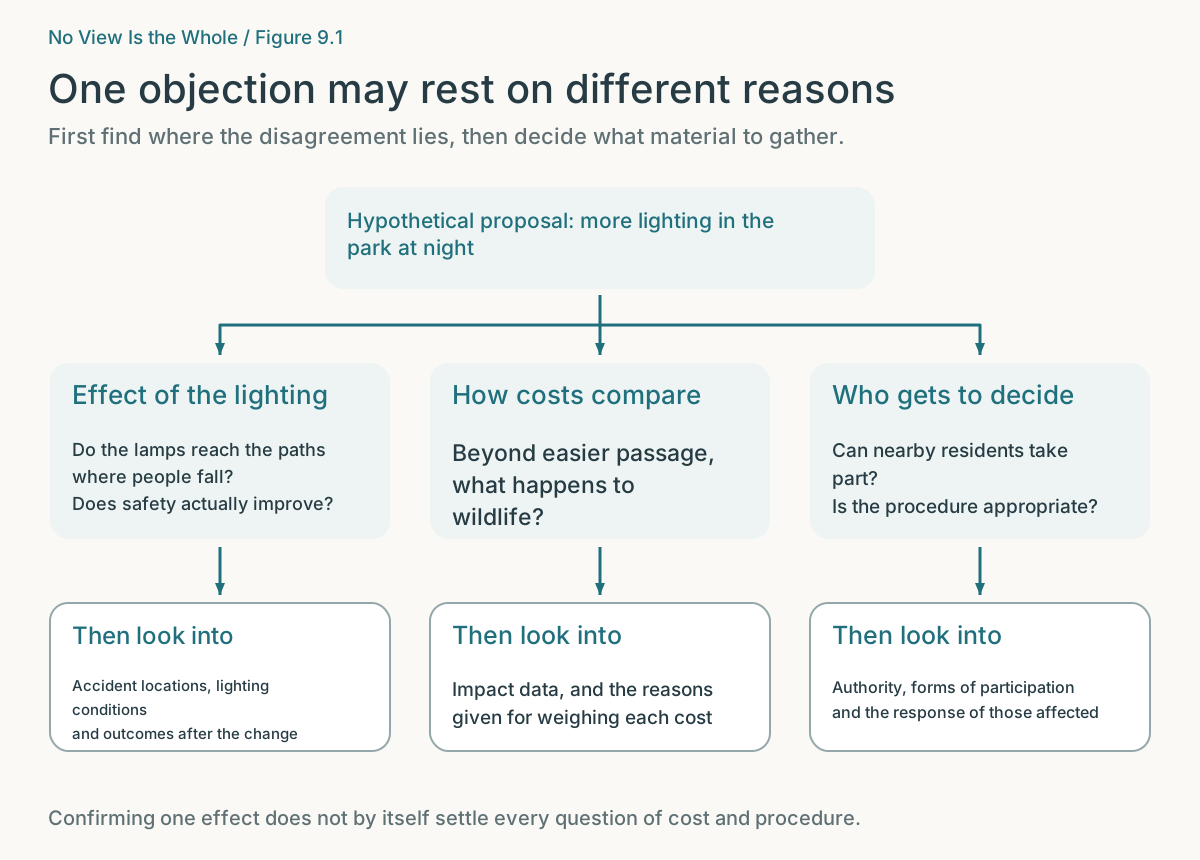
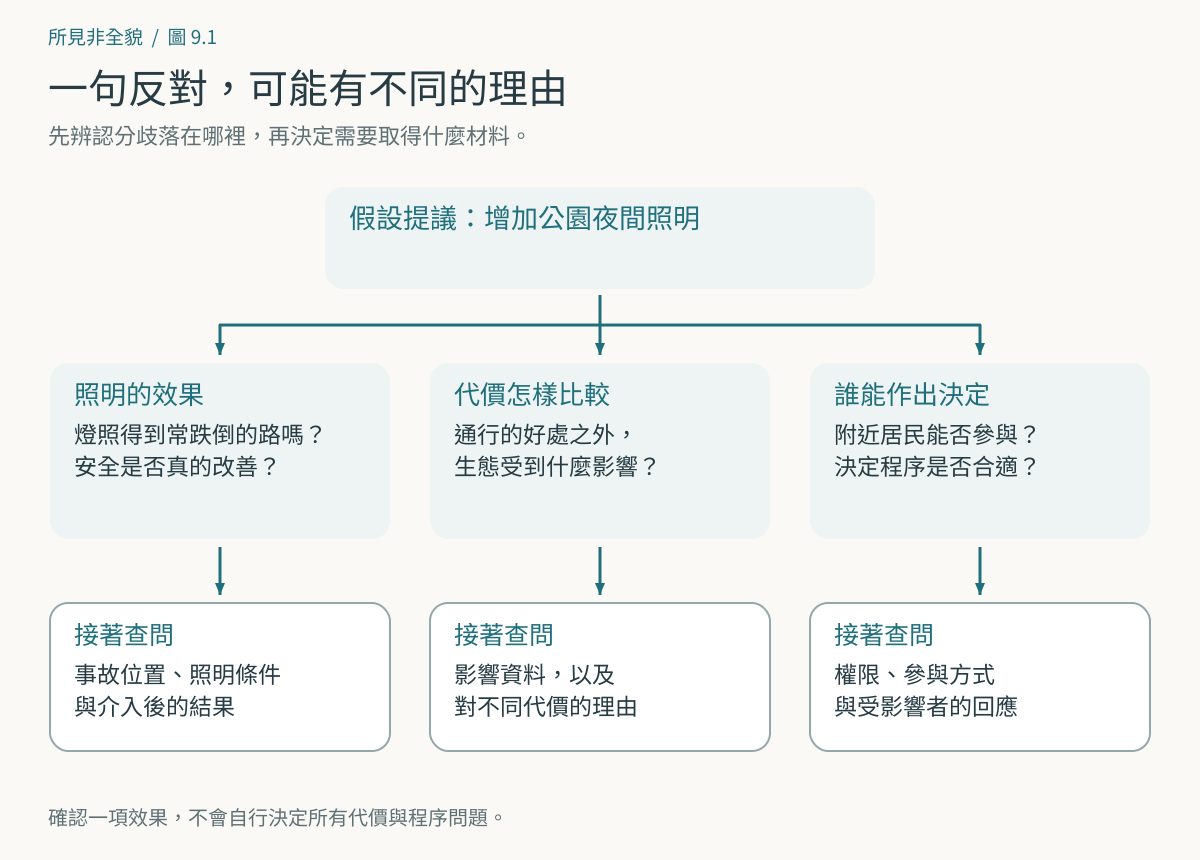
State first whatever part can be agreed
能同意哪一部分,就先說清楚哪一部分
Discussion does not necessarily reach full consensus. In the park lighting example, the parties may agree on the existing accident data, and agree that more lighting would improve one particular path, while still judging differently whether the ecological cost is acceptable. Separating what has been confirmed from what remains disputed saves the next discussion from starting over with the same batch of data.
Some shared criteria can also reach across professions. A product team wants an early launch and a safety team worries about accidents, yet both may agree that a small error which can be corrected quickly and an error which might cause irreversible harm call for different kinds of review. That agreement can become the reason for arranging a procedure, after which the two sides go on to discuss which risks belong in which class.
Shared criteria must themselves be open to checking. The two sides may still differ over what counts as "reversible", or discover that the losses borne by one group have not been counted. The differences should then be set out explicitly, rather than everyone continuing to use the same word and pretending agreement has been reached.
If rankings of value or basic beliefs cannot for now be reconciled, the disagreement itself can at least be stated clearly. One person holds that a certain loss cannot be traded away; another is willing to compensate for it with other goods. This is a different problem from misreading the data. Only by admitting that no shared criterion yet exists can the parties look for negotiation, procedure, or some other acceptable way of living alongside one another.
討論不一定會得到完整共識。在公園照明的例子裡,各方可能同意現有事故資料,也同意增加照明能改善某一條路;但對生態代價能否接受,仍有不同評價。把已確認與仍有爭議的部分分開,能避免下次討論又從同一批資料重來。
有些共同判準也可以跨越不同專業。產品團隊希望提早上市,安全團隊關心事故,兩邊或許都同意:能迅速更正的小錯,與可能造成無法挽回傷害的錯誤,需要不同審查。這份同意可以成為安排程序的理由,接著再討論哪些風險屬於哪一類。
共同判準本身也要接受檢查。雙方可能對何謂「能挽回」仍有分歧,或發現某群人承擔的損失未被計入。這時就應把差異明列,而不是繼續使用同一個詞,假裝大家已經同意。
如果價值排序或基本信念目前無法協調,也可以先說清楚分歧。有人認為某項損失不可交換,另一人願意以其他好處補償,這與資料讀錯是不同的問題。承認目前尚無共同判準,才能尋找協商、程序或其他可接受的共處方式。
The cost of changing one's mind
改變想法的代價
An idea one read about only yesterday may be easy to change; a judgement bound up with professional reputation, group belonging or years of investment may be hard to let go. When persuasion meets resistance, besides checking whether the evidence is sufficient, one can also try to understand what the change would mean for the person concerned.
He may be worried about losing the support of his peers, or afraid that admitting one mistake will wipe out everything he has worked for. Sometimes, clearly separating "this judgement needs correcting" from "this person has no competence at all" is enough to let the discussion go on. Which actions caused damage and must be answered for should still be dealt with specifically.
A distinction is also needed between a reasonable decision made on the information available at the time and a lapse in which evidence that was available then was ignored. Both may need to change when new data appears, but what has to be acknowledged and improved is different in each case.
After changing his judgement, the person still has to go back to his own community and face those who trusted him, or were hurt, because of what he used to maintain. Correcting a statement may be only the beginning of that work.
一個昨天才讀到的想法,改起來可能很容易;一項與專業聲譽、群體歸屬或多年投入相連的判斷,則可能難以放下。說服遇到阻力時,除了查證據是否充分,也可以了解改變對當事人意味著什麼。
他可能擔心失去同儕支持,或害怕承認一項錯誤後,過去全部的努力都被否定。有時,清楚分開「這個判斷需要更正」與「這個人沒有任何能力」,就能讓討論繼續。哪些行動造成損害、需要負責,仍應具體處理。
也要分辨當初依已有資訊作出的合理決定,與當時就忽略了可得證據的疏失。兩者都可能在新資料出現後需要改變,但需要承認與改進的內容不同。
改變判斷以後,當事人還要回到原來的群體,面對那些因他從前的主張而信任或受傷的人。更正一個說法,可能只是這段工作的開始。
10 — Borrowing Other People's Thinking
第十章 借用別人的思考
LeetCode is a platform for practising programming. A problem may ask for the shortest route, or for a way to find one item quickly in a large body of data. Anyone who starts practising soon meets "data structures" and "algorithms". The first studies how data should be arranged so that it is convenient to use; the second sets out the steps for getting a job done, and the reasons behind them.
The statement of a problem is short; finding a good method may have cost researchers many years. The layer-by-layer search for a path in Chapter 4 lets us lean on an existing proof to know when the search can stop, and why no shorter route has been missed. Someone who has learnt the method spends their time recognising the conditions of the problem. Someone who has never met it may be worn out simply from trying a few routes.
Trying for yourself has value. Where you get stuck, you can see what makes the problem hard, and you learn to recognise what exactly a method saves. But if never looking at existing results is taken as proof of independent thought, learning becomes a test of reinventing things. What humanity has accumulated is given no chance to work, while the individual's stamina is asked to stretch without limit.
Faced with the hard questions of life, though, we easily forget this way of learning. Should a person keep every promise? What kind of exchange is fair? If a choice benefits me, is that sufficient reason to make it? These puzzles may have landed on us only today, yet philosophers have been arguing about them for a very long time. The distinctions, counterexamples and arguments they have offered will not live our lives for us, but they can help us see where exactly we are stuck.
A programming problem usually comes with its inputs, its constraints and its test for acceptance already given. In a discussion of fairness, even the test for acceptance may be in dispute. That makes borrowing ideas a matter for more judgement. Reading an argument, you may come away with a method; you may also discover only then that the answer you had been pursuing had ruled out certain people's situations in advance.
LeetCode 是練習寫程式的平台。題目可能要求找出最短路線,或在大量資料中迅速找到某個項目。開始練習的人,很快就會接觸「資料結構」與「演算法」:前者研究資料怎樣安排才方便使用,後者整理完成工作的步驟與理由。
一道題的敘述很短,找出好方法卻可能花了研究者很多年。第四章逐層尋找通路的方法,就讓我們借助已有的證明,知道何時可以停止搜尋,以及為什麼不會漏掉更短的路。學過這個方法的人,把時間用在辨認題目的條件;沒接觸過的人,可能光是試遍幾條路線就已經筋疲力盡。
自己嘗試有價值。你能從卡住的地方看見問題的困難,學會辨認方法究竟省去了什麼。但如果把「永遠不看已有成果」當成獨立思考的證明,便會把學習變成重複發明的考驗。人類的累積無法發揮作用,個人的耐力卻被要求無限擴張。
面對生活中的難題,我們卻很容易忘記這種學習方式。人是否應該守住所有承諾?怎樣的交換才公平?一個選擇讓自己受益,是否就有充分理由去做?這些困惑可能今天才落到我們身上,哲學家卻已經爭論了很久。他們提出的區分、反例與論證,不會替我們過日子,卻能幫我們看出自己究竟卡在哪裡。
程式題通常已給定輸入、限制與驗收方式,討論公平時卻可能連驗收方式也在爭論。這使借用思想更需要判斷。讀到一段論證,可能得到辦法,也可能才發現自己一直追求的那個答案,預先排除了某些人的處境。
Darwin reads a book about population
達爾文讀到一本談人口的書
In his autobiography Charles Darwin recalled that selection in the state of nature had once puzzled him. He had already seen the power of artificial breeding, but he still needed to understand how, with no breeder doing the choosing, differences among living things could be kept.
In 1838 he read Malthus's book on population. Population can grow faster than the means of living, and that problem made him think again about the struggle for existence among animals and plants. In an environment of limited resources, would certain differences make an organism more likely to survive and reproduce, so that those differences were passed to descendants more often? The differences he had gathered over long years of observation now had an explanation that could be worked on further. He still spent many years after that arranging evidence and revising his ideas before he published On the Origin of Species.40
Darwin read with a puzzle left over from long observation, and only because of that did the relation between population and resources turn, before his eyes, into a question in biology. Another person reading the same book need not have arrived there. Making the idea stand up afterwards meant going back to the evidence on species, variation and reproduction. The borrowing happened in this movement back and forth. As for how people should treat the weak, or how a struggle for existence should be conducted, none of this decided that for us.
When we read works of philosophy, we too can choose with a question in hand. You may accept a distinction an author draws about "freedom" while disagreeing with the policy he builds on it. To explain which step you have adopted, and why, you do not first have to become a disciple of some school.
But how does a book hand this ability to its readers? Darwin could say that his reading gave him inspiration. For those who come after, what is more useful is to see how he applied the relation between population and resources to variation among living things, and then to keep checking along that same step.
達爾文在自傳裡回想,自然狀態下的選擇曾讓他困惑。他已看見人工選育的力量,卻還需要理解:沒有飼育者挑選,生物的差異如何被留下?
一八三八年,他讀到馬爾薩斯談人口的書。人口可能增長得比生活資源更快,這個問題使他重新思考動植物之間的生存競爭:在資源有限的環境裡,某些差異是否會使生物更容易存活、繁殖,從而使那些差異更常留到後代?他長期觀察所得的差異,於是有了可以繼續研究的解釋。此後他仍花了多年整理證據、修正想法,才出版《物種起源》。40
達爾文帶著長期觀察留下的困惑閱讀,人口與資源的關係才會在他眼前變成一個生物學問題。另一個人讀同一本書,未必走到這裡。後來要使這個想法站得住腳,又得回到物種、差異與繁殖的證據。借用發生在這一來一往之中。至於人應怎樣對待弱者,生存競爭如何發生,並沒有替我們決定。
讀哲學作品時,我們也可以帶著問題選擇。你可能接受某位作者對「自由」的一個區分,卻不同意他據此提出的政策。要說明自己採用了哪一步、為什麼採用,不需要先成為某個學派的信徒。
但一本書怎樣把這種能力交給讀者?達爾文可以說自己從閱讀得到了啟發。對後來的人,更有用的是看見他怎樣把人口與資源的關係用到生物的差異,再沿著那一步繼續查。
Leaving the reasons for the next person
把理由留給下一個人
Start with a very small example. Why is the sum of two even numbers still even?
You can try four plus six, eight plus twelve, and a few more pairs. To hand the discovery to someone else, though, there is another way of writing it. An even number can be split into two equal whole-number parts. Halve each of two even numbers and put one half from each together; the sum can still be divided into two equal whole-number parts. In symbols, write the two even numbers as 2a and 2b; adding them gives 2(a + b), where a and b are both integers.
The proof about even numbers does not record every detour the discoverer took. It leaves out the mood of the moment and the order of the trial sums, and keeps the relation that is enough for a stranger to redo it. This omission has a power of its own. A reader can point out that "any integer" cannot be substituted for "even number", without first having to judge whether the author, as a whole person, deserves trust.
This is one point on which I set particular store by stated reasons. They make it possible for different people to meet at the same place and to disagree over the same definition, the same step of inference; corrections can therefore pass into the hands of people the original author never knew. When one person works something out once, the benefit need not stop with that person.
To achieve this, the discoverer has to spend more effort, not less. Writing down what you grasp at a glance is often more trouble than simply going on using it. The ease the reader receives contains the work an earlier person did for the sake of passing it on.
Some abilities are handed down mainly through demonstration and practice. In learning to knead dough, knowing that it should be "kneaded to the right degree" is not enough; the learner needs to touch different doughs, try the movements, and then ask someone skilled to point out the differences. Learning to recognise an abnormal noise in a machine likewise takes repeated listening to normal and abnormal examples, checking one's judgement each time. Words can remind us to attend to the spring of the dough or to a particular stretch of sound; the actual feel, the discrimination by ear and the movements still have to be practised.
Sometimes the words stop right there, at "springs back to about this degree". After that, teacher and student have to touch the same piece of dough together. The inference that can be written, the difference that can be pointed to and the movement practised by hand may only together make up the ability the newcomer actually learns.
先看一個很小的例子:兩個偶數相加,為什麼還是偶數?
你可以試四加六、八加十二,再多試幾組。要把這個發現交給別人,卻還有另一種寫法。偶數能分成兩份一樣多的整數;兩個偶數各自分半之後,把各自的一半合在一起,總和仍能分成兩份一樣多的整數。用符號寫,就是把兩個偶數記成 2a 與 2b,相加得到 2(a+b),其中 a、b 都是整數。
偶數的證明沒有記下發現者走過的全部彎路。它省下當時的心情、試算的順序,留下足以讓陌生人重做的關係。這種省略有了力量:讀者可以指出「任意整數」不能替換「偶數」,不必先判定作者整個人值不值得信任。
這是我特別重視明說理由的一點。它使不同的人有可能在同一處相遇,針對同一個定義、同一步推論發生分歧;修正也因此可以傳到原作者不認識的人手中。個人想通一次,未必只對個人有用。
要做到這件事,發現者反而得多花工夫。把自己一眼就看懂的地方寫出來,常比繼續用它還麻煩。讀者得到的容易,包含了前人替傳遞做的工作。
有些能力主要靠示範與練習傳下來。學揉麵時,光知道「揉到適當程度」還不夠;學習者需要摸到不同麵團,試著操作,再請熟練者指出差別。學辨認機器的異常聲音,也需要反覆聽正常與異常的例子,核對判斷。文字能提醒我們注意回彈或某段聲音,實際的觸感、聽辨和動作仍須練習。
文字有時就停在「回彈到這種程度」這裡。接下來,老師和學生要一起碰到那塊麵團。寫得出的推論、指得出的差別與親手練出的動作,可能合起來才是後來者真正學會的能力。
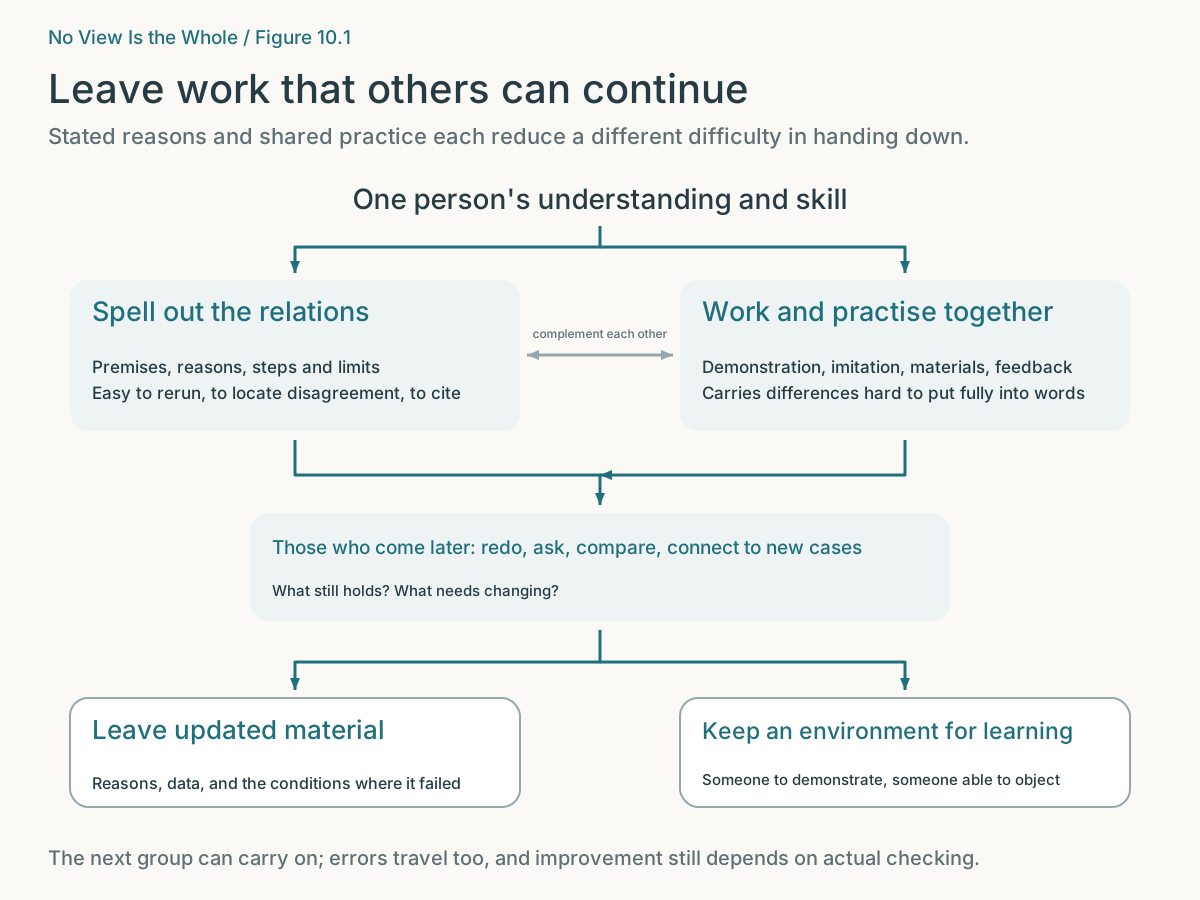
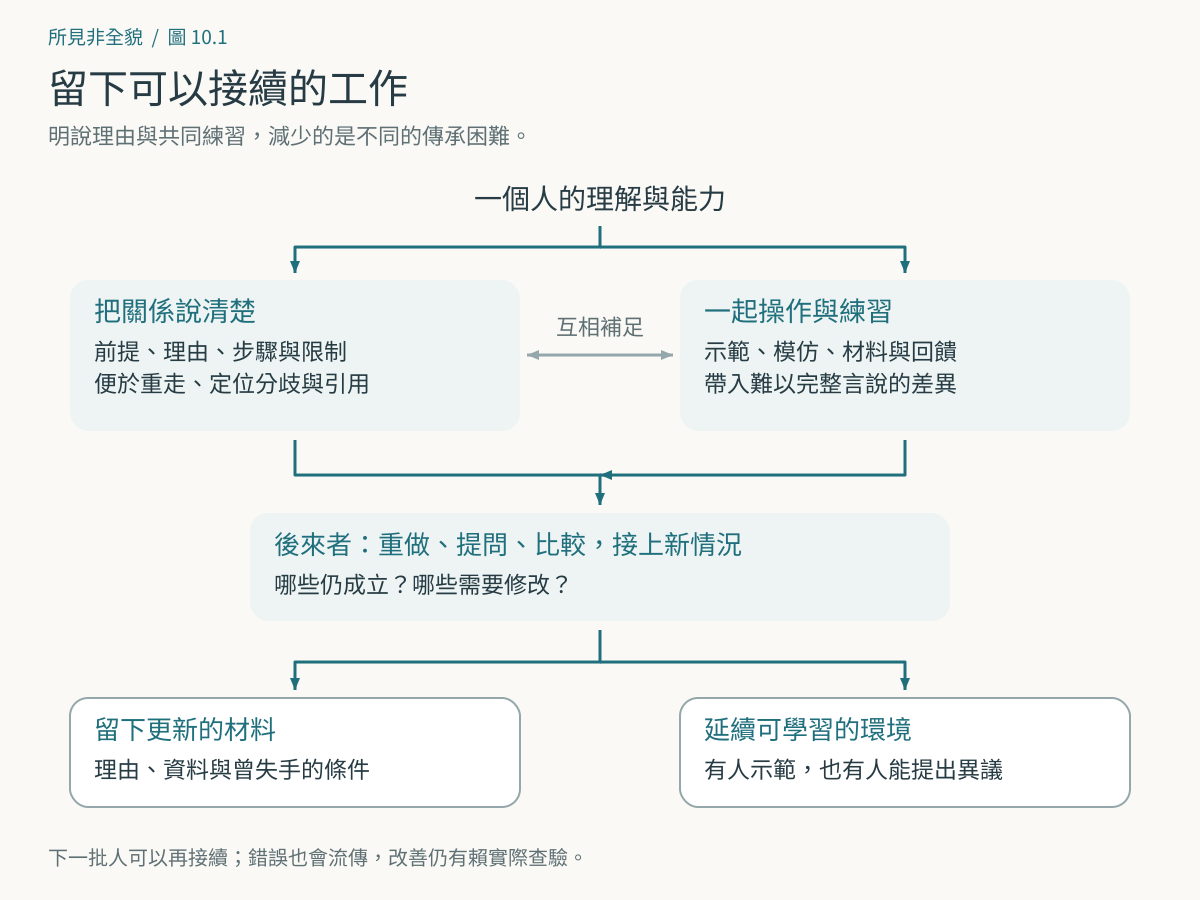
Mathematicians have carried this work of passing on further still, to the point where a machine can take part in the checking.
There is a kind of work in mathematics that sets out its reasons with unusual care. Lean is a tool for expressing definitions, propositions and proofs. People write what is to be proved in a precise form and then supply a proof; the system checks, by its logical rules, whether that proof supports the proposition as written.41
Where a proof on paper would say "from which it follows", a reader can perhaps fill the gap alone. Handed to a tool of this kind, the omitted steps must be capable of being filled in as a checkable proof. The system can help complete some of the details, but whether the definitions are well chosen, and how existing results are joined up, may still take a great deal of work.
The even-number example above is short, and formalising it seems more trouble than simply seeing it. Once proofs grow long and the theorems they cite multiply, this checking becomes more helpful. A later worker can confirm which proposition they are citing and which premises it needs, then use it in a new proof. Nobody has to guess afresh, at every citation, which step the original author left out.
What Lean checks is whether, under the logic and axioms adopted, the proof given derives the proposition written down. That result still depends on the checking tool working correctly; whether the proposition is fit to answer a real question needs a separate check. If a model for studying a bridge left out an important loading condition, a proof inside the model, even one that passes the check, says nothing about how the real bridge would behave under that condition. The question from Chapter 5 sits right here: what was left out when the model was built, and does a later use happen to need exactly that?
數學家把這份傳遞工作繼續往前做,甚至可以讓機器參與檢查。
數學裡有一種把理由交代得格外仔細的工作。Lean 是用來表達定義、命題與證明的工具。人們把要證明的事情寫成精確的形式,再提供證明;系統則依其邏輯規則檢查,這份證明是否支持所寫下的命題。41
平常在紙上寫「由此可知」的地方,讀者或許能自行補完;交給這類工具,就得讓省略的步驟有辦法被補成可檢查的證明。系統可以協助完成一些細節,但定義選得合不合適、已有成果怎樣相接,仍可能需要相當多工作。
前面的偶數例子很短,形式化似乎比直接看懂更麻煩。證明變長、需要引用的定理變多以後,這種檢查就更有幫助。後來者可以確認自己引用的是哪個命題、它需要哪些前提,再把它用於新的證明。大家不必在每次引用時,重新猜原作者省略了哪一步。
Lean 檢查的是:依照所採用的邏輯與公理,給出的證明能否推出寫下來的命題。這個結果仍依賴檢查工具的正確運作;命題是否適合拿來回答現實問題,則需要另外查驗。假如研究橋梁的模型漏掉了重要的受力條件,模型內的證明即使通過檢查,也沒有說明真實橋梁在那種條件下會如何。第五章談的問題就在這裡:建模時省去了什麼,後來的用途是否恰好需要它?
Working a problem through once, properly
把一個問題真正做一遍
To ask whether a job is meaningful may be to ask about income, contribution, autonomy, the growth of a craft or a sense of identity; looking up satisfaction ratings for various job titles may not reach the thing you care about. The hard questions of life rarely run, as the even numbers do, from a clear definition straight through to the end of a proof. Borrowing the thinking of those before us can still begin by redoing a stretch of reasoning. Here is a hypothetical problem. You have promised to help a friend finish a piece of work, and circumstances have since changed. You hold that "having promised, you absolutely must not withdraw", but carrying on would impose a clear burden. How should this principle be understood?
"Having promised, you must not withdraw" may express several different demands: no withdrawal under any circumstances; promises should normally be kept, but a major upheaval allows an exception; or the arrangement may be changed, provided you deal with the preparations the other person made on the strength of your promise. The original sentence does not separate these meanings, so the first question is which one you actually agree with.
Put the strongest version in a hard place first. If what was promised would itself harm someone, is there still a duty to perform it? If a major change arises that could not reasonably have been foreseen at the time, can the responsibility not shift at all? These counterexamples force the principle to narrow, while the weight of everyday promises still has to be explained separately.
Why a promise carries weight can be seen in the other person's arrangements. Because you agreed, he may have turned down other help, set time aside or entrusted important work to you. Withdrawing now would cost him the options he once had, perhaps leaving no time to find a substitute. These consequences supply reasons to perform, to give early notice or to help repair the damage.
In this way, permission to withdraw and continuing responsibility can both hold at once. A major change may be enough to alter the original arrangement, but early notice, an honest account and whatever remedy lies within your power may still be required. After the principle and the case have been checked against each other, what emerges is a finer judgement: the promise keeps supplying reasons, and the weight of those reasons depends on what was promised, on what has changed and on the reliance that has already formed.
Only when conceptual analysis has come this far does the practical enquiry have a direction. What exactly was promised at the time? What arrangements has the other person already made? How heavy is the new burden? Could a different form of help be offered? These facts have to be obtained from the real relationship; thinking the principle through a little further cannot answer them in its place.
Where there were once only two options, grinding on or breaking faith, there are now arrangements that can be discussed with the friend: narrowing the scope of the help, moving the deadline, finding a replacement, or bearing a reasonable remedy after withdrawing. The friend may accept, or may point out that none of these makes good the loss. The analysis gives the conversation a clearer starting point; it has not agreed anything on the friend's behalf.
The analysis above drew on conceptual clarification, counterexamples, the pressing of reasons, and the checking of a general principle against a particular case and back again. All of these are philosophical work that can be read about further, practised and criticised.
From there you can go deeper, choosing works according to the difficulty you have met. Peirce, in "The Fixation of Belief", discusses how people settle their beliefs, and asks which ways of enquiring allow experience to revise what we originally thought. Dewey's How We Think starts from concrete perplexities and discusses how people propose possible explanations and then check them.4243 The analysis of the promise above can go on borrowing tools from studies of conceptual clarification, of counterexamples, and of checking general principles and particular cases against each other.
What reading yields can be quite concrete. Two meanings that were once run together can now be kept apart; where there was once a single explanation, you now know there are rival explanations that can be checked. Each work makes broader claims of its own, and learning one of its methods is only a beginning. Redoing one of the author's inferences with an example of your own, then changing the conditions to see whether it still holds, will help more than remembering the name of a school.
The practice should not end the moment a satisfying answer arrives. Change the situation and see what the method just used can do. Conceptual clarification can let people state their disagreement; it may not make them value the same thing. Weighing consequences can supply important information; it does not automatically turn rights and promises into figures that cancel one another out.
"Every voluntary exchange is fair" can be tried the same way. If one party's alternatives have been deliberately destroyed by the other, is the consent that remains still enough to make the exchange fair? Pressing this one step shows which situations "voluntary" had been leaving out all along. Whether you are willing to revise the principle in those situations is what gives the counterexample its force.
Still, learning to redo this stretch of analysis is not yet the same as being able to read every argument that has come down to us. The promise just now was a hypothetical we had taken care to spell out; with an old piece of writing, what the author was answering at the time may not be written on that page at all.
問一份工作有沒有意義,可能在問收入、貢獻、自主、技藝成長或認同;先查各種職稱的滿意度,未必查到自己在意的事。生活中的難題很少能像偶數那樣,從明確定義一路證明到底。借用前人的思考,仍可以從重做一段推理開始。以下是一個假設問題:你已答應協助朋友完成某項工作,後來情況改變。你認為「既然答應了,就絕對不能退出」,但繼續承擔會造成明顯負擔。這句原則應該怎樣理解?
「答應了就不能退出」可能表達幾種不同要求:任何情況都不准退出;承諾通常應履行,但重大變故容許例外;或是允許修改安排,同時必須處理對方因你的承諾而作出的準備。原句沒有分清這些意思,所以需要先問,自己究竟同意哪一種。
先把最強的版本放到難處。承諾的內容若本來就傷害他人,還有履行的義務嗎?出現當時無法合理預見的重大變化,責任是否一點也不能改?這些反例會逼原則收窄,日常承諾的分量則仍須另外說明。
承諾為什麼有分量,可以從對方的安排看出來。他可能因為你答應了,拒絕其他協助、挪出時間,或把重要工作交給你。現在退出,會使他失去原先可以選擇的機會,甚至來不及尋找替代。這些後果提供了履行、及早通知或協助補救的理由。
如此一來,允許退出與仍有責任便可以同時成立。重大變化或許足以修改原安排,但提早通知、誠實說明,以及能力所及的補救,仍然可能必要。原則與個案互相校對之後,得到的是一項更細的判斷:承諾持續提供理由,理由的分量還要看承諾內容、新變化與已形成的依賴。
概念分析走到這裡,實際查問才有了方向。當初究竟答應什麼?對方已作了哪些安排?新的負擔有多大?能否換一種協助?這些事實要從真實關係取得,光靠把原則再想透一點,無法代為回答。
原先只有硬撐或失信兩個選項,現在多了可以與朋友討論的安排:縮小協助範圍、改變期限、尋找接替者,或者承擔退出後合理的補救。朋友可能接受,也可能指出這些安排仍無法彌補損失。分析讓這場談話有了更清楚的起點,沒有先替對方答應。
前面的分析借助了概念澄清、反例、理由追問,以及一般原則與個案的往返校對。這些都是可以進一步閱讀、練習與批評的哲學工作。
接下來可以按自己遇到的困難,找作品讀得更深入。皮爾士在〈信念的確立〉中討論人如何固定信念,追問哪些探究方式容許經驗修正我們原先的看法。杜威的《我們如何思考》則從具體疑難出發,討論人如何提出可能解釋並加以查驗。4243前面的承諾分析,也可以繼續向概念澄清、反例與一般原則和個案相互校對的研究借助工具。
閱讀的收穫可以很具體:原先把兩個意思混成一個,現在分得開;原先只有一種解釋,現在知道還有可查的競爭解釋。不同作品各有更廣的主張,學會其中一個方法,只是開始。試著用自己的例子重做作者的一次推理,再改變條件,看看它還能不能成立,會比只記住學派名稱更有幫助。
練習不宜到得到一個滿意答案就結束。把情況改掉,再看剛才的方法做得到什麼:概念澄清能使人說明分歧,未必能使他們重視同一件事;考慮後果能補上重要資訊,也沒有自動把權利與承諾換成可互相抵銷的數字。
「凡是自願的交換都公平」也可以拿來這樣試。若一個人的替代選項被另一方刻意破壞,剩下的同意是否仍足以使交換公平?追問這一步,就能看出「自願」原來省去了哪些處境。自己是否願意在這些情況下修改原則,才讓反例有了作用。
然而,學會重做眼前這段分析,還不等於能讀懂所有留下來的論證。剛才的承諾是我們特地交代過的假設;換成一段舊文字,作者當時在回答什麼,可能根本沒有寫在那一頁上。
Understanding a sentence means finding its question again
讀懂一句話,還要找回它的問題
An instruction says only "handle this as soon as possible". Every word is familiar, yet the task has not necessarily been made clear. Does it mean a reply before the end of the day, or dropping whatever is in hand at once? Does handling it mean acknowledging receipt, proposing a plan, or finishing the whole job? Are there checks that must not be skipped for the sake of speed?
The person who wrote it may have assumed that, since the two of them had just come out of a meeting, none of that background needed saying. Whoever takes over later has only those few words, and has to recover the question and the constraints that go with them. Understanding a text sometimes needs exactly this work: setting your own everyday usage aside for a moment and asking what the other person was responding to at the time.
The reader here needs a capacity for understanding other people: to find out what the other person knew at the time, what choices were open to them and which question they were answering, and then to try to reconstruct how they reached their conclusion. This is one layer of what "empathy" can include. Understanding an argument does not necessarily require sharing the author's emotions, but it does require not treating outcomes you know about afterwards as things the author already knew.
In their study of communication, Clark and Brennan stress that common ground has to be built and updated within the interaction. Partners in a conversation gather evidence of how far they understand each other through responses, acknowledgements and repairs.44 Written material can also supply examples, definitions and context in advance; when the author is absent, the gaps may have to be filled by the reader's other reading, hands-on work and discussion.
How much background needs filling in depends on how the material was written. A carefully laid-out textbook may be easier to understand than a hurried spoken explanation; the advantage of talking face to face is that you can ask at once. Whether communication has been adequate is judged by whether the receiver can find the necessary information and confirm that they have understood correctly.
一份指示只寫「盡快處理」。字都認識,工作卻未必已經交代清楚。是今天結束前回覆,還是必須立刻打斷手上的事?處理是先確認收到、提出方案,還是完成整項工作?有沒有不能為了搶快而略過的查核?
說話的人可能以為,彼此剛開過會,這些背景不用再說。後來接手的人只有那四個字,就得找回相應的問題與限制。讀懂文字,需要的有時正是這種工作:暫時把自己的日常用法放在旁邊,追問對方當時在回應什麼。
讀者在這裡需要一種理解他人的能力:查明對方當時知道什麼、能選擇什麼,以及正在回答哪個問題,再嘗試還原他如何得到結論。這也是「同理」可以包含的一層意思。讀懂一段論證,未必需要有和作者相同的情緒,卻需要避免把自己知道的後來結果,當成作者當時也已知道的事。
克拉克與布倫南研究溝通時,強調共同背景需要在互動中建立與更新。對話者會透過回應、確認及修補,取得對彼此理解程度的證據。44書面材料也能預先提供例子、定義與上下文;作者未在場時,缺口則可能需要由讀者的其他閱讀、操作與討論補上。
需要補多少背景,取決於材料怎麼寫。一份交代仔細的教材,可能比一段匆忙的口頭說明更容易理解;當面討論的好處,則是可以立刻追問。評估溝通是否充分,要看收訊的人能否找出必要資訊,並確認自己是否理解正確。
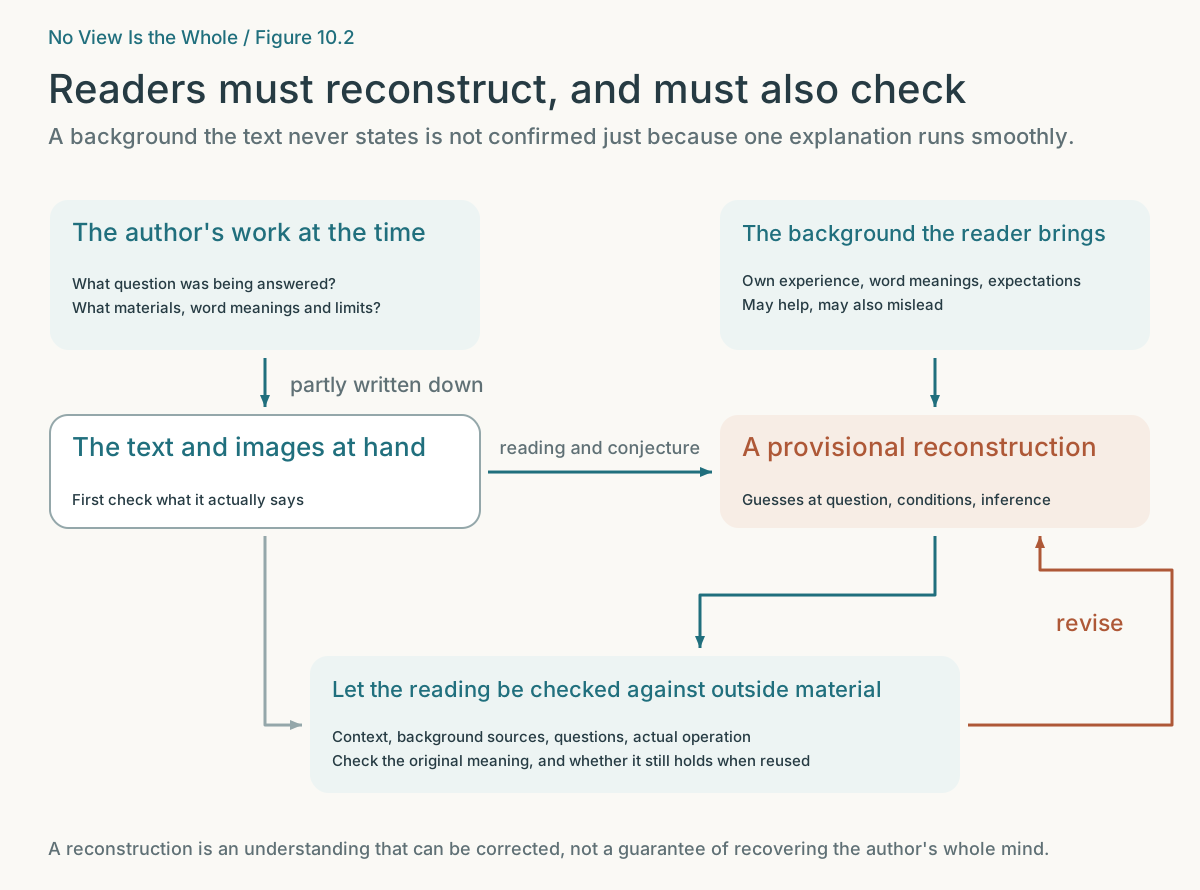
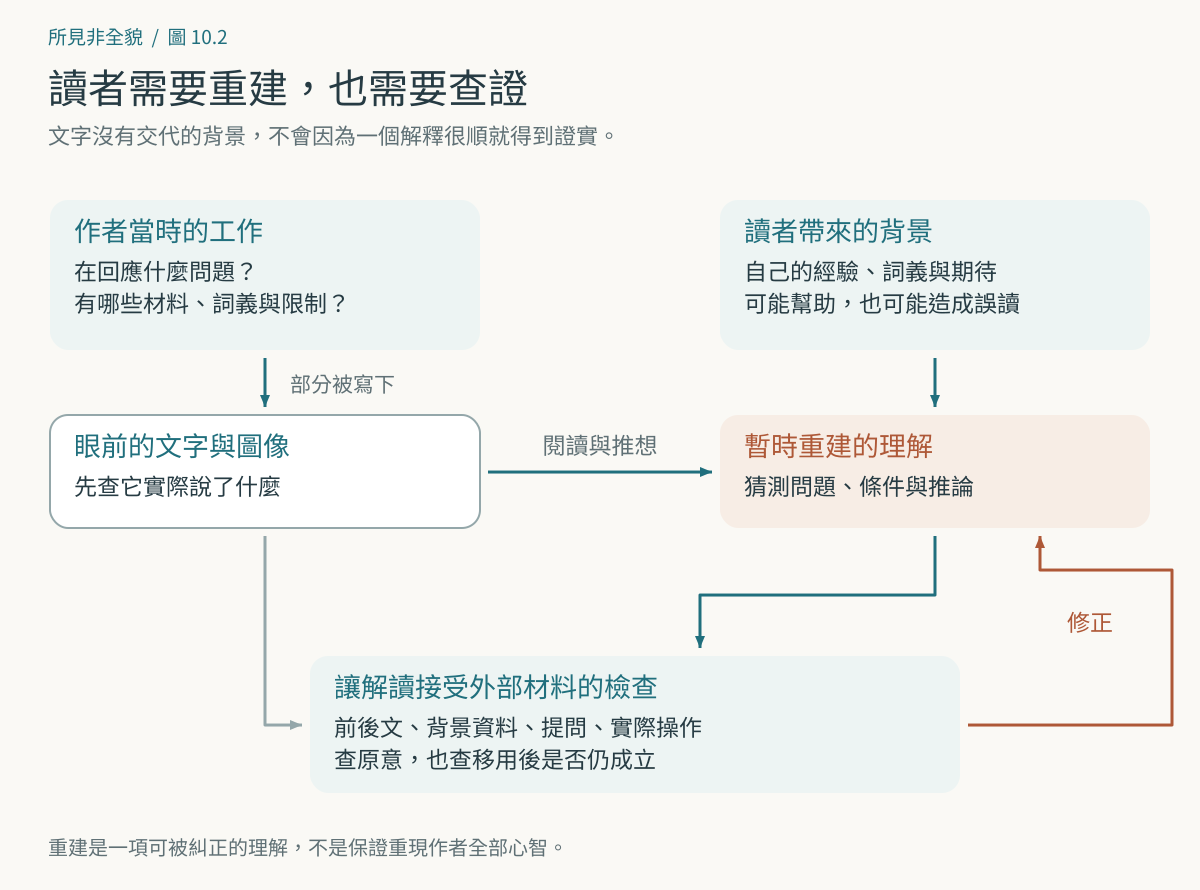
Reconstruction also has a trap that is easily overlooked. The smoother the explanation, the more likely we are to forget that it is still a guess.
In a series of studies, Eyal, Steffel and Epley compared imagining another person's perspective with actually obtaining information from that person. In the judgement tasks the studies set up, asking participants to put themselves in the other's shoes did not consistently improve the accuracy of their judgements about what others thought and felt; the condition in which perspectives were obtained through conversation did improve understanding.45 Imagining a few more details and knowing more about the other person's actual situation do not have the same effect.
Back to "handle this as soon as possible". We can propose several readings first, then look at the minutes of the meeting or simply confirm the deadline. With an old book, what can be checked is the surrounding text, the same author's usage elsewhere, the materials of the period and other scholarship. Different objects call for different checks; only by giving your reconstruction a chance to be corrected do you avoid merely writing another handsome story on the other person's behalf.
Stretch the distance to several hundred or several thousand years, and restoring the background takes far more work. Being able to read the symbols is a very small part of it.
The Yijing, the Book of Changes, is a body of texts that has passed through long handing down and interpretation. Each of the sixty-four hexagrams is made of six lines, and each line can take one of two forms, yin or yang; the hexagram statement is a written account of the hexagram as a whole, while line statements are attached beneath each line. Later interpretation gave further meanings to the hexagram images, the positions of the lines and the words. Knowing how six lines combine is only the starting point for reading the figures; the reader also needs to know how a particular interpreter used them to judge a situation.
The core hexagram and line statements, and the writings later called the Yizhuan, the Commentaries on the Changes, or the Ten Wings, took shape in different periods and passed through long use in divination and long interpretation. The dating of the texts and the manner of their formation are still under scholarly discussion.46 In reading, therefore, one needs to be clear which layer of text one is reading, and from which period, and which interpreter, a claim comes.
On a first reading, you can learn one interpretation that has textual grounding, then compare it with other readings. On what kinds of question is the same hexagram cited? Which hexagram or line statement do the reasons come from? What assumptions has the interpreter added? Doing this lets you check whether you have understood. Whether divination has any predictive power is a separate matter; it needs evidence that can tell successful predictions from failed ones, and familiarity with the text cannot stand in as proof.
Sometimes a reader who already has a mature method of their own meets an old set of figures and finds a new correspondence. Leibniz was a reader of that kind.
After developing binary arithmetic, Leibniz corresponded with Joachim Bouvet, a Jesuit in Beijing. The hexagram diagrams Bouvet sent him showed him a very attractive correspondence: match the two kinds of line to 0 and 1, and under a suitable arrangement and way of reading, the six-line combinations can correspond to six-digit binary numbers. Leibniz's paper on binary of 1703 discussed these Chinese figures.47
This mathematical correspondence can be checked directly: two choices at each position, six positions, sixty-four combinations in all. Leibniz had found a way of understanding the hexagram diagrams through his own mathematics. The arrangement he saw, however, belonged to the tradition of Shao Yong in the Song dynasty; how ancient users understood those figures still has to be explained from the texts of their own time and other historical sources.
Two different results appear here. A new correspondence may help mathematical thinking; to claim that the arithmetical knowledge of the ancients has been recovered, historical evidence must be produced. Success in the first does not automatically accomplish the second. Even once the rules of the symbols are clear, there remains a great deal to learn about how their users understood them in ritual, in community and in daily life.
Someone reading the Yijing today may also want to borrow it for a problem in front of them. That requires setting out one's own usage, so that others know what we are actually proposing.
In borrowing yin and yang, this book adopts a contemporary usage of very small scope: when faced with a one-sided judgement, first look for the complementary conditions, costs, counterweights and changes it has overlooked. This is an exercise in asking questions, and no generalisation about every ancient use of yin and yang.
Suppose a project has gone a long time without results, and "we should continue" and "we should give up" seem to leave room for only one answer. One can first find out what abilities and data have actually accumulated over that time, then reckon which options the investment has crowded out and which resources are near their limit. With that information, it becomes possible to compare whether to try once more, to change approach, or to end the project.
If, after swapping in a new set of words, we still know only that we want to continue, and have found no new reason and no checkable difference, the borrowing has not helped. Whether a method is useful depends on what more it made us see and check; the ancient name cannot vouch for it by itself.
重建也有一個很容易被忽略的陷阱:解釋越順,我們越可能忘了它仍是一個猜測。
艾亞爾、史蒂弗爾與艾普利在一系列研究中,比較了想像他人視角與實際取得他人資訊。在研究安排的判斷任務裡,要求參與者設身處地想像,沒有一致地提高其判斷他人想法與感受的準確度;其中透過對話取得觀點的安排,則改善了理解。45多想像了一些細節,和知道了更多對方的實際情況,效果並不相同。
回到「盡快處理」,我們可以先提出幾種解讀,再查會議紀錄或直接確認期限。閱讀舊書時,能查的是前後文、同一作者的用語、當時的材料與其他研究。對象不同,查法不同;讓自己的重建有機會被糾正,才不會只是替對方寫出另一篇漂亮故事。
距離拉到幾百年、幾千年,補回背景就更費工夫。符號看得懂,是其中很小的一部分。
《易經》是一組經過長時間傳承與解釋的文本。六十四卦的每一卦由六爻構成,爻可以用陰、陽兩種形式表示;卦辭是對整卦的文字說明,爻辭則附在各爻之下。後來的解釋又賦予卦象、爻位與文字不同意義。懂得六條線如何組合,只是讀圖的起點;讀者還需要知道某位解釋者如何把它們用於判斷一個處境。
核心卦爻辭與後來稱為「易傳」或「十翼」的文獻,在不同時期形成,也經歷了長期的占筮使用與詮釋。文本的年代和形成方式仍有學術討論。46因此,閱讀時需要分清正在讀的是哪一層文本,以及哪個時期、哪位解釋者的主張。
初讀時,可以先學一種有文本根據的解釋,再比較其他讀法:同一卦在什麼問題上被引用?理由來自哪句卦爻辭?解釋者又增加了哪些假設?這樣做能檢查自己是否讀懂。至於占筮是否具有預測能力,則需要能區分預測成功與失敗的證據,不能由熟悉文本代為證明。
有時,一位讀者已經有自己的成熟方法,遇見舊圖形時便會找到新的對應。萊布尼茲就是這樣的一位讀者。
萊布尼茲發展二進位算術之後,與在北京的耶穌會士白晉通信。白晉寄來的卦圖,使他看見一個很有吸引力的對應:以兩種爻對應 0 與 1,在合適的排列與讀法下,六爻組合可以對應六位的二進位數。萊布尼茲一七〇三年的二進位論文討論了這些中國圖形。47
這個數學對應可以直接檢查:每個位置有兩種選擇,六個位置共有六十四種組合。萊布尼茲由此找到一種用自己的數學理解卦圖的方式。然而,他所見的排列與宋代邵雍傳統有關;古代使用者怎樣理解那些圖形,還需要當時的文本與其他史料來說明。
這裡出現兩個不同的成果。新的對應可能幫助數學思考;若要聲稱已還原古人的算術知識,則必須提出歷史證據。前一項成功不會自動完成後一項。就算符號規則已經清楚,使用者在儀式、社群與日常生活中如何理解它,也仍有許多事情要學。
今天讀《易經》的人,也可能想借它處理眼前的問題。這就需要把自己的用法交代出來,讓別人知道我們正在提出什麼。
借用陰陽時,本書採取一個範圍很小的當代用法:遇到單面的判斷,先找出它忽略的互補條件、代價、制衡與轉變。這是一種提問練習,並非對古代所有陰陽用法的概括。
假設一個計畫遲遲沒有成果,「應該繼續」和「應該放棄」看來只容得下一個答案。可以先查這段時間究竟累積了什麼能力與資料,再算投入排擠了哪些選項,哪些資源已接近限度。有了這些資訊,才比較得出是應再試一次、改變做法,還是結束計畫。
若換了一批詞以後,我們依然只知道自己想繼續,沒有找出任何新的理由或可查證的差別,這次借用就沒有幫上忙。方法有沒有用,要看它使我們多看見、多檢查了什麼,古老的名稱本身無法作保。
The past a file name carries
一個檔名帶著的過去
"CON" is only three letters, yet under the file-naming rules commonly used in Windows it is no ordinary name. Along with PRN, NUL and others, it is reserved for devices; simply adding an extension does not necessarily turn it back into an ordinary file.
Raymond Chen, an engineer at Microsoft, has traced what such names were used for in the DOS era. Tools could handle devices in much the way they handled files, and the special status of the names had to survive conventions such as programs adding an extension automatically. By the time the system acquired fuller support for paths and directories, the expectations early programs had about names still had to be respected.48
To know which operation is restricted today, one still has to look up the rules for the interface, namespace and version in use. The history of how it took shape explains which dependencies to check; only the current documentation and actual testing tell us how the operation in front of us will run.
The use behind the name is on record and can be checked. Other origin stories that sound reasonable do not necessarily have the same footing. The keyboard we use every day is one example.
Why does the first row of the keyboard begin QWERTY? The common answer is that early typewriters, to stop the type bars jamming, deliberately made people type a little slower. The story is easy to remember, and it makes it easy to believe that today's familiar layout came from a constraint that has since disappeared.
Koichi Yasuoka and Motoko Yasuoka, who have studied the early sources, have cast doubt on this popular version. Tracing the changes in the keyboard layout and the demands made by its early users, they argue that the problems telegraph operators met in transcribing Morse code provide an important clue to understanding how the layout changed.49 This is an explanation argued from historical sources, and it has not settled every detail of how the layout formed.
The keyboard story can therefore also be used to check how we accept explanations. "To avoid jamming, so they slowed typing deliberately" joins purpose, method and result very smoothly; to confirm that this really was the design reason at the time, one still has to find evidence of decisions and modifications. Having found another, more attractive version, one owes it the same check.
Once the sources are in hand, one still has to trace how that choice was carried forward afterwards. An arrangement that saved effort at the time may run into new difficulties only after a great many people have come to depend on it.
In some early computer systems, only the last two digits of the year were stored, so 1999 was written 99. Two characters fewer per record had real value where storage was expensive and data piled up in volume. The cost was left to later users: when 2000 arrived, should 00 be read as 1900 or as 2000?
If a system used the year to order events, or to calculate ages, interest or terms, the difference of a century amounted to far more than two missing characters on a screen. How the data were encoded, how the programs computed, and what assumptions the systems exchanging data with one another had made all needed to be checked.
In the late 1990s, governments and businesses invested heavily in inventories, patches, testing and contingency preparations. After the turn of the year, the large-scale disasters that had been anticipated did not generally occur.50 Assessing whether the preparations were worth it requires finding out which faults were actually discovered, which fixes removed risk, and whether the spending was proportionate. Looking only at the fact that the new year passed largely without incident tells us neither what would have happened without the fixes nor which measures had what effect.
What the two-digit year left behind was a choice that was once understandable, and a dependency that lived longer than expected. Tracing the history of how it took shape lets us know which places to check; it does not require us to keep things as they were for ever because there was once a reason.
A rule that is hard to understand may once have solved a problem that no longer exists. That is a hypothesis worth checking; it is not yet the rule's history.
If we ask only "what reason would lead a reasonable person to do this", it is easy to invent a plausible origin for whatever exists. The actual cause may equally have been an oversight, an imbalance of power, an accident carried forward, or several mutually incompatible modifications. To tell these possibilities apart, historical research needs the material that has survived; it cannot rely on how smoothly an explanation sounds.
An old comment in the code may preserve the original reason, or it may be out of date. How the program works today still has to be confirmed from current documentation and tests. Even when the original reason has gone, later programs may have formed new dependencies, and the consequences of removing a restriction have to be traced separately.
A rule may persist because its function is still there, or because of the cost of replacing it, vested interests, or the fact that nobody ever had the authority to change it. Tracing the past can separate these possibilities more clearly; deciding whether to keep the rule today still means weighing the evidence and costs in front of us.
A bridge lets us separate two kinds of question. Why the designers chose a particular safety factor, and why the code demands a particular test, are questions for the design goals, the known risks and the technical conditions of the time. How the bridge will deform or fail under a specific load is a question for mechanical analysis and the relevant testing. Understanding the design reasons helps to reveal which situations the model may have left out; the forces the structure actually bears do not change on that account.
Investigating the history of how something took shape and studying the properties of the thing itself can therefore help each other, yet they answer different questions. The first is particularly suited to recognising why programs, procedures, interfaces and classifications have the form they now have; to calculate a load-bearing capacity or find the limits of an algorithm, one still has to study the relevant properties and inferences. Sometimes the sources fall short, and the origin cannot be established within the deadline; then the unknown has to be written down clearly, and the decision supported instead by present-day tests.
Where to begin can be judged from the difficulty at hand. Asking "what is the essence of a file name" will not necessarily explain the special rule for CON; finding out what it was once used for can point to concrete compatibility problems. Turn to the load calculations for a bridge, and the history of the design cannot substitute for the data the calculation needs.
「CON」只有三個字母,在 Windows 常用的檔名規則裡,卻不是一個普通名字。它和 PRN、NUL 等名稱被保留給裝置;單純補上副檔名,也未必使它變回一般檔案。
微軟工程師 Raymond Chen 曾追溯這類名稱在 DOS 時代的用途:工具可以用類似檔案的方式處理裝置,名稱的特殊性也得穿過程式自動補副檔名等慣例。等到系統有了更多路徑與目錄能力,早期程式對名稱的期待仍需要被顧及。48
要知道今天哪個操作會受限制,仍須查所用介面、命名空間與版本的規則。形成史解釋了應該查哪些依賴,現行文件和實際測試才告訴我們,眼前的操作會如何執行。
名字背後的用途有紀錄可查;其他聽來合理的起源故事,卻未必有同樣的根據。每天都在使用的鍵盤,就是一個例子。
鍵盤第一排為什麼從 QWERTY 開始?常見的答案是:早期打字機為了避免字桿卡住,刻意使人打慢一點。這個說法好記,也很容易使人相信,今天的熟悉排列原來出於一個已經消失的限制。
研究早期資料的安岡孝一與安岡素子,對這個流行版本提出了疑問。他們追查鍵盤排列的改變,以及早期使用者提出的需求,主張電報員謄寫摩斯電碼時遇到的問題,提供了理解排列變化的重要線索。49這是一項有史料論證的解釋,並未使所有形成細節都有了定案。
鍵盤故事因此也能用來檢查我們怎樣接受解釋。「為了避免卡鍵,所以故意減速」把目的、做法與結果接得很順;要確認這真是當時的設計理由,仍得找到決策與修改的證據。查到另一個更吸引人的版本以後,也要做同樣的查核。
有了史料,還要追查那項選擇後來怎樣被沿用。某個當時省事的安排,可能在依賴它的人已經很多之後,才碰到新的困難。
在一些早期電腦系統中,年份只存最後兩位,1999 寫成 99。每一筆少放兩個字元,在儲存昂貴、資料大量累積的環境中有實際價值。代價卻被留給往後使用的人:到了 2000,00 究竟應讀成 1900 還是 2000?
如果系統用年份比較先後、計算年齡、利息或期限,世紀的差異就不是畫面少顯示兩個字而已。資料如何編碼、程式怎樣運算,以及彼此交換資料的系統作了什麼假設,都需要查。
一九九〇年代後期,政府與企業投入大量盤點、修補、測試及應變準備。跨年後,預想中的大規模災難沒有普遍發生。50評估這些準備是否值得,需要查明實際發現了哪些故障、哪些修補消除了風險,以及花費是否相稱。單看跨年後大致平安,既不知道不修補會怎樣,也分不出各項措施的效果。
兩位年份留下的是一種曾經可以理解的選擇,以及後來比預期活得更久的依賴。追查形成脈絡,能使我們知道要檢查哪些地方;它不要求我們因為當初有理由,就永遠維持原樣。
一條難懂的規則,可能曾解決一個今天已經消失的問題。這是一個值得查的假說,卻還不是它的歷史。
如果我們只問「什麼理由會讓一個講理的人這樣做」,很容易替現存事物編出一個合理起源。實際原因也可能是疏失、權力不對等、偶然沿用,或幾次互不相容的修改。歷史研究要區分這些可能,需要留下來的材料,而不能只靠解釋聽起來多順。
一份舊註解可能保留了當初的理由,也可能已經過時。今天的程式怎樣運作,還要由現行文件和測試確認。即使原來的理由已消失,後來的程式也可能形成新的依賴,移除限制的後果要另行追查。
一條規定持續存在,可能因為功能仍在,也可能因為更換成本、既得利益,或始終沒有人有權修改。追查過去能使這些可能分得更清楚;決定今天要不要保留,仍有眼前的證據和代價要比較。
一座橋可以讓我們把兩類問題分開。設計者為什麼選某個安全係數、規範為什麼要求某種試驗,需要查設計目標、已知風險與當時的技術條件。橋梁在特定載重下會如何變形或損壞,則需要力學分析與相關測試。了解設計理由,有助於發現模型可能漏掉了哪些情況;結構實際承受的力量,卻不會因此改變。
因此,查形成史和研究對象的性質,可以互相幫助,卻回答不同的問題。前者特別適合用來辨認程式、流程、介面與分類為什麼採取目前的形式;若要計算承載能力或找出演算法的限制,還是得研究相應的性質與推論。有時史料也不足,不能在期限內查明來歷,就需要把這份未知寫清楚,另以當前測試支持決定。
該從哪裡開始,可以由眼前的困難判斷。問「檔名的本質是什麼」,不一定能解釋 CON 的特殊規則;查它曾用來做什麼,卻能指出具體的相容性問題。換成橋梁的受力計算,設計史就無法代替計算所需的資料。
Learning from the aircraft story to check a different set of data
從飛機的故事,學會檢查另一份資料
What would it mean to have learnt the aircraft case from Chapter 8? Remembering only "pay attention to what cannot be seen" may still leave you not knowing what to check when a new problem comes. More exact questions can be kept instead. What conditions decide whether a case enters the data? Would the cases that did not enter happen to change the answer we want?
Now apply the questions to feedback on a course. If everything collected is the evaluations of those who completed it, first find out who dropped out after enrolling, and why. Falling behind, running out of time and losing interest each mean something different for evaluating the course. Reading only the responses of those who finished, one cannot know the course's effect on everyone who enrolled.
The two cases can borrow the same method of checking: recognise how the data were filtered, then ask whether the filtering bears on the question under study. Their specific causes differ, so a conclusion such as "reinforce the places with fewer bullet holes" cannot simply be carried across. How to obtain information from learners after they drop out still requires a survey designed afresh for the course.
This is the detail to keep when borrowing a method. Remembering only the aircraft, the bullet holes and the war, one easily assumes it is useful only for military matters; left with only "do not ignore the unknown", one cannot guide a single enquiry. Explaining how the filtering process affects the data is what lets those who come later know which groups to compare.
If, when the question, the evidence and the conditions all change, you can still always use the same method to prove the answer you liked in the first place, it is worth going back to check: is there any result that would really make you change your view? If there is none, using the method may be nothing more than supplying reasons for a preference after the fact.
Understanding that can be carried over does not always come from agreement. Finding where an analogy fails may teach us a difference we had not noticed. Conversely, an example that holds completely, if it says only what we already knew, does not necessarily add to our capacity for judgement.
Ways of thinking accumulated like this can cross out of their original disciplines without our having to declare every field the same thing. Mathematical proof, historical tracing, shared practice and counterexamples each help us obtain something different. In choosing among them, we also gradually learn to explain why the case in front of us needs this one.
Those who come later will meet problems those before them never met. Learning a method is for having the ability to get that far; once there, sometimes the method itself has to change too.
第八章的飛機案例,怎樣才算學會了?只記住「要注意看不見的東西」,遇到新問題時仍可能不知道要查什麼。可以留下更確切的問題:什麼條件決定一個案例能否進入資料?沒有進入的案例,是否正好會改變我們想知道的答案?
現在把問題用於學習心得。若蒐集的全是完成課程者的評價,先查報名之後有哪些人退出、退出的原因為何。程度跟不上、時間不足和改變興趣,對評估課程分別有不同意義。只讀完課者的回應,就無法知道課程對所有報名者的效果。
兩個案例可以借用相同的檢查方式:辨認資料如何被篩選,再問篩選是否與研究的問題有關。它們的具體成因並不一樣,所以也不能直接照搬「替彈孔較少的地方加強防護」這類結論。學習者退出後的資訊要怎樣取得,仍須針對課程重新設計調查。
這是借用方法時要保留的細節。只記住飛機、彈孔與戰爭,容易以為它只對軍事有用;只剩「別忽略未知」,又無法指導一次調查。說明篩選過程怎樣影響資料,才讓後來者知道要比較哪些對象。
如果換了問題、證據和條件,自己仍總能用同一套方法證明原先喜歡的答案,就值得回頭查:有沒有某種結果,真的會使自己修改看法?若沒有,使用方法可能只是事後替偏好補上理由。
能移用的理解也不總來自同意。找出一個類比在哪裡失敗,可能教會我們原先沒有注意到的差異。反過來,一個完全成立的例子,若只說了自己已經知道的事,就未必增加判斷的能力。
這樣累積的思考方式,可以跨過原來的學科,又不用把各領域說成同一件事。數學證明、歷史追查、共同練習與反例,分別幫我們取得不同的東西。選用它們時,我們也逐漸學會說明,為什麼眼前需要這一種。
後來者還會遇到前人沒遇過的問題。學會一套方法,是為了有能力走到那裡;到了那裡,有時得連方法一起改。
11 — Thinking Has Deadlines Too
第十一章 思考也有期限
On 20 July 1969, Neil Armstrong and Buzz Aldrin were descending from lunar orbit towards the surface of the Moon in the lunar module, the Eagle. Mission control on the ground was receiving a continuous stream of flight data and talking with them by radio.
The guidance computer suddenly threw up a programme alarm. Armstrong reported the code, 1202, and shortly afterwards asked the ground again for a reading on it. Knowing which code it was did not yet let the astronauts decide whether to carry on descending. The module did not hang in the air while it waited for an answer.
What the ground had to answer at that moment was whether this alarm was interfering with any function the landing needed. A 1202 meant that the work the computer had scheduled exceeded the resources available, but the software had been given an order of priorities in advance, and after an overload it could still recover the guidance tasks that mattered. Whether the system could go on doing those tasks became the crux of the judgement. Why the extra load had appeared had not, at that point, been traced.
Jack Garman, who knew the software well, advised continuing. Steve Bales, responsible for the guidance system, assessed the alarm and the state of the vehicle and read it as safe to keep descending. Charlie Duke passed the answer up to the Eagle.
The alarm came back. Aldrin reported the same code, and said what data had been on the display when it appeared. The ground replied that they would be watching the difference between the two estimates of altitude. The descent went on, and so did the checking of status over the radio. A question that had just been answered had to be judged again as each new report came in.51
Only after the module had landed safely did the engineering teams have time to hunt down the extra load. Fred Martin, who took part, recalled that they examined the software, used the simulators, and checked the telemetry against the operating procedures, and traced the additional load to something connected with the rendezvous radar. Those findings bore on later flights; the fact that this landing had succeeded was no reason to stop asking.
The judgement that allowed the descent to continue was far narrower than "we understand the whole fault". It rested on the kind of alarm, on how the software handled an overload, and on the essential guidance that was still running. The question the later investigation set out to answer mattered at the time as well, but nobody could demand that it be settled first before the module was allowed to fly on.
The same division of labour across time appears in ordinary life. A conversation needs continuous responses and cannot wait for every motive to be dissected; afterwards, even with a whole evening to hand, you cannot finish the foundational research on every concept before you permit yourself to form the next step.
Analysis paralysis is sometimes caused by something other than a shortfall in reasoning: every question worth pursuing has been promoted to a necessary precondition of the decision at hand.
Starting from first principles, taking assumptions apart and following them down to more basic conditions, comes into its own when an old framework no longer applies. But it cannot guarantee that you have reached a place with no presuppositions. You are still using concepts, rules of inference, observations, and some knowledge you have accepted for the time being.
The more immediate limit is cost. To decide how to practise a foreign language next week, you do not first have to settle the nature of language, the complete neural mechanism of learning, and the ultimate purpose of education. These questions deserve study; whether they belong to the necessary groundwork for this particular decision is a separate judgement.
If a method that has already been checked is to hand, and your situation broadly meets its conditions, using it first is usually more feasible than rebuilding every reason on your own. When the results turn out oddly, when the conditions are plainly different, or when the method's premises run straight into your central doubt, that is the place to put more analysis.
Tracing things back to more basic conditions ought to help us identify which assumption has gone wrong. If each layer we peel away adds another requirement of the form "this must be fully thought through before we can begin", the task of planning next week's practice will never be finished. At that point we need to ask again: which of these doubts has an answer that would really change this plan?
Acting in the moment, checking afterwards, and learning over the long run make different demands on thinking.
一九六九年七月二十日,尼爾・阿姆斯壯與巴茲・艾德林搭乘「鷹號」登月小艇,正從月球軌道向月面下降。地面控制中心持續接收飛行資料,也透過無線電與他們通話。
導引電腦忽然出現程式警報。阿姆斯壯回報代碼 1202,稍後再次要求地面解讀。知道是哪個代碼,還不能讓太空人決定是否繼續下降。小艇並沒有因等待答覆而停在空中。
地面此刻需要回答的是,這項警報有沒有妨礙降落必需的功能。1202 表示電腦安排中的工作超出了可用資源,但軟體預先訂了優先次序,超載後仍能恢復重要的導引工作。系統能不能繼續做這些工作,成了判斷的關鍵;額外負荷為什麼出現,當時還沒有查清楚。
熟悉軟體的傑克・加曼建議繼續。負責導引系統的史提夫・貝爾斯評估警報與狀態後,作出可以續降的判讀;查爾斯・杜克把答覆傳給鷹號。
警報又來了。艾德林回報同樣的代碼,也說明出現時正在顯示哪些資料。地面答覆,會監看兩種高度估計之間的差異。下降繼續,通訊裡也繼續確認狀況。剛才答覆過的問題,必須隨著新的回報再判斷。51
小艇安全降落後,工程團隊才有時間追查多出來的負荷。參與者佛瑞德・馬丁回憶,他們檢查程式、使用模擬設備,並核對遙測與操作程序,追查到與交會雷達有關的額外負荷。這些結果關係到後續飛行,不能因為這一次降落成功就不再追究。
允許續降的判斷,比「我們已了解整個故障」窄得多。它依靠警報種類、軟體對超載的處理,以及仍在運作的必要導引。後續調查要回答的問題,當下也很重要,卻無法要求它先完成,才准小艇繼續飛。
這種時間的分工也出現在日常。對話需要持續回應,無法等待每個動機都被剖析;事後即使有一個晚上,也不能先完成所有概念的基礎研究,才准許自己形成下一步。
分析癱瘓有時不是推理能力不足,而是每個值得追問的問題,都被升格為眼前決定的必要前提。
從第一性原理出發,把假設拆開,追到較基本的條件,能在舊框架不適用時發揮力量。但它無法保證你已抵達沒有預設的地方。你仍在使用概念、推論規則、觀察和某些暫時接受的知識。
更直接的限制是成本。為了決定下週怎樣練習外語,你不必先解決語言的本質、學習的完整神經機制,以及教育的終極目的。這些問題值得研究;它們是否屬於本次決定的必要前置工作,需要另外判斷。
如果眼前已有經過檢查的方法,而你的情境大致符合其條件,先使用它通常比獨自重建全部理由更可行。當結果出現異常、條件明顯不同,或方法的前提直接碰上你的核心疑問,再把更多分析放到那一處。
往較基本的條件追查,應該幫助我們辨認哪個假設出了問題。若每解開一層,就再增加一個「必須完全想通才能開始」的要求,原本要安排下週練習的任務,便再也沒有完成的時候。這時需要重新確認:哪一項疑問的答案,真的會改變這次安排?
即時行動、事後檢查和長期學習,對思考有不同要求。
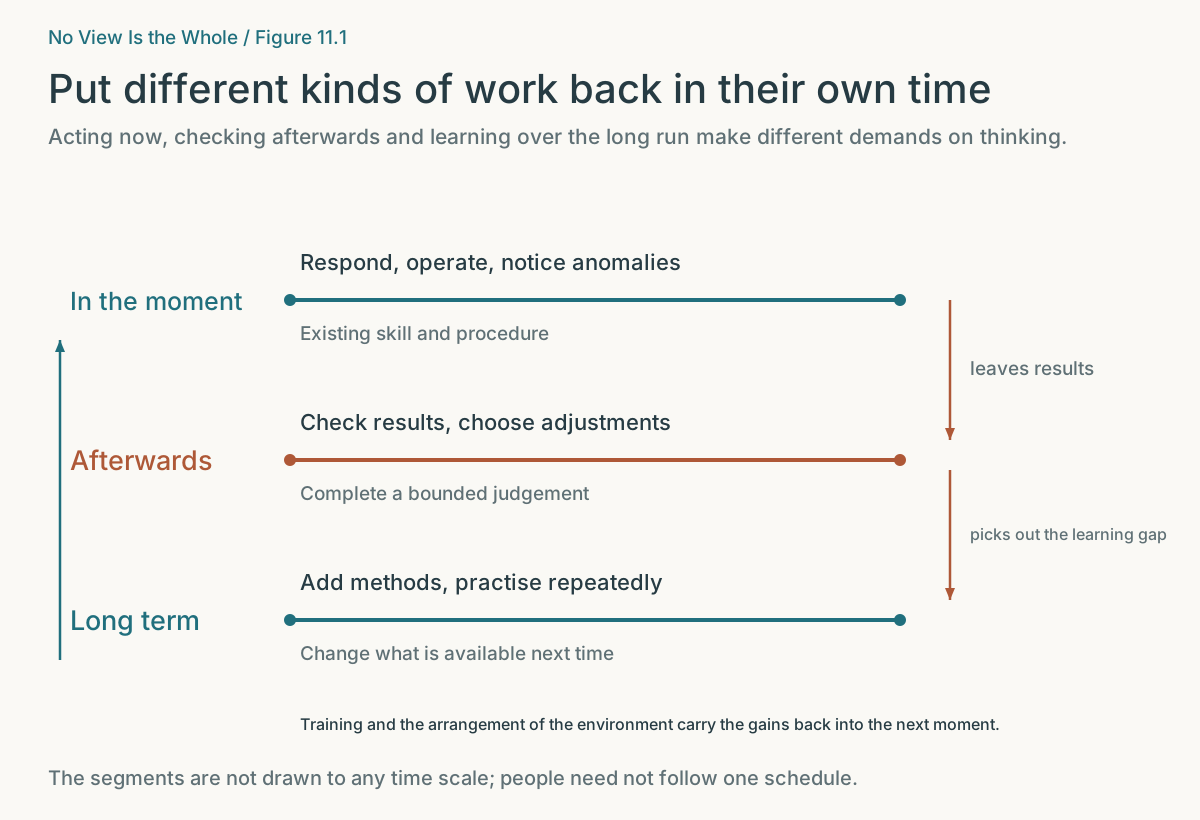
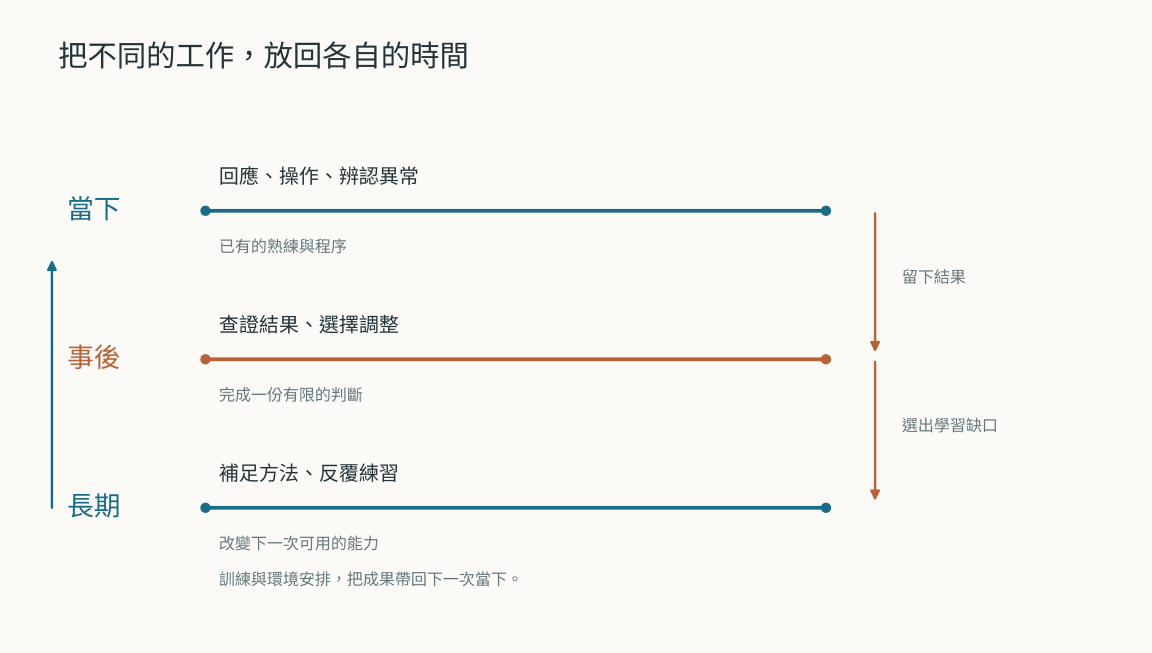
High stakes alone do not settle that one should slow down either. Some high-stakes situations, precisely because time is so short, have to rely on trained, rapid responses. The questions that matter are what reliable abilities and materials were available at the time, what delay would cost, and whether the conditions can be improved in ordinary times.
高風險也不能單獨決定要慢下來。有些高風險情境正因時間極短,必須依靠受過訓練的快速反應。重要的問題是,當時有哪些可靠能力和材料可用,推遲的代價是什麼,以及能否在平時改善其條件。
Half the problem is in the environment
問題的一半在環境裡
Herbert Simon studied how organisations make decisions and proposed the direction that came to be called "bounded rationality". Real people cannot obtain all the information at once, list every option, and then compute the best answer at no cost. Decisions happen within limited time, knowledge and ability, and those conditions need to enter the explanation directly.52
One strategy he discussed goes by the name satisficing: you first set a requirement that would be acceptable, and once the search turns up an option that meets it you can stop, without exhausting every possibility. For instance, you might first establish that an arrangement has to be affordable and fit the time available, and then decide among the options that qualify. Set the requirement too low and you miss improvements that were worth fighting for; too high and you may never find a workable plan. The requirement can also be adjusted in the course of the search as new information arrives.
He likened rational behaviour to a pair of scissors: one blade is the structure of the task environment, the other the abilities of the agent. Looking at one blade alone, it is hard to explain the work that gets done. If the environment gives off stable signals, a simple rule may be enough; when the signals change, or when mistakes are costly, the same rule may no longer suit.
The same person, with clear records to hand, a usable method already learnt, and someone who knows the situation within reach, has many more ways forward than when facing vague data alone. The decision-maker is still the same person; the judgements they are able to make have already changed.
赫伯特・賽蒙研究組織如何作決定,提出「有限理性」的方向。真實的人無法同時取得全部資訊、列出所有選項,再無成本地算出最好的答案。決策發生在有限時間、知識與能力之中,這些條件需要直接進入解釋。52
他討論的一種策略稱為 satisficing,常譯為「滿意化」:先設立可以接受的要求,搜尋到符合要求的選項就能停止,不必窮盡全部可能。例如,先確定一個安排必須負擔得起、時間也能配合,再從符合條件的選項中決定。要求太低會錯過有必要爭取的改善,太高則可能一直找不到可行方案;搜尋時也可以根據新資訊調整要求。
他用剪刀比喻理性行為:一邊是任務環境的結構,一邊是行為者的能力。只看其中一邊,難以解釋完成的工作。若環境提供穩定訊號,一項簡單規則可能足夠;訊號改變或錯誤代價很高時,同一規則又可能不再適合。
同一個人,手邊有清楚的紀錄、學過可用的方法,又能找到熟悉情況的人,會比獨自面對含糊資料多出許多辦法。決策者仍是他,能作出的判斷卻已經變了。
How a bounded analysis gets finished
一次有限分析怎樣完成
Take a hypothetical case. You have to decide whether to change your current study arrangements next week. You read a great deal every evening, yet feel that very little of it is genuinely usable. Tonight you have only forty minutes to deal with the question.
What tonight needs is an arrangement you can try next week. As for why you have kept studying this way, that may involve habits many years old, and it will not all become clear in forty minutes.
The material may be too hard; you may be reading a lot and using little; and there is a further possibility, that you have in fact learnt something and simply never checked. These explanations lead to different arrangements, and it is worth trying to tell them apart first.
So you pick one concept you read recently, close the material, and try to explain it and to work a fresh example. If you cannot even state the basic meaning, the material or your prior knowledge deserves another look; if you can state it but cannot use it, the practice that follows has a clearer direction. It may also turn out, once you try, that you can use it better than you had supposed.
Carry the case further. Suppose the check shows that you can explain the concept but do not know how to use it when a problem alters the conditions. Next week you could provisionally keep half of your reading time and give the other half to working through examples with variations. This adjustment targets the gap just exposed. If the check had instead shown that the basic concept was unclear, the priority would have to shift to shoring up the foundations, and the same timetable could not simply be applied.
A week later, check again with a new task of similar difficulty. If you still cannot apply the concept, the difficulty of the examples, the feedback, and your prior knowledge all need looking at again; if there has been progress, then decide whether to keep this allocation. Which step to take first, and how to judge the next, are already written into the arrangement. Whether it works is left for the actual learning to answer.
The remaining doubts can still be written down: whether the long-term goal is clear, whether the choice of material is too scattered, whether your present job is breaking your study time into fragments. They do not lose their standing because they went unresolved this time, but neither do they all have to stand in the way of tonight's decision.
If the next check is likely to change an important decision, or to avert an obvious loss, there is usually reason to go on checking. If the feasible choices in front of you are the same however a minor detail turns out, spending a great deal more time chasing it may not pay.
But "would it change the decision" is not the whole of it. Some information helps you carry out the same decision, showing you how to do it better; some inquiry, though it does not alter today's choice, builds capacity for a question that will keep coming back. These kinds of value have to be counted too.
On the other side lie the time, money and attention the checking itself consumes, and the cost of delay. In pursuing a better decision, you cannot assume that the process of arriving at it is free.
Bringing the time and resources that thinking requires into the evaluation connects with research on bounded rationality and resource rationality. The resource-rational analysis proposed by Falk Lieder and Thomas Griffiths studies exactly this: the effectiveness and the cost of different cognitive strategies under limited computation.53 For our question it offers a useful line of inquiry. Beyond comparing which answer is better, it also compares whether the way of getting to an answer is worth it.
Once we begin to calculate "is this still worth thinking about", we may go on to ask "is it worth calculating whether this is still worth thinking about". If every level is required to have a complete guarantee from the level above it, analysis paralysis has merely moved house.
In practice this needs some starting points that are open to revision: adopt a time budget proportionate to the task, check first the information that will swing the main differences, and keep a limited number of chances to look back. When you already have reason to believe the allocation of time has gone wrong, adjust it then; there is no need to re-prove the whole philosophy of allocation before every piece of work.
If the analysis keeps circling the same set of reasons, that is the moment to stop and look something up, try it out, or ask someone; if a cheap and reliable way of checking the key doubt is still available, it may be worth spending a little more time. Whether to continue should be decided by what can be learnt next.
Please also keep some time for inquiry with no immediate output. Philosophy need not always be in the service of tomorrow's to-do list. Only be clear at the outset which you are doing: solving a problem with a deadline, or allowing a question to change you slowly. Both activities can have value. It is confusing them that makes it easy to lose the freedom to act and the freedom to think at the same time.
假設你要決定,下週是否改變自己目前的學習安排。你每晚讀很多資料,卻覺得真正能用的東西很少。今晚只有四十分鐘可以處理這個問題。
今晚需要的是一份下週可試的安排。至於自己為什麼一直這樣學,或許包含多年習慣,不會在四十分鐘裡全部明白。
材料可能太難,也可能讀得多、用得少;還有一種可能,是其實已經學會一些,只是一直沒有核對。這幾個解釋會導向不同安排,值得先試著分辨。
於是選最近讀過的一個概念,關掉資料,試著說明並做一個新例子。若基本意思都說不清,材料或先備知識值得重查;若說得出卻用不出來,接下來的練習就有了更明確的方向。也可能一試才發現,自己比原先以為的更能使用它。
把案例繼續做下去:假設檢查結果是,你能說明概念,遇到改變條件的題目卻不知如何使用。下週便可暫時保留一半閱讀時間,另一半改用來處理有變化的例子。這項調整針對剛才暴露的缺口;如果檢查顯示的是基礎概念不清,優先工作就應改為補足基礎,不能仍套用同一份時間表。
一週後,以相近難度的新任務再檢查。如果仍無法應用,就需要重看例子難度、回饋與先備知識;如果已有進步,再決定是否繼續這種分配。先採取哪一步、如何判斷下一步,都已經寫進安排,成效則留給實際學習來回答。
剩餘疑問仍可寫下來:長期目標是否清楚、材料選擇是否太分散、現有工作是否讓學習時間支離破碎。它們不會因本次沒有解決就失去地位,但也不必全都成為今晚決定的障礙。
若下一項查證很可能改變重要決定,或避免明顯損失,繼續查通常有理由。若不論一個次要細節最後如何,眼前可行的選擇都相同,再花大量時間追它可能不划算。
但「會不會改變決定」還不是全部。有些資訊能幫助執行同一個決定,讓你知道怎樣做得更好;有些探索雖不改變今天的選擇,卻為將來反覆出現的問題建立能力。這些價值也要算進去。
另一邊是查證本身的時間、金錢、注意力與推遲代價。追求更好的決定,不能假定取得決定的過程免費。
把思考所需的時間與資源一起納入評價,與有限理性及資源理性的研究有關。福克・利德與湯瑪斯・葛里菲斯提出的資源理性分析,就是研究有限計算條件下,不同認知策略的效果與成本。53對我們的問題而言,它提供一個有用的研究方向:除了比較哪個答案好,也比較取得答案的方法是否值得。
一旦開始計算「還值不值得想」,我們也可能繼續追問「值不值得計算還值不值得想」。如果要求每一層都有更上一層的完整保證,分析癱瘓只是搬了家。
實際做法需要一些可以接受修訂的起點:先採用與任務相稱的時間預算,優先查會左右主要差異的資訊,保留有限次的回看機會。當你已有理由相信時間分配失當,再調整它;不必在每次工作前重新證明整套分配哲學。
如果分析一直重複同一批理由,就可以停下來查資料、試做或請教;如果關鍵疑問仍有便宜而可靠的查法,也可能值得多花一些時間。是否繼續,要由接下來能學到什麼來決定。
也請保留沒有立即產出的研究時間。哲學不必永遠替明天的待辦清單服務。只是在開始時說清楚:此刻是在解一個有期限的問題,還是在容許一個問題慢慢改變自己。兩種活動都可以有價值;混淆它們,才容易同時失去行動與思考的自由。
A choice you cannot go back and redo
不能回頭重做的一次選擇
A study arrangement can be adjusted again next week; some choices cannot be fully withdrawn. After accepting a job, you can check whether the duties match what was described, but you will not also live through the life in which you did not accept it. The other road leaves behind no result waiting for you to go back and read.
If things go well afterwards, that does not prove the other choice would necessarily have been worse; if difficulties come, the outcome alone cannot show that the decision was rash. What can still be traced is which expectations fell through, which information was off, and whether a check worth doing was missed at the time. Asking about actual working hours before the deadline, talking it over with the person you share caring duties with, and finding out what the day-to-day responsibilities are come closer to those questions than turning a few job titles over and over in your mind.
These efforts give a choice something to rest on; they do not spare anyone the choosing. While the module went on descending, the ground was still receiving new data. Some answers only begin to become obtainable after events have already moved on.
學習安排可以下週再調整,有些選擇卻不能完整撤回。接受一份工作以後,你可以核對職責是否與原先說明相符,卻不會同時活過沒有接受的那段人生。另一條路並沒有留下一份等待你回去讀取的結果。
後來順利,不能證明別的選擇必然更差;遇到困難,也不能單憑結局斷定當時草率。仍可追查的,是哪些預期落空、哪些資訊失準,以及當時是否漏做了值得做的查證。期限以前詢問實際工時、與共同照顧者商量、了解日常職責,會比在心裡反覆比較幾個職稱更接近這些問題。
這些努力讓選擇有所依據,沒有替人免除選擇。小艇繼續下降時,地面還在接收新的資料;某些答案只能在事情已經往前走了以後,才開始有條件取得。
12 — What We Know Before We Can Say It
第十二章 尚未說出口的知道
A fire crew entered a house to deal with a fire that appeared to have started around the kitchen. The crew put water on it in the familiar way, but the fire did not respond as the commander expected.
When the decision researcher Gary Klein interviewed this commander, he heard an account that he kept returning to with further questions. The commander had suddenly felt that something was wrong and ordered everyone out. After the crew had left, the floor where they had been standing collapsed. The real fire was in the basement. They had been standing above it the whole time.54
At first the commander called the judgement a sixth sense. If the matter stopped at that name, nobody else would know whether it could be learned, or when to trust it next time. Only as the interview kept working backwards did several cues gradually surface: the heat in the room was out of proportion to the fire he could see, the sound was unusually quiet, and the water was doing less than expected.
In that moment, he had not first arranged these into a complete argument about the basement. A few discrepancies had already combined into the feeling that they needed to get out.
These cues were recovered step by step in the interview afterwards. A researcher can follow them up, but cannot take the full explanation given in the interview and put it back, unchanged, into the commander's mind before the retreat.
The scene did not simply present one extra, conspicuous danger signal. Some responses that would normally have occurred failed to occur: the fire did not die down as expected once water was on it, and the sound and the heat did not match. The commander noticed these differences first, and explained them step by step only in the interview. Had he been required to name the differences, quantify them and complete the argument before they were allowed to affect his decision, the time to get out might have been lost.
We often put "fast, intuitive, emotional" on one side and "slow, rational" on the other. These words describe different things. "Fast" refers to how much time was taken. "Intuitive" usually means that the answer arrived first, without the person being aware of any step-by-step reasoning. Emotion includes feeling, an appraisal of the situation, and a disposition to act. "Rational" sometimes means explicit inference, and sometimes means that a judgement responds appropriately to reasons. To compare two judgements, we first need to know whether we are comparing their speed, the way they were formed, or the adequacy of their reasons.
A quick answer may come out of years of practice; an analysis that lasts for hours may spend the whole time finding excuses for an existing prejudice. Emotion can prompt a person to notice a harm that has been overlooked, while reasoning can examine the cause of the harm, who is responsible, and how to respond. To evaluate them, it is not enough to ask which arrived first or which looks calmer.
Intuitions also differ in how they are formed. Some skills are learned from explicit rules and, once practised, no longer need to be recited step by step; other powers of recognition are formed mainly through repeated exposure, imitation and feedback, and the learner never wrote out a complete set of rules in the first place. With the former, one can trace the steps that were once learned; with the latter, one has more need to compare experience against outcomes. The fact that both arrive quickly does not mean that beneath each there must lie an argument waiting to be recovered.
一支消防小隊進屋,處理看似從廚房一帶燒起的火。隊員照著熟悉的方式噴水,火勢卻沒有出現隊長預期的反應。
決策研究者蓋瑞・克萊恩訪談這位指揮者時,聽到一段讓他反覆追問的經過:隊長忽然覺得不對,命令所有人撤出。小隊離開後,原先站立的地板坍塌。真正的火在地下室,他們一直站在火的上方。54
隊長起初把這個判斷稱為第六感。若只停在這個名字,旁人既不知道能不能學,也不知道下一次何時該相信。訪談繼續往回追,才逐漸浮出幾項線索:現場的熱度與眼前火勢不相稱,聲音異常安靜,水的作用也不如預期。
那一刻,他沒有先把它們整理成一段關於地下室的完整論證。幾項差異,已經合成了需要撤離的感覺。
這些線索是事後訪談逐步取得的。研究者能沿著它們追查,卻不能把訪談中的完整說明,原封不動放回隊長撤離前的腦中。
現場並非只多出一個醒目的危險訊號。有些平常應該出現的反應,恰好沒有出現:噴水以後火勢沒有照預期減弱,聲音和熱度也不相稱。隊長先察覺這些差別,才在訪談中逐步說明。假如要求他先把差別命名、量化並完成論證,才准許它影響決定,就可能失去撤離的時間。
我們常把「快、直覺、情緒」放在一邊,把「慢、理性」放在另一邊。其實它們描述的事情不同。「快」指花了多少時間;「直覺」通常指答案先出現,當事人沒有察覺逐步推理;情緒包含感受、對事情的評價與行動傾向。「理性」有時指明說的推論,有時則指判斷是否適當回應理由。要比較兩種判斷,得先知道比較的是速度、形成方式,還是理由是否充分。
一個快速答案可能源自多年練習;一場持續數小時的分析,也可能始終替原先的偏見尋找藉口。情緒可以促使人注意到一項遭忽略的傷害,推理則能檢查傷害的原因、責任與回應方式。要評價它們,不能只問誰先出現、誰看起來較冷靜。
直覺的形成方式也有差異。某些技能從明確規則學起,練熟後不再需要逐步默念;另一些辨認能力主要在反覆接觸、模仿與回饋中形成,學習者從來沒有先寫出完整規則。前一種可以追查曾學過的步驟,後一種則更需要比較經驗與結果。不能因為兩者都來得快,就認定底下必定藏著一份等待還原的論證。
Information we cannot yet put into words
還說不出來的資訊
In 2007 a group of researchers ran an experiment in which odours that participants could not consciously detect were paired with ratings of how likeable neutral faces were, and observed that under particular conditions the odours affected the ratings. This supports a limited claim: some sensory influences can take part in a judgement while the person is unable to report clearly where they came from.55
It does not show that such influence is more accurate. The odour in the experiment was no evidence of whether the person in the photograph deserved to be liked; in this setting, an undetected influence may even pull the judgement away from the very thing it was meant to assess.
A feeling whose source cannot yet be explained can serve as a starting point for checking. Someone who hears that a machine sounds wrong, for instance, can first record the sound, compare it with the normal state, and then check whether it goes with a fault. That the person cannot say which frequency has changed does not make the difference unreal; that the feeling is strong does not remove the need to compare.
Explicit reasoning needs access to the relevant information before it has any chance of judging well. If the only input is "the machine is still running", no amount of careful inference from that sentence will produce a stretch of abnormal sound on its own. Sensory observation, instrument readings and hands-on operation can supply details that never entered the analysis.
The reverse also holds: explicit comparison can find what feeling has missed. Only when Chapter 5 set out two groups of numbers with the same average did we see that one group contained values below twenty; the impression that "average performance is about the same" could not have answered that question. Feeling and inference can each miss things, and each can make new differences visible.
An operator hears the fault first, measurement then confirms what kind it is, and a few sessions of listening together lead a newcomer to start noticing parts of the sound she had not heard before. By this point, feeling and explicit comparison have altered each other, and the ability that results is hard to credit wholly to either side.
二〇〇七年,一組研究者在實驗中,以受試者未能有意識察覺的氣味,配合中性臉孔的喜好評分,觀察到特定條件下氣味對評價的影響。這支持了一項有限主張:某些感官影響可以在當事人未能明確報告其來源時,參與判斷。55
它沒有證明這種影響比較準確。實驗中的氣味並不是臉孔人物是否值得喜歡的證據;在這個情境裡,未被察覺的影響甚至可能使判斷偏離原先要評價的對象。
尚未能說明來源的感覺,可以先作為查證的起點。例如,有人聽到設備聲音不對,可以先記錄聲音、與正常狀態比較,再查它是否伴隨異常。當事人說不出是哪個頻率,並不使這份差異不存在;感覺很強烈,也不免除比較的必要。
明說的推論需要取得相關資訊,才有機會作出好判斷。若輸入只有「設備還在運轉」,再仔細推演這句話,也不會自行產生某段異常聲音。感官觀察、工具量測和現場操作,可以提供原先沒有進入分析的細節。
反過來,明確比較也能發現感覺漏掉的事。第五章把兩組平均相同的數字列出來,我們才看見其中一組有低於二十的數值;只憑「平均表現差不多」的印象,無法回答這個問題。感覺和推論各自可能遺漏,也各自可能使新差異變得可見。
設備操作員先聽出異常,量測隨後確認種類,幾次共同聽辨又使新人開始注意原先沒聽見的部分。到這裡,感覺和明說的比較已經互相改變,難以把後來的能力完整算在任何一邊。
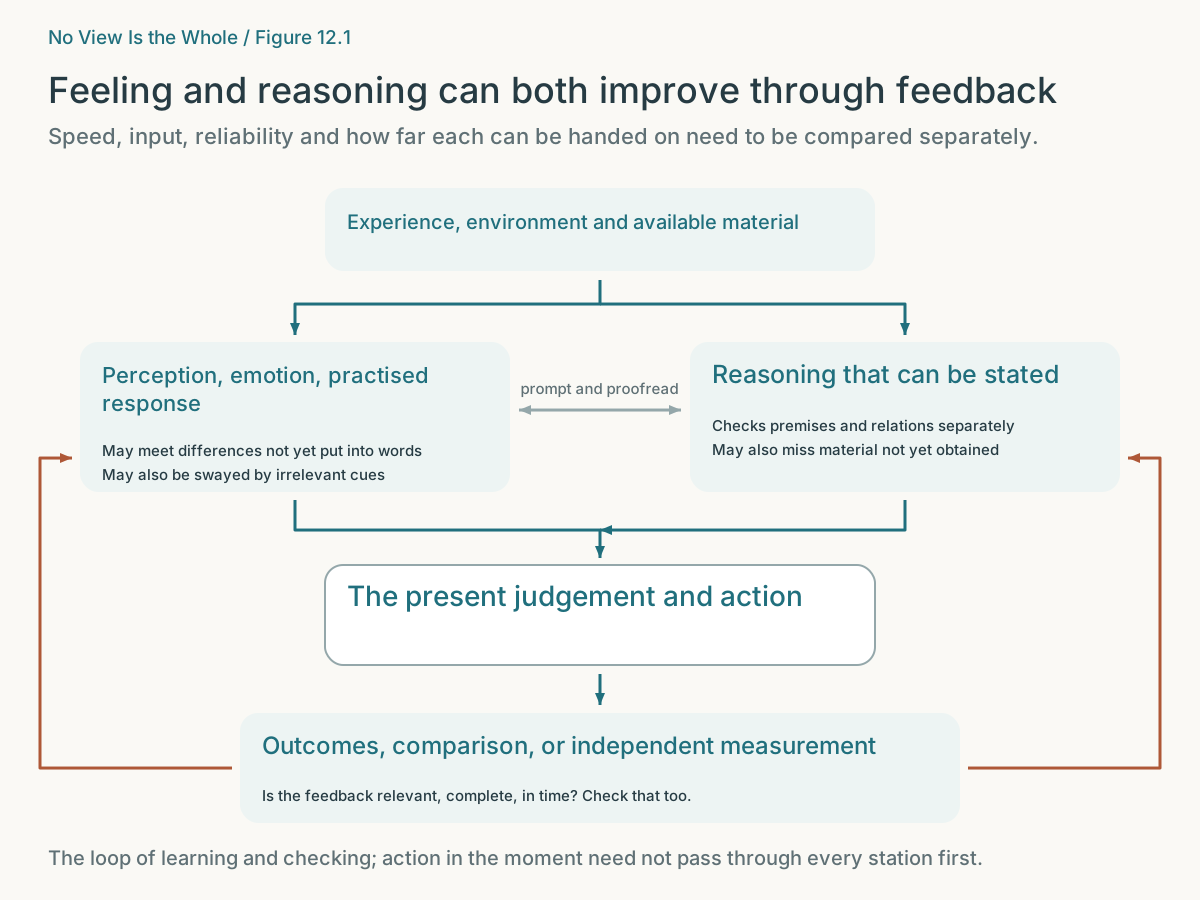
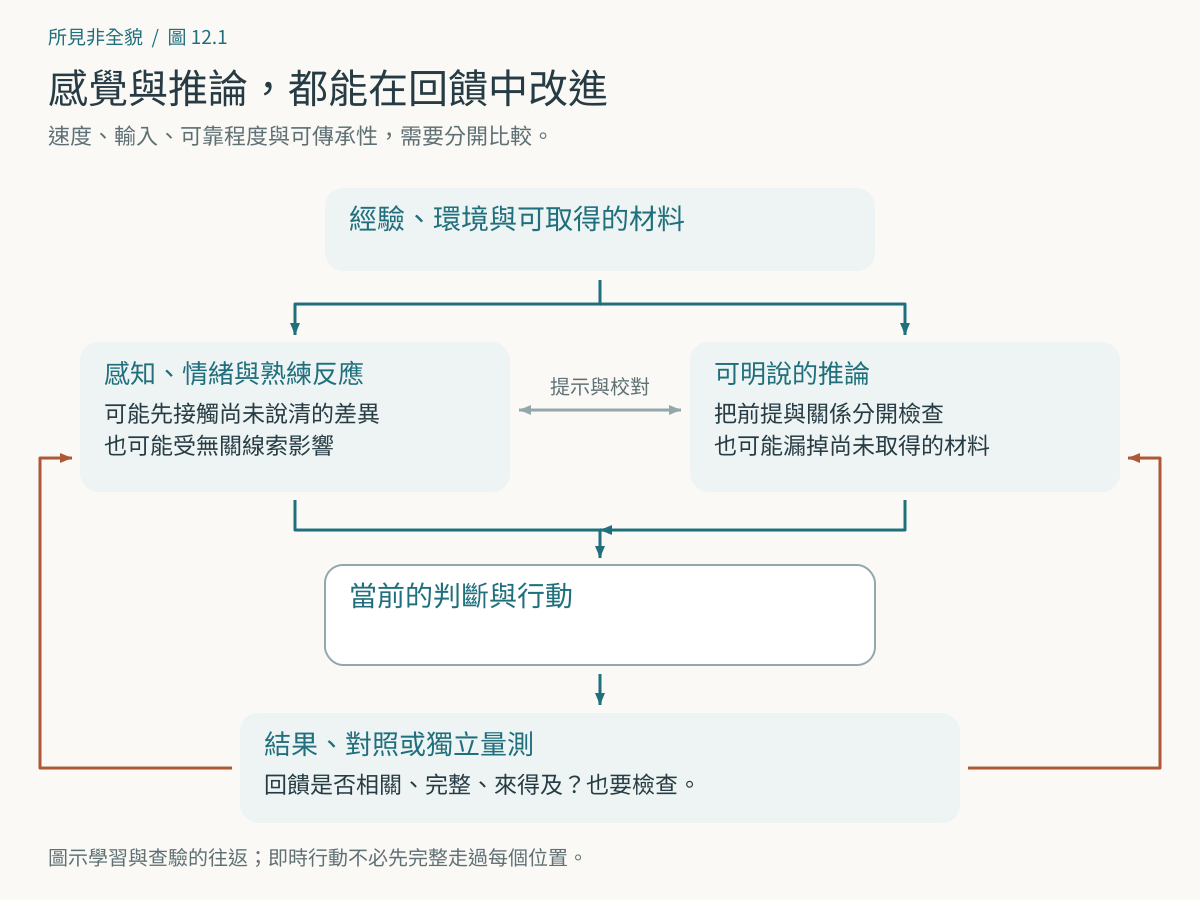
After checking of this kind, the operator may know more quickly which part to inspect the next time a similar sound appears. Where the measurement did not support the original judgement, that record needs keeping too, so that we do not remember only the times the guess was right. Learning over the long run can improve the response in the moment, without the whole of that learning having to be redone before each action.
經過這樣的查驗,下一次聽見相似聲音時,操作者可能更快知道應查哪個部位。若量測沒有支持原判斷,也需要保留這次紀錄,免得只記住猜中的時候。長期學習可以使當下反應更好,不必每次行動前重做全部學習。
The ball is still in the air and the feet are already running
球還在空中,腳已經開始跑
A baseball is hit towards the outfield. The fielder looks up to track it and starts moving at the same time. If we say his job is first to obtain the ball's initial speed, its spin and the wind, and then to work out where it will land, we slip easily into thinking that the body is just quietly completing a ballistic calculation there was no time to say aloud.
Research on catching has offered another kind of explanation. The player uses the continuously changing relationship of the ball within his field of view, adjusting as he runs, with no need to compute a fixed landing point first and then run to it with his eyes shut. The models researchers have proposed include keeping the ball's visual trajectory linear in some respect and regulating a particular optical acceleration; different models come with different conditions and testable predictions.56
The player's movement also changes the trajectory he will see next. Researchers therefore need to observe how visual information and movement pass back and forth before they can compare the models. The process of catching does not sit waiting behind some complete calculation performed before the action.
Walking with a nearly full glass of water makes the same adjusting-as-you-go easy to notice: you see the surface tilt, and hand and step correct accordingly. Studying activities like these means observing what information people pick up while acting and how they respond; looking only for a comprehensive plan finished before the action began may miss the important part of the process.
棒球被打向外野,守備者抬頭追球,同時開始移動。如果說他的工作是先取得球的初速、旋轉與風,再算出落點,我們很容易以為,身體只是在偷偷完成一套來不及說出口的彈道計算。
接球研究提出過另一類解釋。球員利用球在視野中持續變化的關係,邊跑邊調整,不必先算好固定落點,再閉著眼睛奔向它。研究者提出的模型,包括維持某種線性的視覺軌跡、調整特定光學加速度等;不同模型有不同條件與可檢驗的預期。56
球員的移動也會改變他接下來看到的軌跡。研究者因此需要同時觀察視覺資訊與動作怎樣往返,才能比較這些模型。接球的過程沒有一直等在某份行動前的完整計算後面。
端著快滿的水杯走路,也容易注意到這種邊做邊調整:看到水面晃動,手和腳步便跟著修正。研究這類活動時,需要觀察人在行動中取得了什麼資訊,又如何回應;只尋找一份行動前就完成的全面計畫,可能會漏掉重要過程。
Even Cook Ding slows down
庖丁也有放慢的時候
In "The Secret of Caring for Life", in the Zhuangzi, Lord Wenhui watches Cook Ding cut up an ox and is astonished at his movements. Hand, shoulder, foot and knee work with the knife like a performance with its own rhythm.
Cook Ding says that when he began, what he saw was the whole ox; after a few years, what stood before him was no longer a single, complete object. He runs the knife along the gaps between sinew and bone, rather than forcing his way through. The story pushes this skill to a point that is almost beyond belief: the knife has been in use for nineteen years and has cut up several thousand oxen, yet its edge is still as if freshly ground.
Where sinew and bone knot together and the knife is hard to place, he still becomes wary. His attention gathers, his movements slow, and he moves the blade by the smallest degrees. Only when it is done does he withdraw the knife.39
Cook Ding's skill lies in doing the ordinary work quickly, and equally in slowing down when he meets a difficult place. The nineteen-year blade carries the exaggeration of a parable, but the pause raises a question that can be studied: what kind of experience lets a person carry a familiar movement through smoothly and also notice early that this time calls for special care?
In 2009 Kahneman and Klein discussed expert intuition together and set out two important conditions: the environment must contain stable cues that can be learned, and the person judging must have had enough opportunity to learn them through experience and feedback. They also cautioned that a subjective sense of certainty is, in itself, no guarantee that a judgement is correct.57
If errors are never pointed out, twenty years may do no more than make a certain kind of guessing more fluent. When feedback comes too late, or when outcomes are obscured by luck or by standing, a person may not even be able to tell which judgement went wrong. Equal years of service can hide very different histories of learning.
Recognition exercises in which the answer is withheld, records of predictions set against outcomes, or a measurement of another kind can make this difference visible. Someone good at telling sounds apart will not necessarily be good at estimating quantities, and a cue that was reliable may fail in a new environment; "having intuition" has never been a qualification that covers all of a job.
《莊子・養生主》裡,文惠君看庖丁解牛,驚訝於他的動作。手、肩、腳、膝配合著刀,像一場有節奏的演出。
庖丁說,剛開始時,他看見的是整頭牛;幾年之後,眼前已不再只是完整的一個物件。他沿著筋骨之間的空隙運刀,不靠硬碰硬切開。故事把這份熟練推到近乎不可思議的程度:刀用了十九年,解了數千頭牛,刀刃卻仍像剛磨過。
遇到筋骨聚結、難以下刀的地方,他仍會警惕,注意力收束,動作放慢,把刀移得很細微。做完之後,才收刀。39
庖丁的熟練,不只在於一般情況下做得快,也在於遇到難處時會放慢。故事中的十九年刀刃帶有寓言的誇張,這個停頓卻提出了一個可用於研究的問題:什麼樣的經驗,使人既能順利完成熟悉動作,又能及早發現這次需要特別注意?
Kahneman 與 Klein 在二〇〇九年共同討論專家直覺,提出兩個重要條件:環境中存在可學習的穩定線索,以及判斷者有足夠機會透過經驗與回饋學會它們。他們也提醒,主觀上的確定感本身不能保證判斷正確。57
如果錯誤一直沒被指出,二十年也可能只是把某種猜測練得更熟。回饋來得太晚、結果被運氣或身分遮住時,人甚至不容易知道是哪次判斷出了問題。年資相同,學習的歷史可以很不一樣。
不告知答案的辨認練習、預測與結果的紀錄,或另一種量測,能使這種差別被看見。善於聽辨聲音的人未必也會估計數值,原本可靠的線索換了環境也可能失效;「有直覺」始終不是一份可以用於全部工作的資格。
After understanding, there is still some way to go
想通之後,還有一段路
Understanding a claim when you hear it and being able to use it when needed are different outcomes of learning. You may agree that "one failure does not condemn the whole person" and yet want to defend yourself the instant you are criticised; you may know that past investment cannot be recovered and still find it hard, facing a project you have worked on for three years, to decide only on the costs and opportunities ahead.
This gap can point to what needs practising next. Being able to explain a reason in a quiet moment tells us only that we have understood it; to recall it in the relevant situation and act on it, we also need to recognise the moment, remember what to do, and sometimes learn to bear an uncomfortable feeling.
In his 1982 work on skill acquisition, John Anderson proposed a theory in which explicit knowledge gradually gives rise to procedural ability. When first learning certain cognitive skills, people need to recall the rules one after another; with practice, execution may become faster and no longer require every step to be rehearsed silently.58 The theory helps us study how certain skills become fluent; changes in emotion and belief still require an examination of the learning processes proper to them.
Reflection therefore has a long-term use: choosing which practices are worth keeping, arranging for their repeated use and checking, and making them easier to carry out next time. Someone who, in an argument, always hears a single objection as total rejection can reread the exchange afterwards and practise separating the specific criticism from a verdict on the whole person; next time, they can first confirm which point the other person objects to, and then answer. If the practice helps, what changes may be the difference noticed first, rather than merely one more reminder committed to memory.
Moral judgement faces a similar demand. Some harms that call for a timely response cannot wait to be seen until a full debate has run its course each time; we hope that a concern which has passed through reflection will gradually shape ordinary attention and reaction as well. But habit in itself carries no guarantee of right or wrong: a group's ways of discriminating, or of shifting responsibility, can be learned to the same high degree of fluency.
聽懂一種說法,與在需要時用得出來,是不同的學習成果。你可能同意「一次失敗不足以否定整個人」,被批評時卻立刻想替自己辯護;也可能知道過去的投入已無法收回,面對做了三年的計畫,仍難以只按今後的成本和機會決定。
這種落差可以指出接下來需要練習什麼。安靜時能說明一項理由,只告訴我們已經理解了它;遇到相關情境時能想起來並採取行動,還需要辨認時機、記得做法,有時也要學會承受不舒服的感受。
約翰・安德森在一九八二年的技能習得研究中,提出由明確知識逐漸形成程序能力的理論。初學某些認知技能時,人需要依次回想規則;經過練習,執行方式可能變得較快,不再需要每一步都在心裡默念。58這項理論幫助我們研究某些技能如何熟練,情緒與信念的改變則還須考察相應的學習過程。
反省因而有一項長期用途:選擇值得保留的做法,安排反覆使用和查驗,使下一次較容易做得到。例如,爭論時總把對方的一句反對聽成全盤否定,可以在事後重讀對話,練習分開具體批評與對整個人的評價;下次先確認對方反對的是哪一點,再回答。練習若有幫助,改變的可能是最先注意到的差別,而不只是多背了一條提醒。
道德判斷也面對類似的要求。某些需要及時回應的傷害,不能每次都等完整辯論後才看見;我們希望經過反思的關懷,也逐漸影響平常的注意與反應。但習慣本身沒有保證對錯:一個群體的歧視或推卸責任方式,同樣可能被學得非常熟練。
Ask the expert when they would stop
向專家問他什麼時候會停手
When a learner asks a master "how did you know?", the answer is sometimes just "you can tell at a glance". The question can be put differently: which detail made you change what you were doing? If that detail had been different, would you have carried on? Under what circumstances would you ask someone else to help check?
Questioning of this kind is one of the main ways Klein studied expert decisions. Rather than asking the interviewee to produce a complete theory on the spot, it follows a single actual decision and picks out which cues would have affected the choice. In the firefighting case, the heat, the sound and the fire's response to water were exactly what the interview went on to pursue.
Having learned these cues, the newcomer still has to compare and practise in the relevant situations. An interview can tell him where attention is worth directing; a spoken account alone cannot give him the same experience. If the account can be set beside records made at the time and the outcomes that followed, it also becomes easier to separate what the interviewee noticed then from the explanations that formed only afterwards.
學習者問高手「你怎麼知道」,有時只能得到「一看就知道」。可以換一種問法:當時有哪項細節使你改變做法?如果那項細節不同,你會繼續嗎?什麼情況下,你會請別人協助檢查?
這類追問是克萊恩研究專家決策的重要方式。它不要求受訪者立刻提出完整理論,而是沿著一次實際決定,找出哪些線索會影響選擇。回到消防案例,熱度、聲音與噴水後的反應,就是訪談繼續追查的內容。
學到了這些線索,新人仍須在相關情境裡比較和練習。訪談可以告訴他何處值得注意,不能單憑一段口述便取得相同經驗。若能再配合當時的紀錄與後來結果,也比較容易分清受訪者當時注意到什麼,以及事後才形成了哪些解釋。
Leave a record before the outcome arrives
在結果出現以前留下紀錄
Looking back, we easily mix the outcome we later learned into the feeling we had at the time. A study published in 1975 by Fischhoff and Beyth examined this using judgements made before and after Nixon's visits to China and the Soviet Union. Before the visits, participants estimated the probabilities of a series of possible outcomes; afterwards, they recalled how they had estimated them. In recollection, what had happened tended to become more foreseeable than it had originally seemed, and what had not happened seemed to have been more doubtful all along.59
If a record from before the outcome can be kept, there is a chance of catching this rewriting. For important judgements where time allows, you can write down first what you noticed earliest, what you expect to happen, and how confident you are; where the reasons are still unclear, record that as it is. Then, when you check afterwards, reasons that occurred to you later will not all be counted as things you knew from the start.
A record preserves the original judgement, but it does not automatically supply every outcome. Take a hypothetical manager who notes "this applicant may not be suitable" and therefore does not hire the person; however complete the log, it has not produced that person's performance after joining. To compare prediction with outcome, one still has to identify which kind of data is missing.
Some outcomes are not determined by our own choice and could always have been tracked. A share that was considered but not bought, for example, will still have a market price afterwards. If a specific price expectation and time horizon were recorded beforehand, they can be checked later, rather than remembering only what was actually bought.
Other comparisons require actually putting different arrangements in place. A/B testing of a product exposes different groups to different versions, so the effect of a particular change can be compared. This design has its costs; where people's opportunities or treatment are involved, fairness, consent and tolerable risk limit how one may experiment. Wanting to improve one's own predictive ability is not sufficient to justify handing the costs to other people at will.
For still other questions, what is missing is the outcome of the same person taking the other road through the same stretch of history. The job that was not accepted cannot afterwards become another life one has already lived. Other people's experience under similar conditions, broader statistics and relevant research can narrow the uncertainty, but they will not restore the individual outcome that never occurred.
Before checking, then, first establish which question this data can answer and what it leaves unknown. How much is worth investing must be weighed together with the cost of obtaining the information, the consequences of a wrong judgement, and how many future occasions there will be to use what is learned. Each of these can add to the reasons for checking, but "it matters a great deal" or "it will come up again" is not by itself enough to conclude that any expensive investigation is worth it.
事後回想時,我們容易把後來知道的結果,混進當時的感覺。一九七五年,費雪霍夫和貝絲發表的研究,利用尼克森訪問中國和蘇聯前後的判斷檢查這件事。訪問前,參與者先評估一系列可能結果的機率;訪問後,再回憶自己當初如何評估。已經發生的事,在回憶裡往往變得比原先更容易預見;未發生的事,則顯得當初就更值得懷疑。59
若能保留結果出現以前的紀錄,便有機會發現這種改寫。在時間容許的重要判斷中,可以先寫下自己最早注意到什麼、預期會發生什麼、有多大把握;理由還不清楚,也照實記下。事後核對時,才不會把後來想到的理由全算成早已知道。
紀錄能保存原判斷,卻不會自動提供所有結果。假設主管記下「這位應徵者可能不適合」,因此沒有錄用;日誌再完整,也沒有產生這個人入職後的表現。要比較預測和結果,還得辨認缺少的是哪一種資料。
有些結果不受自己的選擇決定,原本就可以追蹤。例如,考慮過但沒有購買的股票,之後仍會有市場價格。若事前記得具體的價格預期和期限,就能事後核對,避免只記住自己買了什麼。
另一些比較需要實際採取不同安排。產品的 A/B 測試讓不同群組接觸不同版本,因而能比較某項變更的效果。這種設計也有成本;涉及人的機會或待遇時,公平、同意與可承受的風險會限制能怎樣試。想提高自己的預測能力,並不足以正當化把代價任意交給別人。
還有些問題,缺少的是同一個人在同一段歷史中走另一條路的結果。沒有接受的工作,無法在事後變成自己已經經歷的另一段人生。別人在近似條件下的經驗、較廣的統計和相關研究,可以縮小不確定,卻不會還原那個未曾發生的個人結果。
因此,查證之前要先確定:這份資料能回答哪一個問題,又留下什麼未知。值得投入多少,則須一併比較取得資訊的成本、判斷錯誤的後果,以及未來還有多少機會使用所學。這些都能增加查證的理由,但不能只憑「很重要」或「會反覆用」,就認定任何昂貴調查都值得。
Emotion shapes what we take to be a problem
情緒會影響我們把什麼當成問題
Why something becomes a problem for us often has to do with emotion. The indignation of seeing someone humiliated can make behaviour that had passed as a joke worth questioning; concern for a person can keep us attentive to difficulties he has not spoken of. Emotion affects answers, and sometimes it has already affected what we are willing to ask.
This practical role also needs to be identified case by case. Anger may notice an injustice, or it may mistake frustration for another person's malice; shame may prompt reflection, or it may stem from a group's demands that do not deserve acceptance. Emotion needs to be understood and checked, but the checking should not assume that the only acceptable result is for the emotion to disappear.
You can discover that your anger was attributed to the wrong cause and still keep your original sensitivity to a certain kind of harm; you can also, through someone else's account, learn to respond to experiences you never used to care about. Changes like these do more than speed up the response in the moment. They alter what you will notice in future, what you will remember, and what you will be willing to check.
Care keeps a person observing a difficulty over time; liking sustains long practice; disappointment drives a person to re-examine what they had expected. Feelings such as these can take part in understanding and learning over long stretches, and their role goes beyond quickly offering a guess before the analysis begins. The judgements they guide still have to be checked, but they cannot be evaluated by calmness alone.
Within these long-term changes, reflection alters what is felt next time, and feeling can make the old reasons come to seem insufficient. After you have understood what someone else went through, a kind of joke that once seemed harmless may no longer raise a laugh. That change does not have to be maintained by silently rehearsing the whole argument every time.
The conditions of learning play their part too. Comparing similar examples, receiving timely feedback and adjusting practice beforehand make differences easier to recognise in the moment. Whether the work allows time for rest, whether the people around you are willing to point out mistakes, and which cues the tools display, in turn set limits on whether these changes can happen at all.
If the present moment is abnormal and time is short, the practised response may still be the most usable capacity to hand; when there is time, one can stop to compare and check. Both may be the products of this joint learning.
What we change is sometimes a sentence we believe, and sometimes what we notice at first glance. Once the second kind of change has taken place, a person may no longer remember that it once took so much time to learn.
事情為什麼會成為我們的問題,常與情緒有關。看見別人受辱時的不平,可能使原先被當成玩笑的行為值得追問;對一個人的牽掛,也可能使我們持續注意他沒有說出口的困難。情緒不只影響答案,有時先影響了我們願意問什麼。
這項實踐上的作用,也需要逐一辨認。憤怒可能注意到不公,也可能錯把挫折當成他人惡意;羞愧可能促成反省,也可能來自不值得接受的群體要求。情緒需要被理解和檢查,但檢查不應預設它的唯一合格結果是消失。
你可以發現憤怒的歸因錯了,仍保留原先對某種傷害的敏感;也可以透過別人的說明,學會對過去不曾在意的經驗作出反應。這些變化不只提高當下速度,還會改變未來注意什麼、記住什麼、願意查什麼。
關懷使人持續觀察一種困難,喜愛支持長期練習,失望促使人重新查證原先期待。這些感受能參與長時間的理解與學習,不只是在分析開始前迅速提出一個猜想。它們所引導的判斷仍須核對,但不能只按是否冷靜來評價。
在這些長期變化裡,反省會改變下一次感受到什麼,感受也會使原來的理由變得不足。聽懂別人的遭遇以後,某種曾經覺得無傷大雅的玩笑,可能再也笑不出來。這份改變不必每次都靠重新默念完整論證維持。
學習的條件也參與其中。比較相近例子、取得及時回饋、在事前調整練習,能使當下更容易辨認差異。工作有沒有休息時間,旁人願不願指出失誤,工具呈現了哪些線索,又會限制這些改變能否發生。
若此刻異常而時間緊迫,熟練反應可能仍是最可用的能力;有時間時,則可以停下來比較和查證。兩者都可能是這段共同學習的成果。
我們改變的,有時是相信的一句話,有時是第一眼就會注意到的東西。後一種變化已經發生時,人未必還記得,它曾經需要那麼多時間才學會。
13 — One Body, Many Kinds of Regulation
第十三章 一個身體,許多種調節
Close your eyes and you will most likely still know where your right hand is: whether the arm is bent, stretched out, or resting on the back of the chair. This sense of position and movement is seldom noticed on its own. It is what lets the limbs keep working while the eyes are busy looking somewhere else.
In 1992 the researchers Jonathan Cole and E. M. Sedgwick reported on an unusual participant. He could still move voluntarily, and he retained some sensation of pain and of heat and cold, but below the neck he had lost most of the sensory input concerned with light touch and the position of his limbs. Being able to move a muscle and being able to feel how one is moving turned out, in his case, to be clearly different things.
Asked to compare weights while watching his forearm move, he could still tell apart quite fine differences; with his eyes closed, the ability fell away markedly. Certain postures and simple repeated movements could be kept up to a limited extent, but new movements needed visual feedback.60
Movements that ordinarily need no particular attention required him to keep watching, adjusting and relearning. Vision made up part of the missing information about position, and in doing so it took up attention that could otherwise have been turned elsewhere.
Other kinds of work need even less in the way of step-by-step commands from the nerves. When the edge of a sheet of paper cuts the skin, tiny blood vessels are damaged and blood seeps out, and the local process of stopping the bleeding is already under way. You can notice the wound, deal with it or ask for help, but you do not first approve each protein reaction in your mind.
When a vessel is injured, local signals, platelets and clotting proteins take part in forming a clot. This is a set of physiological mechanisms. It does not have to pass through conscious judgement first, and it is not a neural reflex in which a message travels to the spinal cord before an order to stop the bleeding is sent back.61
Platelets are small cell fragments in the blood that take part in stopping bleeding; the reactions of the clotting proteins help to form a fibrous mesh. The local reaction is triggered and amplified, and it is also shaped by mechanisms that limit it and clear it away. To explain when a clot forms, and why it does not go on spreading without limit, one has to study how these chemical reactions act on one another.
Spinal reflexes, by contrast, do involve neural circuits. Some responses can be organised without waiting for a conscious decision, while still remaining open to modulation by other neural activity. That a response goes ahead without permission from present awareness does not mean it is forever cut off from the influence of the brain.62
The brainstem connects the cerebrum with the spinal cord and takes part in vital functions such as breathing, as well as in a great deal of signal processing; the cerebellum takes part in the coordination and adjustment of movement, among other functions; and different regions of the cerebrum share in sensation, memory, language and planning. These parts are extensively connected, and many activities have to be carried out across regions together.63 To explain a piece of behaviour, one usually also needs to know which information is passed on and how, and which activities modulate which others. A list of organ names is not enough.
Figure 13.1 sets the two kinds of process side by side. The left shows the local stopping of bleeding; the right shows the interplay between sensory information, neural circuits and responses. Both sides can operate without a conscious decision in the moment, yet the particular ways in which they are triggered, regulated and limited differ.
把眼睛閉上,你多半仍知道自己的右手在哪裡:手臂是彎著、伸直,還是靠在椅背上。這種位置與動作的感覺,平常很少被單獨注意;它讓視線忙著看別處時,肢體仍能持續活動。
一九九二年,研究者喬納森・柯爾與 E. M. 塞奇威克報告了一名特殊參與者。他仍能主動運動,也保有某些痛與冷熱感受,頸部以下卻失去了大部分與輕觸、肢體位置有關的感覺輸入。肌肉能動,與能感覺自己怎樣動,在他的情況下顯出了明確的差異。
讓他看著前臂移動並比較重量,他還能辨認相當細的差別;閉上眼睛,能力便明顯變差。某些姿勢與簡單重複動作仍能有限地延續,新的動作卻需要視覺回饋。60
平常不必特別注意的動作,對他而言需要更持續地看著、調整與重新學習。視覺補上一部分缺少的位置資訊,卻也占去了原來可以望向別處的注意力。
另一些工作更不需要先由神經下達逐步命令。紙邊劃破皮膚,微小血管受損,血液滲出時,局部止血也開始運作。你可以注意傷口、處理或求助,卻不是先在心裡批准每一次蛋白質反應。
血管受傷時,局部訊號、血小板與凝血蛋白等過程參與形成血塊。這是一組生理機制,不需要先經過有意識的判斷,也不是把訊息送到脊髓後才下令止血的神經反射。61
血小板是血液中參與止血的小型細胞碎片;凝血蛋白的反應則有助於形成纖維網。局部反應會被啟動與放大,也受到限制與清除機制影響。要解釋血塊何時形成、為什麼沒有無限制擴大,就需要研究這些化學反應如何相互影響。
脊髓反射則由神經迴路參與。某些反應可在不等待有意識決定的情況下組織起來,同時仍可能受到其他神經活動調節。未經當下意識許可,並不代表永遠與腦的影響隔絕。62
腦幹連接大腦與脊髓,參與呼吸等生命活動及許多訊號處理;小腦參與動作協調、調整與其他功能;大腦的不同區域共同參與感覺、記憶、語言與規劃。這些部分有廣泛連結,許多活動需要跨區域共同完成。63解釋一項行為時,通常還得知道哪些資訊如何傳遞、哪些活動會調節另一些活動,單列器官名稱並不足夠。
圖 13.1 把兩種過程並列。左側呈現局部止血;右側呈現感覺資訊、神經迴路與反應之間的交互影響。兩邊都能在沒有當下有意識決定的情況下運作,具體的啟動、調節與限制方式卻不同。
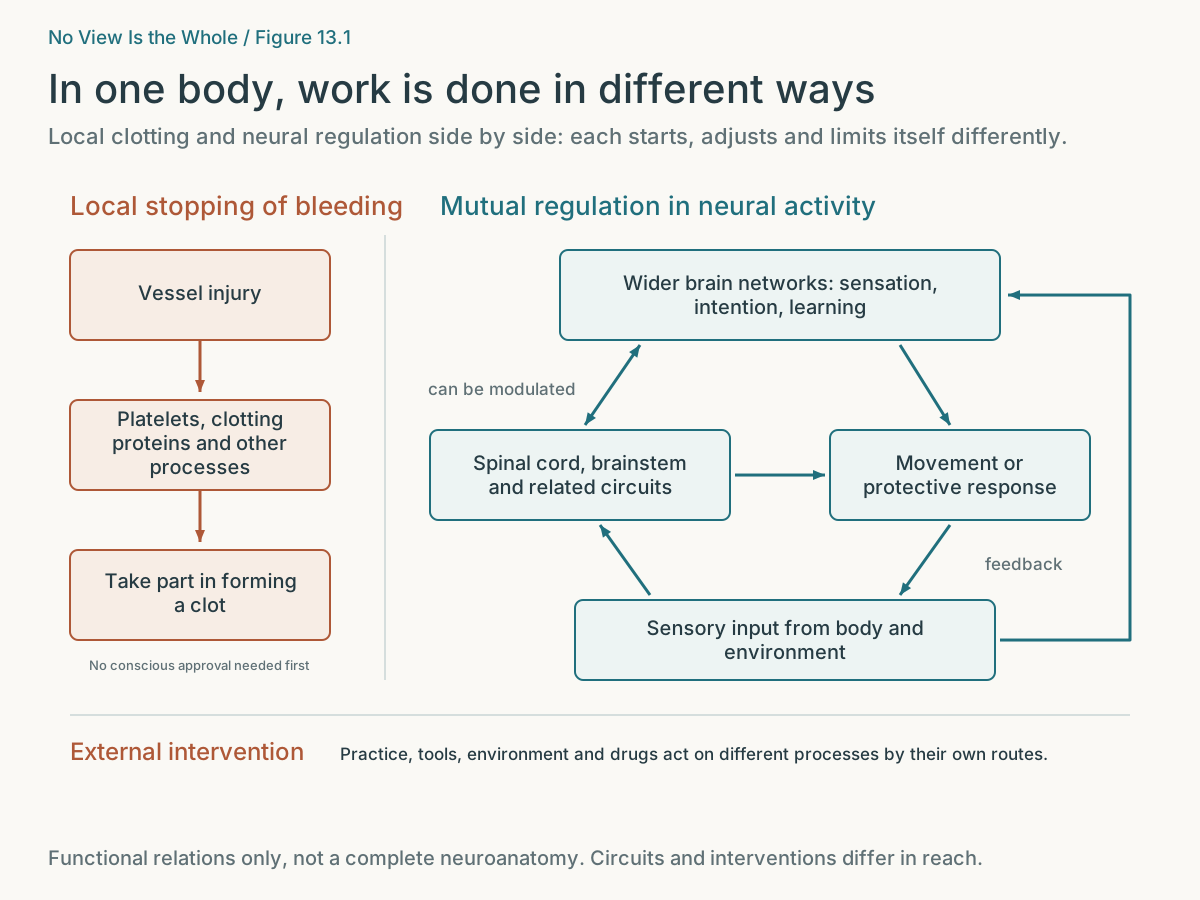
Coughing shows mutual regulation
咳嗽顯示了交互調節
In a quiet room, when the urge to cough rises in your throat, you can sometimes hold it back for a while and sometimes cannot; you can also cough deliberately to catch someone's attention. From the outside all of these are coughs, yet the processes that set them off and shape them are not quite the same. Research therefore has to separate the stimulus, the urge to cough, the number of coughs actually produced, and the activity that goes on during deliberate suppression.
Functional brain imaging studies by Stuart Mazzone and colleagues compared coughing with the suppression of coughing, among other conditions, and observed different patterns of brain activity, which supports the view that the control of coughing in humans involves networks above the brainstem. Differences in activity seen in the images help in studying the processes concerned, but they do not amount to establishing, from the images alone, the complete causal function of each region.64
The attempt to hold a cough back does affect it, and there are also times when it cannot be held. Being able to take an active part in regulation has not turned the body into a procedure that waits for one's approval every time.
在安靜的場合,喉嚨出現想咳的感覺,你有時能暫時忍住,有時忍不住;也可以為了提醒別人而刻意咳一聲。外表都是咳嗽,啟動與影響它的過程卻不完全相同。研究因此需要分開刺激、咳嗽衝動、實際咳出的次數,以及刻意抑制時的活動。
史都華・馬佐內等人的功能性腦影像研究,比較咳嗽與咳嗽抑制等情況,觀察到不同的腦活動模式,支持人類咳嗽的控制牽涉腦幹以上的網絡。影像中的活動差異能幫助研究相關過程,但不等於單憑影像就確定了每個區域的完整因果功能。64
忍住的企圖會影響咳嗽,也會有忍不住的時候。能主動參與調節,沒有使身體變成一套每次都等自己批准的程序。
People can also change themselves through external things
人也能透過外部事物改變自己
Deliberate adjustment does not happen only inside consciousness. You can change how you practise, arrange the environment you sleep in, lean on tools, and you can also alter certain physiological processes through medical intervention. These measures work in different ways and call for different bodies of knowledge; they cannot all be treated as another name for the will.
A small randomised trial by Alyn Morice and colleagues in 2007 shows what needs to be kept apart when an external intervention is assessed. The study treated chronic cough with morphine and observed improvement on some symptom scores; a citric acid cough challenge in the same study, however, did not show a significant change.65 The two methods of measurement produced different results: one recorded symptoms, the other observed the coughs elicited by an experimental stimulus.
A threshold is the level a condition has to reach before a given response begins to appear. To say that a drug has raised some cough threshold, one has to state what the stimulus was, how the response was measured, and how before and after the intervention were compared. Coughing less in daily life, or feeling more comfortable, is not by itself enough to prove that a stronger experimental stimulus is now needed to bring on a cough. Only by keeping these results apart can one know which kind of improvement the study actually supports.
A person can decide to accept an intervention without having to direct in person every physiological response that follows it. Researchers identify what a substance does and design trials, medical workers assess whether it suits a given case, and institutions affect whether a person can obtain help at all; the change that finally takes place in one person's body has depended on a great deal of work that was never inside that body.
This gives "changing yourself by your own efforts" a second meaning. A learner can choose the setting in which to practise, ask others to correct them, and use tools that issue reminders; these arrangements in turn gradually change their habits and their judgement. It is the present self that makes the arrangements, yet what the self can later do, and what it readily notices, will be shaped by them. A person's agency can extend through external conditions, and there is no need first to assume an inner commander in charge of the whole body.
刻意調整不只發生在意識裡。你可以改變練習方式、安排睡眠環境、借助工具,也可以透過醫療介入改變某些生理過程。這些做法的作用不同,需要各自的知識,不能全部視為意志的另一種名稱。
艾林・莫里斯等人二〇〇七年的一項小型隨機試驗,可以說明評估外部介入時要分清什麼。研究以嗎啡治療慢性咳嗽,觀察到部分症狀評量改善;同一研究的檸檬酸誘發咳嗽測試,卻沒有呈現顯著變化。65兩種測法取得了不同結果:一種記錄症狀,另一種觀察實驗刺激所引出的咳嗽。
閾值是開始出現某種反應所需條件的門檻。若要說藥物提高了某種咳嗽閾值,就須交代刺激是什麼、反應怎樣量,以及介入前後如何比較。日常咳得少或自覺較舒服,尚不足以單獨證明需要更強的實驗刺激才會咳。把這些結果分開,才能知道研究實際支持哪種改善。
人能決定接受一項介入,卻不用親自指揮介入後的每一項生理反應。研究者辨認物質作用、設計試驗,醫療工作者評估適用情況,制度影響人能否取得協助;最後發生在一個人身上的改變,依靠了許多不在他身體裡的工作。
這使「靠自己改變自己」也有了另一種意思。學習者可以選擇練習環境,請人糾正,使用會提醒自己的工具;這些安排又逐漸改變他的習慣和判斷。作出安排的是現在的自己,後來能做什麼、容易注意什麼,卻會受安排影響。人的主動性可以透過外部條件延伸,無須先假定有一個能統管全部身體的內在指揮者。
Which changes count as regulation
怎樣的變化,才是在調節
At this point it is tempting to call every natural change "information processing". But if a falling stone, clotting blood, catching a ball and debating a regulation are left with only one name between them, the very differences that were worth understanding disappear.
Start by comparing a stone with a thermostat. Both obey the laws of physics, but the thermostat has a sensor, a temperature setting and a switch: when the measured temperature departs from the setting, the device changes the heating. By adjusting the setting or disabling the sensor, one can check how each part affects the outcome. A stone falls, and has acquired no such set of measurement and response in doing so.
Nor is clotting simply another thermostat. It includes the triggering, amplification and limitation of a local reaction, while the control of movement draws on many kinds of continuously changing sensation. Learning may further change how one responds in future. To compare these processes, one should point out which differences they detect, how those differences alter activity, and how the outcome feeds into later responses.
Feedback can also arrive too late, or amplify the original deviation. A thermostat that keeps heating on the basis of an out-of-date temperature may fail to stop at the right moment; two modules that take turns undoing each other's changes may leave a piece of work being altered back and forth. The name feedback carries no guarantee that it helps. One has to check what it takes in and when it changes activity.
Letting fixed procedures carry out familiar tasks, letting the parts that can adjust their strategy deal with new situations, and then having people handle certain exceptions, is a division of labour that can be studied. Which part should take over depends on the information it receives, the time available to it, and the capacities it has already demonstrated. If a person cannot see the original situation and has only a few seconds to respond, writing "a human is responsible" does not supply the missing capacity.
What a whole can do may be something no single part can do on its own. Studying such a capacity means looking at local activity and at how the parts affect one another at the same time; calling one part the brain or the command centre still leaves one having to return to these concrete relations.
Once we cross over into society, the participants can also object to the goal. Workers protest, and their disagreement carries reasons that need to be heard; it cannot be treated across the board as a deviation awaiting correction. The body's division of labour can prompt questions, but it cannot provide legitimacy for anyone's right to demand anyone else's obedience.
談到這裡,容易把所有自然變化都叫作「資訊處理」。但若石頭落下、血液凝固、接球和討論一項規定都只剩同一個名稱,原先值得理解的差異反而不見了。
可以先比較石頭與恆溫裝置。兩者都服從物理規律,恆溫裝置卻有感測器、溫度設定與開關:量到的溫度偏離設定後,裝置會改變加熱。調整設定或讓感測器失效,可以檢查這些部分如何影響結果。石頭往下落,沒有因此具有同一套量測和回應。
凝血也不只是另一個恆溫器。它包含局部反應的啟動、放大與限制;動作控制則會利用持續變化的多種感覺。學習還可能改變未來如何回應。要比較這些過程,應指出它們偵測哪些差異、差異如何改變活動,以及結果如何影響後續反應。
回饋也可能來得太晚,或放大了原先的偏差。恆溫裝置如果依過時的溫度不斷加熱,就可能來不及在適當時候停止;兩個模組輪流撤回對方的修改,也可能使工作反覆改動。回饋的名稱沒有保證它有益,必須查它接收什麼、何時改變活動。
讓固定程序完成熟悉任務,讓能調整策略的部分應對新情況,再由人處理某些例外,是一種可研究的分工。哪一部分該接手,取決於它取得的資訊、可用的時間和已經證明的能力。若人看不到原始狀況,只剩幾秒回應,寫上「人工負責」也沒有補出缺少的能力。
一個整體能做的事,可能沒有任何單一部分獨自做得到。研究這種能力,需要同時看局部活動與彼此如何影響;稱某一部分為大腦或指揮中心,仍然得回到這些具體關係。
跨到社會以後,參與者還能反對目標。員工會抗議,他們的不同意有需要聽取的理由,不能一律當作等待校正的偏差。身體的分工可以啟發問題,卻不能替誰有權要求誰服從提供正當性。
Part Four
Understanding the World Together
第四部
共同理解世界
14 — Letting Other People's Findings Change Decisions
第十四章 讓別人的發現改變決定
Some people go to a bank in order to pay their salary into an account. They ask for no further services and agree to no other products, yet new accounts appear in their names.
Why would a bank open accounts for customers who know nothing about them? Besides serving existing needs, staff were also required to sell more products to the same customer. The number of accounts is easy to count; it can be recorded as performance, set as a target, and tied to rewards. If every added service came from the customer's own choice, the count might well show that business had grown.
In 2016 the U.S. Consumer Financial Protection Bureau took enforcement action against Wells Fargo. The regulatory documents record that employees, in order to meet sales targets and earn incentives, opened accounts without customers' consent; some of these operations also moved funds from customers' existing accounts into the new ones, leaving some customers to bear fees. The problems the regulator pointed to included sales incentives and inadequate oversight.66
The accounts really were created and the transactions really were recorded, but the thing those numbers were originally meant to stand for did not happen: a customer choosing a new service because they needed it. For the bank's evaluation there may have been one more sale on the books; for the unwitting customer there may have been fees, and paperwork that had to be sorted out.
A customer's consent is itself a necessary condition for the service to exist at all. Besides counting the accounts opened, the institution needs to let customers find out what has happened, stop services they never agreed to, and deal with the losses already caused. Raising the efficiency of account opening cannot take the place of these requirements.
有些人到銀行,是為了把薪水存進一個帳戶。他們沒有要求更多服務,也沒有同意開立別的產品,名下卻出現了新帳戶。
銀行為什麼要替不知情的客戶開戶?除了服務既有需求,員工也被要求向同一名客戶銷售更多產品。帳戶數量容易計算,可以列成績、設目標,也可以和獎酬接在一起。如果新增服務都出於客戶的選擇,數量或許能顯示業務增加。
二〇一六年,美國消費者金融保護局對富國銀行採取執法行動。監管文件記載,員工為達成銷售目標、取得獎勵,未經客戶同意開立帳戶;部分操作還把客戶原有帳戶的資金移進新帳戶,使一些客戶承擔費用。監管者指向的問題,包括銷售激勵與監督不足。66
帳戶確實被建立,交易也確實被記錄,卻沒有發生這些數字原先要代表的事:客戶因需要而選擇新的服務。對銀行的考核而言可能多了一筆業績,對不知情的客戶而言,卻可能多了費用和必須處理的帳務。
客戶的同意本身就是服務成立的必要條件。制度除了計算開戶數,還需要讓客戶查明發生了什麼、停止未同意的服務,並處理已造成的損失。這些要求無法由提高開戶效率代替。
What a tail actually proves
一條尾巴,究竟證明了什麼
In 1902 Hanoi, under French colonial rule, faced a rat infestation and the risk of disease. The newly built sewers brought modern sanitation to parts of the city, and also gave the rats a space in which to move and breed with ease. The colonial authorities organised a rat-killing campaign and paid by the piece.
Counting needs evidence. Large numbers of rat carcasses are hard to transport and tally; a tail is far smaller, and seemed enough to show that one rat had been disposed of. So the tail became the proof that earned the bounty. The historian Michael Vann traced the campaign through the colonial archives, and what he found in its aftermath included live rats without tails, and activity that supplied rats for the sake of the reward. A tail cut off could be exchanged for money; the rat that remained had not necessarily died.67
The tail was originally meant to prove that a rat had been eliminated; once a tail could be exchanged for money on its own, the supply of tails could come apart from any reduction in the number of living rats. Vann's research also sets these practices back within the residential divisions, labour and power of a colonial city. Who designed the payment scheme, who could earn an income from it, and who bore the infestation all shaped the campaign, and the question cannot be reduced to whether individual rat-catchers were greedy.
The bank's accounts and Hanoi's tails both show us a gap in time: before a metric becomes a target, it may be connected to the thing we care about; once the target is announced and people begin acting on it, the original relationship needs to be checked again.
Several researchers have studied changes of this kind from different fields. Charles Goodhart, discussing monetary management in the 1970s, noticed that a statistical relationship may change once it becomes a point of leverage for policy; Donald Campbell studied the distorting pressures on indicators used in social evaluation; and Marilyn Strathern, in a discussion of university assessment, set out the problem that arises when a measure becomes a target.68 The relationship observed when a metric was set will not necessarily persist unchanged once rewards and penalties have altered behaviour.
一九〇二年,法國殖民統治下的河內面臨鼠患與疾病風險。新建的下水道為部分地區帶來現代衛生設施,也讓老鼠有了便於移動和繁殖的空間。殖民當局組織滅鼠,並使用按件付酬的辦法。
計數需要憑據。大量老鼠屍體難以運送與清點,老鼠尾巴小得多,似乎也足以表示一隻老鼠已被除掉。於是尾巴成了領賞的證明。歷史學家麥可・凡恩從殖民檔案中追查這場行動,找到的後續卻包括無尾的活鼠,以及為賞金供應老鼠的活動。尾巴被剪下可以換錢,剩下的老鼠卻未必死去。67
尾巴原本用來證明老鼠已被消滅;當尾巴可以單獨換錢,供應尾巴便可能與減少活鼠數量分開。凡恩的研究還把這些做法放回殖民城市的居住差別、勞動與權力之中。誰設計付酬辦法、誰能靠它取得收入,以及鼠患由誰承擔,都會影響這場行動,不能只問個別捕鼠人是否貪心。
銀行的帳戶與河內的尾巴,都讓我們看見一個時間差:某個指標在成為目標以前,可能與我們在意的事相連;目標公布後,人開始針對它行動,原先的關係就需要重新檢查。
幾位研究者從不同領域研究過這類變化。查爾斯・顧德哈特在一九七〇年代討論貨幣管理時,注意到統計關係成為政策施力點後可能改變;唐納・坎伯研究社會評估指標受到的扭曲壓力;瑪莉琳・斯特拉森則在大學評鑑的討論中,說明量尺成為目標後的問題。68制定指標時所觀察的關係,不一定會在獎懲改變行為後照樣持續。
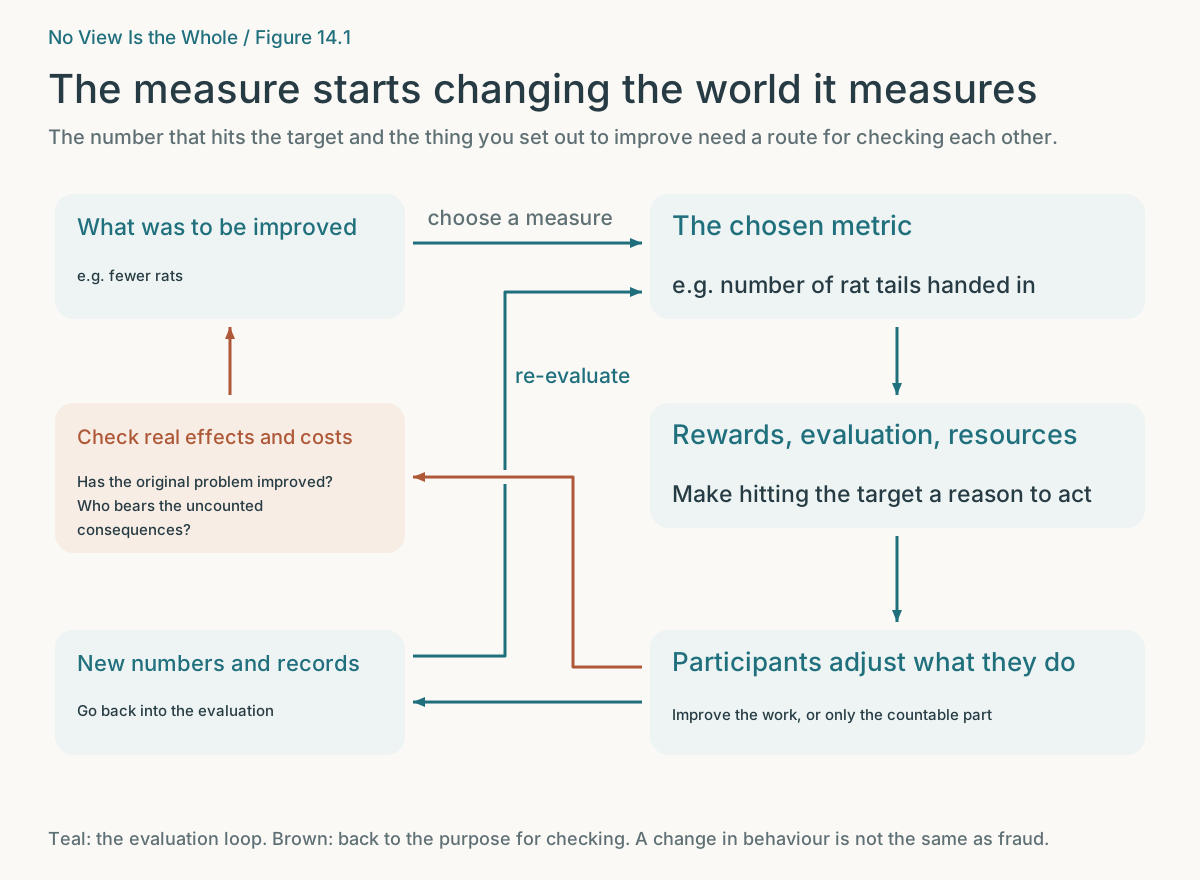
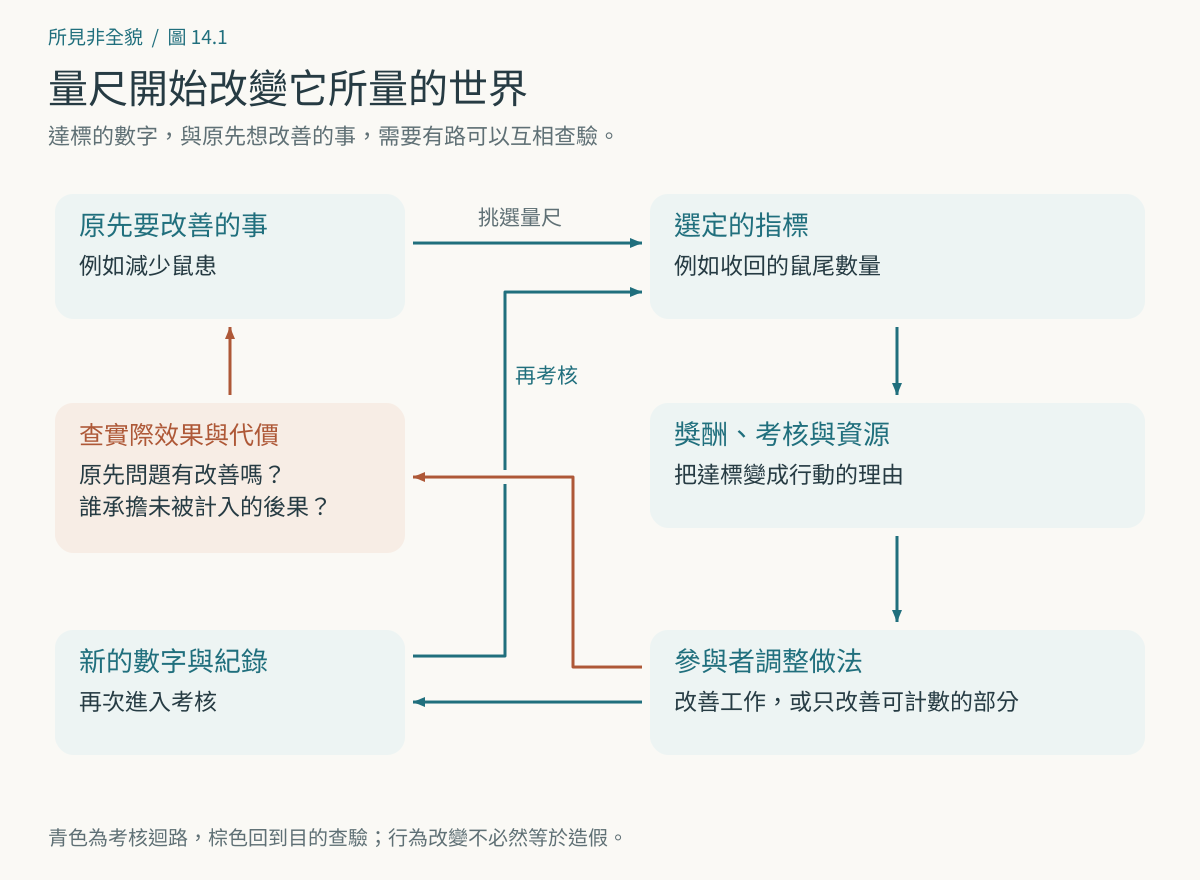
Four hours can change a hospital
四小時,可以改變一間醫院
England once faced the problem of emergency patients being held for long periods. A patient who had arrived at hospital might still wait and wait for assessment, a bed or the next arrangement. The government turned time into an explicit requirement: most emergency patients should be admitted, transferred or discharged within four hours. In 2005 the target demanded that 98 per cent be dealt with in that time.
It is not enough for the emergency department alone to move faster. If a patient who needs admission has no bed, however hard the frontline clinicians work, the next step cannot be completed. The hospital has to manage the coordination of tests, beds and the various departments; waits that had easily been seen as internal to emergency medicine began to become the responsibility of the whole hospital.
Researchers interviewed emergency department leaders at nine hospitals in 2008 and published their results in 2011. They recorded the changes in coordination, resources and process that interviewees reported, and also the pressure the time target brought and the doubts about quality.69 These interviews help us understand how hospitals responded to the target; whether patients received better care as a result still has to be checked against the corresponding clinical outcomes.
If decisions cluster just before the four-hour deadline, the patients' circumstances need further examination. Some may be tests, beds or transfers that had previously been delayed and were at last arranged in time; others may have been hurried out while they still needed observation. The distribution of times can point to where investigation is worthwhile; only the clinical picture, the subsequent outcomes and the actual process can help tell the causes apart.
Setting a target sometimes brings people who had each been busy on their own to work together on a single difficulty. But how the difficulty is named also decides who can join that work.
Consider a hypothetical job-help form. It asks: "What is the main difficulty you face in looking for work?" It offers only three options: no work experience, not knowing how to write a CV, and not knowing how to find vacancies. There is no box for anything further.
Someone may lack none of the three; the real constraint is a clash between the time needed to care for a family member and the fixed shifts the vacancies demand. What needs comparing here is two ways of keeping the record:
英格蘭曾面對急診病人長時間滯留的問題。病人進了醫院,仍可能一直等待評估、病床或後續安排。政府把時間訂成明確要求:大部分急診病人應在四小時內完成收治入院、轉送或出院。二〇〇五年,目標要求達到百分之九十八。
急診室自己跑快一點並不夠。如果需要住院的病人沒有病床,前端醫護再努力,也無法完成下一步。醫院必須處理檢查、病床與各科的協調;原先容易被視為急診內部的等待,開始成為整間醫院的責任。
研究者在二〇〇八年訪談九間醫院的急診領導者,於二〇一一年發表結果。他們記下受訪者報告的協調、資源與流程改變,也記錄時間目標帶來的壓力與品質疑慮。69這些訪談幫助我們了解院方如何回應目標;病人是否因此獲得較好的照護,還須核對相應的臨床結果。
若處置集中在四小時期限之前,便需要進一步查病人的情況。有些可能是原先拖延的檢查、病床或轉送終於被及時安排;另一些則可能在還需要觀察時被催促離開。時間分布能指出值得調查的位置,病況、後續結果與實際流程才能幫助區分原因。
訂下目標,有時使原先各自忙碌的人開始共同處理一項困難。可是,困難如何被命名,也會決定哪些人能加入這場工作。
請看一個假設的求職協助表單。它問:「你求職遇到的主要困難是什麼?」只提供三個選項:沒有工作經驗、不會撰寫履歷、不知道如何找職缺,而且沒有補充欄。
一個人可能三項都不缺,真正的限制是照顧家人的時間與職缺要求的固定排班衝突。這裡需要比較的,是兩種紀錄方式:
| Replies the form allows | Whether the record can retain this difficulty |
|---|---|
| Only one of the original three options | The clash between shift patterns and caring responsibilities cannot be recorded faithfully as a different kind of cause |
| Answers not on the list are allowed, and a procedure reviews the categories | There is a chance of recognising situations the original options left out; it still has to be checked whether the additional information actually enters the handling of the case |
| 表單容許的回覆 | 紀錄能否保留這項困難 |
|---|---|
| 只能從原三項選一項 | 無法把排班與照顧責任的衝突如實記為另一種原因 |
| 容許未列出的回答,並有程序檢視分類 | 有機會辨認原選項遺漏的情況;仍需檢查補充資料是否實際進入處理 |
In the first format, the omission in the classification cannot remove itself by collecting more copies of the same form. The person filling it in may give up, pick an option reluctantly, or look for another channel to explain; which of these happens needs actual investigation. What can be settled first is that the original options provided no place where this difference could be faithfully written down.
Then ask a further question: what if the help on offer is also allocated according to those three options alone? At that point the form is no longer merely describing difficulties. It may affect which kinds of help can be obtained, and it gives people reason to adjust what they say to fit what the institution will accept.
If the answers received match the three options more and more closely, that cannot be taken directly as evidence that the classification is correct. People may have learned how to answer in order to stand a chance of getting help.
Revising the form is a start. Suppose the additional box at last lets the person explain their caring responsibilities, and the caseworker, having read it, confirms it with them; the caseworker then knows that another CV course will not solve this difficulty. What has to be looked for next may be a working arrangement that fits, or other support for caring. Whether such help can be provided already runs up against the limits of how resources were originally allocated.
A new answer may call for a new practice, and it may call for deciding afresh whom this service is meant to help and how far it should go. Folding the exception back into the nearest old option keeps the reports tidy; hearing the exception out may let managers discover that the original question was asked too narrowly.
在第一種格式裡,分類的遺漏不能靠增加同一份表單的回收數量自行消除。填表者可能退出、勉強選一項,或另尋管道說明;究竟發生哪一種,需要實際調查。可以先確定的是,原有選項沒有提供忠實記下這項差異的位置。
接著再問:如果協助資源也只按那三個選項分配,會怎樣?這時表單便不只在描述困難。它可能影響哪些協助可以取得,也使人有理由調整自己的表達,以符合制度接受的內容。
如果收到的答案越來越符合三個選項,便不能直接當成分類正確的證據。人可能已經學會怎樣回答,才有機會取得協助。
修改表單是個開始。假設補充欄終於容許當事人說明照顧責任,承辦人閱讀後又與他確認,便知道重上履歷課並不能解決這次困難。接下來要尋找的可能是能配合的工作安排,或其他照顧支持。能否提供這些協助,已經碰到原來資源分配的範圍。
新的答案可能要求新做法,也可能要求重新決定這項服務應該幫誰、做到哪裡。把例外歸回最接近的舊選項,能讓報表繼續整齊;認真聽完這個例外,卻可能讓管理者發現,原先的問題問得太窄。
After a manual is revised
一本手冊改版之後
The Diagnostic and Statistical Manual of Mental Disorders, published by the American Psychiatric Association, is usually shortened to DSM. It organises diagnostic names and criteria so that research and clinical work can communicate in a reasonably consistent language. Medical, insurance and educational arrangements in different places also refer to diagnoses, so the classifications in the manual may, through these various institutions, affect the resources a person can obtain.
In 1980 the third edition formally included post-traumatic stress disorder. People living with the long-term effects of trauma had existed before that, and had been described and treated under other names. The new diagnosis provided a shared name and shared criteria, allowing researchers to compare cases in a more consistent way, and giving clinicians and the people concerned one more way to explain a difficulty and seek help.70 Whether resources actually increased still depended on how subsequent services and institutions adopted the classification.
In 1973 the Association decided to stop listing homosexuality itself as a mental disorder. That change involved research evidence, professional dispute, action by the people concerned, and a reassessment of which conditions should count as illness. The related diagnostic names continued to be adjusted afterwards, and stigma did not vanish with a single revision; but changing the diagnostic status put the reasons that had used a medical classification to support certain kinds of treatment under direct challenge.
The fifth edition, in 2013, brought several previously separate diagnoses, Asperger's syndrome among them, into autism spectrum disorder. The Association explained that some of the old categories had not been applied consistently across different clinical settings, and that there were research and diagnostic reasons for moving to a more integrated description. For people who had come to understand themselves under an old name, this also touched community, identity and the way they explained their own experience to others. How the criteria are revised, and whether a person still wishes to use a particular name for who they are, are not entirely the same decision.
The philosopher Ian Hacking called the back-and-forth influence between classifications and people "looping effects": a classification changes how people are treated and may change how they understand themselves; and as people accept, reject or adapt these names, researchers in turn rethink the classification.71 To study such effects, one has to trace which services, expectations and actions a diagnosis actually changed, and not infer every person's life from the name alone.
A child who receives a diagnosis may gain support that had been missing, and may also have their abilities underestimated. These two consequences need to be checked separately. Reducing stigma can proceed alongside taking the child's difficulties seriously; keeping a useful diagnosis still leaves room to change expectations that are set too low or services that do not fit.
美國精神醫學學會出版的《精神疾病診斷與統計手冊》,通常簡稱 DSM。它整理診斷名稱與準則,讓研究與臨床工作能用較一致的語言溝通。各地的醫療、保險與教育安排也會參考診斷,所以手冊中的分類,可能透過這些不同制度影響人能取得的資源。
一九八〇年,第三版正式納入創傷後壓力症。受到創傷長期影響的人,在此之前已經存在,也曾得到不同名稱的描述與治療。新診斷提供了共同的名稱與準則,使研究者能按較一致的方式比較案例,醫護與當事人也多了一種說明困難、尋求協助的方式。70資源是否實際增加,則仍取決於後續服務與制度如何採用這項分類。
一九七三年,學會決定不再把同性戀本身列作精神疾病。這項變化涉及研究證據、專業爭論、當事人的行動,以及對何種狀況應算作疾病的重新評估。相關診斷名稱此後仍有調整,污名也沒有隨一次改版消失;但改變診斷地位,使原先以醫學分類支持某些對待方式的理由,受到直接挑戰。
二〇一三年的第五版,把原先分開的若干診斷,包括亞斯伯格症,納入自閉症類群障礙。學會說明,一些舊分類在不同臨床環境中沒有被一致使用,改採較整合的描述有研究與診斷理由。對已用舊名稱理解自己的人而言,這也牽涉社群、身分與向他人解釋自身經驗的方式。準則怎樣修改,與一個人仍願不願意使用某個身分名稱,並非完全相同的決定。
哲學家伊恩・哈金把分類與人的往返影響稱為「迴圈效應」:分類改變人受到的對待,也可能改變自我理解;人接受、拒絕或改用這些名字,又使研究者重新思考分類。71要研究這種效應,得追查診斷實際改變了哪些服務、期待與行動,不能只由名稱推測每個人的生活。
一個孩子得到診斷後,可能取得原先缺少的支持,也可能被低估能力。這兩種後果需要分開查。改善污名,可以與認真處理孩子的困難同時進行;保留有用的診斷,也仍可改變過低的期待或不合適的服務。
The people an average score cannot see
平均分數看不到的人
Suppose a tool gets ninety-five of a hundred cases right. Knowing that figure alone, we do not yet know where the five errors fall: scattered across all kinds of situations, or almost all in the same predicament? Nor do we know whether the consequence is a notice that can be corrected, or the loss of an opportunity that is hard to recover.
Judging someone who does not meet the conditions to be eligible, and keeping out someone who does, sometimes need different channels before they can be discovered. The former enters the process, and their later performance may leave a record; the latter never gets the opportunity at all, and the system may never see them again. Follow-up data on those already admitted cannot by itself prove that everyone excluded ought to have been excluded.
Appeals and additional information can bring back errors that were not seen the first time. If someone wrongly excluded has a way to submit further evidence, for instance, the institution has a chance to look at their eligibility again. It also has to be checked whether the appeal takes so long that it cannot be used, whether the information needed was obtained, and whether the person receiving the appeal has the authority to correct the decision. A procedure listed on paper is not enough to show that errors can be dealt with.
A frontline worker may notice a kind of exception very early, yet have no field in which to record it; the person who has a field may only be able to add a note, without being able to change the decision; and the person with the authority to change the rules may see only the aggregated figures.
The form's additional explanation may run into an obstacle here too. The caseworker sees the clash between shifts and caring; those above receive only the statistics for the three established difficulties. Only if the original explanation is sent along to the people who can adjust the service does the new problem stand a chance of changing how resources are allocated.
Once it arrives, someone still has to respond. A decision that a service cannot be added for now also has to state which resources or which authority constrain it; only then can the records accumulate into a fresh discussion when the same kind of need appears again. The person concerned should not have to prove from scratch, every time they are passed to a different caseworker, that the same difficulty in their life really exists.
假設一套工具在一百個案例中判對九十五個。只知道這個數字,還不知道五個錯誤落在哪裡:分散在各種情況,還是幾乎都落在同一種處境?也不知道後果是一封可以更正的通知,還是使人失去難以追回的機會。
把不符合條件的人判為符合,與把符合的人擋在外面,有時需要不同管道才能發現。前者進入流程,後來的表現可能留下紀錄;後者根本沒有取得機會,系統未必再見到他。只有已被接納者的後續資料,不能自動證明被排除的人都應該被排除。
申訴與補充資料可以帶回原先未被看見的錯誤。例如,被錯誤排除的人若有辦法補交證據,制度才有機會重看他的資格。還要檢查申訴是否費時到無法使用、需要的資料是否取得了,以及受理者有沒有更正判定的權限。紙上列有程序,不足以證明錯誤能被處理。
第一線工作者可能很早就發現某種例外,卻沒有欄位記錄;有欄位的人可能只能備註,無法改變判定;有權修改規則的人又可能只看到彙總數字。
表單的補充說明,可能在這裡又遇到阻礙。承辦人看見排班與照顧的衝突,上級卻只收到三種既有困難的統計。若把原始說明一併送交能調整服務的人,新的問題才有機會改變資源如何分配。
送到之後還需要有人回應。決定暫時不能新增服務,也得說明受哪些資源或權限限制;同類需求再出現時,紀錄才有辦法累積成一次重新討論。當事人不必每次換一位承辦者,就從頭證明同一種生活困難確實存在。
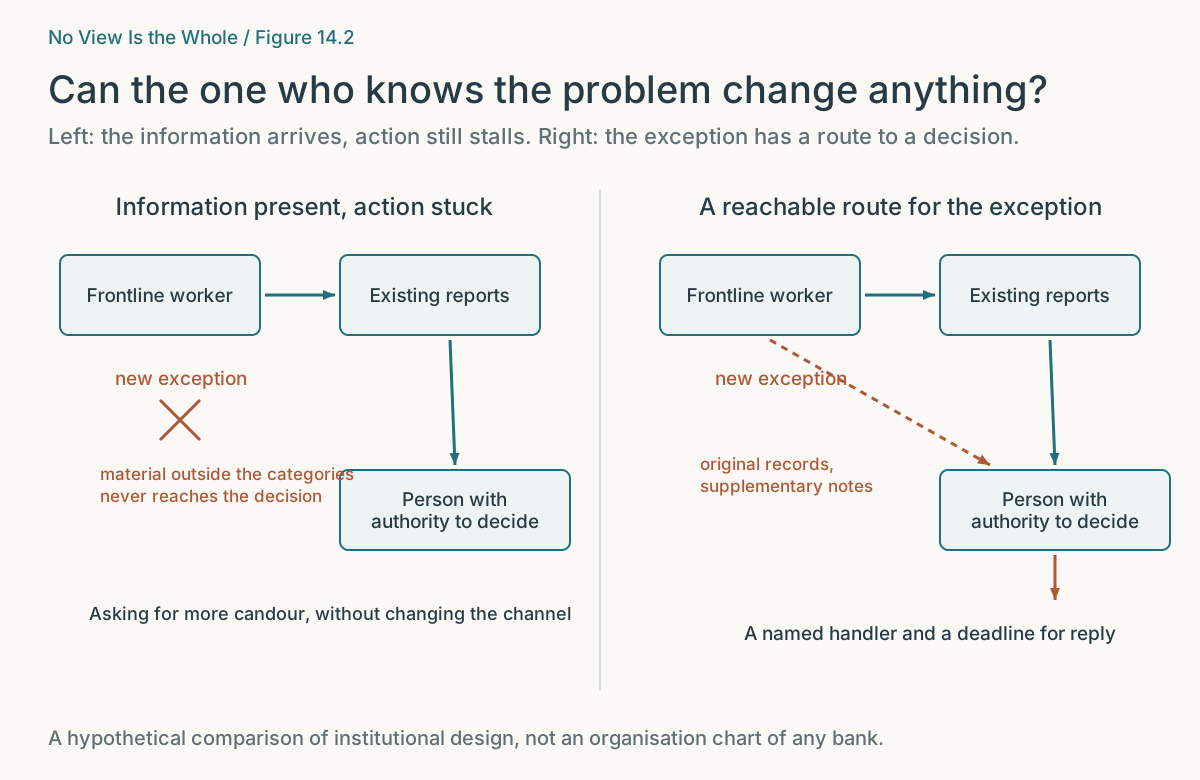
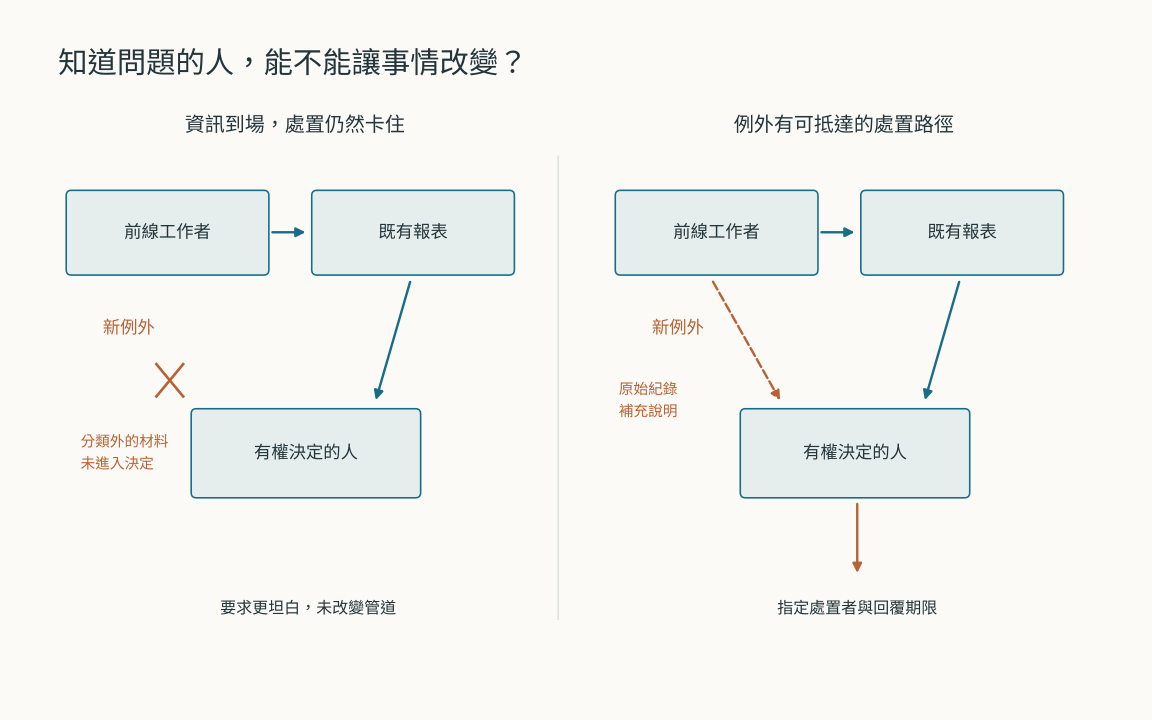
A worker who sees a failure still may not be able to decide alone what a new rule will mean for everyone. The person who holds the authority to decide may not understand the ground any better than the worker does. Bringing raw experience into the discussion does not require handing all authority to one side first; it requires that each side's reasons can actually change the proposal, and that the person responsible for the decision then explains which arrangement has been adopted.
Some results only show later. After the service is adjusted, whether the person concerned really has a better chance of finding work, and who has been given a heavier load by the new arrangement, both need new reports. That is how an institution can learn what its original classification never taught it.
But this depends on the people who raise the problem not being pushed out for making things more troublesome. An institution that lets only its designers name failure will find it hard to learn from experiences its designers never had. This limits knowledge, and it limits participants' influence on their shared life.
一名工作者看見失效,仍未必能獨自決定新規則對所有人的影響。持有決定權的人也未必比他了解現場。讓原始經驗進入討論,並不需要先把所有權限交給其中一方;它需要讓各方的理由能實際改變提議,最後由有責任作決定的人說明採取哪個安排。
有些結果要等後來才看得出。服務調整後,當事人是否真的比較有機會就業,新的安排又讓誰增加了負擔,都需要新的回報。制度因此能學到原先分類沒有教給它的事情。
但前提是,提出問題的人沒有因為使事情變麻煩而被排除。一套制度若只准制定者命名失敗,便很難從制定者未曾有過的經驗裡學習。這既限制知識,也限制參與者對共同生活的影響。
Placing ability outside the individual
把能力放到個人以外
Work distributed across different positions can also make up an ability that no individual had to begin with. As an aircraft prepares to land, the speeds that need attention at different stages depend on conditions such as weight and flap setting. The pilot has to know more than a single number; in the midst of a busy operation, they also have to recognise how the current speed relates to the speed needed next.
Studying the cockpit, Edwin Hutchins observed that reference cards, spoken confirmations, instruments and speed bugs all take part in this work. The required speeds can be looked up in advance and placed on the instrument as markers; afterwards, looking at where the needle stands in relation to the markers completes part of what might otherwise have required remembering the numbers and then comparing values.72
The markers move some of the work to beforehand, and they also turn a comparison of values into a comparison of positions in front of the eyes. If they are set wrongly, they preserve the error just as faithfully; the confirmation between the pilot and their colleagues is part of this ability. Testing one person alone on how much they can remember without tools would miss what the actual operation relies on.
Andy Clark and David Chalmers's "The Extended Mind" makes a stronger philosophical claim: under suitable conditions of coupling, external resources can become part of a cognitive process, and even of certain beliefs. The claim concerns how the boundary of the mind is to be drawn, and it remains a matter of philosophical dispute.73
The authors use a thought experiment to make the question concrete. Two people want to go to a museum; one recalls the address from memory, while the other, because of difficulties with memory, has long kept important information in a notebook carried everywhere, and turns to it as a matter of course when needed. If the notebook is reliably available, its contents consistently trusted, and it takes a continuing part in the person's life, should we exclude it from the relevant cognition simply because it lies outside the skin?
Even without ruling for now on whether the notebook belongs to the mind, we can still study how it takes part in a person's actual abilities. The same holds for the cockpit: the reference cards, the markers and the colleagues' confirmations are all factors that have to be examined when explaining performance and error.
As the scope of cooperation widens further, new problems appear. Departments in a company can exchange data yet pursue different interests; schools can share student records yet hold different ideas of what good education is. Doing cognitive work together does not mean that everyone has the same purpose or a single shared consciousness. In analysing an organisation, the disagreements between participants, and what each of them is able to decide, still have to be kept in view.
Cooperation between disciplines also meets institutional differences of this kind. Different disciplines may genuinely need different concepts, instruments and training; within a university, they also organise their own courses, award their own degrees, and use their own systems of publication and review. Researchers who want to work together therefore face more than conceptual problems.
For instance, a study that needs the methods of two fields at once may first have to settle: which side can assess the other side's evidence? To which kind of reviewer should the results be submitted? Is the time participants put in recognised within each side's system of evaluation? These institutional arrangements affect whether the cooperation can continue. If the whole difficulty is put down to "the two sides think differently", there is no training or evaluation system left that could be changed.
Researchers can first spend time learning to understand the other side's evidence, and they may also find that what is hardest to change is the evaluation system. Two people already know how to work together; the units they belong to may not give them the conditions to keep going.
分散在不同位置的工作,也能構成個人原先不具備的能力。飛機準備進場時,不同階段需要留意的速度,會受重量、襟翼等條件影響。飛行員不只要知道一個數字,還要在忙碌操作中辨認,眼前速度與接下來需要的速度有什麼關係。
艾德溫・赫欽斯研究駕駛艙時,觀察到資料卡、口頭確認、儀表與速度標記共同參與這項工作。所需速度可以事先查出,並以標記放到儀表上;後續看指針與標記的位置,就能完成原先可能需要記住數字、再作數值比較的一部分工作。72
標記把某些工作移到事前,也把數值比較轉為眼前的位置比較。它若設定有誤,同樣會保存錯誤;飛行員與同伴的確認,便是這份能力的一部分。單測一個人不帶工具時能記住多少,會漏掉實際操作依靠的東西。
安迪・克拉克與大衛・查默斯的〈延伸心智〉提出一個更強的哲學主張:在適當的結合條件下,外部資源可以成為認知過程、甚至某些信念的一部分。這個主張涉及如何劃定心智邊界,仍有哲學爭論。73
作者用一個思想實驗使問題具體起來。兩個人想去博物館,一個人從記憶想起地址;另一個人因記憶方面的困難,長期把重要資訊記在隨身筆記本,需要時自然翻閱。若筆記本穩定可用、內容受到一貫信任,並持續參與生活,我們應不應只因它在皮膚外,就把它排除在相關認知之外?
即使暫時不裁定筆記本是否屬於心智,我們仍可以研究它怎樣參與一個人的實際能力。駕駛艙也是如此:資料卡、標記與同伴確認,都是解釋表現與失誤時需要查的因素。
合作範圍再擴大,還會遇到新的問題。公司的部門可以交換資料,卻追求不同利益;學校可以共用學生紀錄,卻對好的教育有不同想法。共同完成認知工作,不等於所有人有同一目的或一個共同意識。分析組織時,仍須保留參與者的分歧,以及他們各自能作出什麼決定。
學科之間的合作,也會碰到這種制度差異。不同學科確實可能需要不同的概念、儀器與訓練;在大學裡,它們又分別組織課程、授予學位,並使用各自的發表與審查制度。研究者要合作時,面對的因此不只有概念問題。
例如,一項研究同時需要兩個領域的方法,就可能需要先確認:哪一邊能評估另一邊的證據?成果應交給哪類審查者?參與者付出的時間,在各自的評量方式裡是否得到承認?這些制度安排會影響合作能否持續。若把困難全算成「兩邊的人想法不同」,便找不到可以修改的訓練與評量方式。
研究者可以先花時間學懂另一邊的證據,也可能發現最難改變的是評量制度。兩個人已經知道怎樣合作,所屬單位卻未必給他們繼續做下去的條件。
What questions a talking system brings back
一個會說話的系統,帶回哪些問題
AI can learn from the text, images and other data that people have accumulated over a long time, and can also acquire abilities through different kinds of training and tools. Some work that once required a person to learn for many years is work in which machines can now provide useful results; how ability is distributed, though, cannot be guessed by following the order in which humans grow up. Doing a hard task well does not automatically make every apparently simpler task reliable.
Before discussing "whether it is intelligent", one can first sort out which question one wants to ask. The same answer may concern function, degree of resemblance to humans, internal mechanism or subjective experience:
AI 可以從人類長期累積的文字、圖像等資料學習,也能經由不同訓練與工具取得能力。某些工作原本需要人學習很多年,機器現在能在其中提供有用結果;能力如何分布,卻不能照著人的成長順序猜測。一項困難任務做得好,不會使所有看似更簡單的工作自動可靠。
討論「它有沒有智慧」以前,可以先分清自己想問哪件事。同一個回答,可能涉及功能、與人的相似程度、內部機制或主觀經驗:
| What you actually want to ask | Where to start checking | What this does not answer on its own |
|---|---|---|
| Whether it can complete a given piece of work | The task, its conditions, stability and failures | Whether it completes the work in the same way a person does |
| Whether its behaviour resembles a person's | Language, actions and modes of interaction | Whether it has the same feelings |
| What usable representations have formed inside it | How information affects its operation and transfer | Whether this is enough to produce subjective experience |
| Whether it has subjective experience | First clarify what experience means and what evidence would be acceptable | A single human-like answer cannot close the case |
| 實際想問的問題 | 可以從哪裡開始查 | 不能直接替它回答的問題 |
|---|---|---|
| 能不能完成某項工作 | 任務、條件、穩定度與失敗 | 是否以和人相同的方式完成 |
| 表現像不像人 | 語言、行動與互動方式 | 是否具有相同的感受 |
| 內部形成了什麼可用表示 | 資訊如何影響運作與遷移 | 這是否足以產生主觀經驗 |
| 有沒有主觀經驗 | 先釐清經驗與可接受的證據 | 一次像人的回答不能直接結案 |
Being able to produce sentences about grief is an observable performance; whether it feels grief still needs other arguments. That it uses statistical methods internally is likewise not enough on its own to decide whether it can understand. Only once the questions are sorted out do we know which kind of claim a given observation supports.
Deployment also makes a model part of other people's environment. A classification that exists only on paper and one that takes part in a great many screenings every day have different consequences. Users adjust their inputs, the people being classified respond to the rules, and later data may be affected by earlier decisions. So the original test scores still matter, yet they are not enough to answer how the new behaviour, power and costs are distributed.
In a hypothetical workflow, fixed programs can check clearly defined formats and constraints, AI or other search methods propose candidate solutions, and suitable trials then compare the results. AI might also first judge whether the conditions for a known method are met and then call a fixed procedure; if the results turn out anomalous, another approach is tried. Whether this division of labour is useful needs to be confirmed by testing on the task.
Some low-impact operations can be carried out first and logged, to be checked afterwards; some risks need to be constrained in advance. When a person takes over, they also have to be given the original situation and enough time. Which party seems more human, and which is called the intelligent core, cannot substitute for these arrangements. As for whether to change the shared goal, that still requires the participation of those who bear the responsibility and those who are affected.
Each stage may also receive the errors of the stage before. A model's explanations need to be checked against the original data, the tool results and the operation logs; if the generator and the checker would miss the same kind of problem, running it once more does not necessarily add much capacity to catch errors. When designing a check, state which kinds of error it can find.
A person with only a few seconds left, and no view of the crucial information, can hardly carry all the checking that the process on paper hands to them. Who is actually able to spot a problem, and who has the authority to halt or change things, should be designed together with the allocation of responsibility.
能產生關於悲傷的語句,是可觀察的表現;是否感到悲傷,則還需要其他論證。內部採用統計方法,也不足以單獨判定它能否理解。分清問題以後,才知道某項觀察支持的是哪一種主張。
部署還使模型成為別人的環境。分類只寫在紙上,與每天參與大量篩選,後果不同。使用者會調整輸入,被分類的人會回應規則,後續資料也可能受到先前決定影響。因此,原有測試成績仍重要,卻不足以回答新的行為、權力與代價怎樣分布。
在一套假設的工作流程裡,固定程式可以檢查已明確定義的格式和限制,AI 或其他搜尋方法提出候選方案,再由適合的試驗比較結果。AI 也可能先判斷是否符合已知方法的條件,然後呼叫固定流程;結果出現異常,再換一種方式處理。這些分工是否有用,需要由任務測試確認。
有些低影響操作可以先執行並留下紀錄,後續再查;有些風險需要事前限制。人接手時也得取得原始狀況與足夠時間。誰比較像人、誰被叫作智慧核心,都不能代替這些安排。至於是否更改共同目標,還需要讓承擔責任和受影響的人參與。
每個環節還可能接收到上一個環節的錯誤。模型的說明需要與原始資料、工具結果和操作紀錄核對;若生成者與檢查者會漏掉同一種問題,多做一次也未必多出多少查錯能力。設計檢查時,要說明它能發現哪類錯誤。
一名只剩幾秒鐘、又看不到關鍵資訊的人,難以承擔流程紙面上交給他的全部查驗工作。誰實際有能力發現問題、誰有權中止或改變,應與責任的分配一起設計。
Self-correction may serve only the original goal
自我修正,也可能只服務原來的目標
A system can be very good at correcting errors while allowing only one kind of error to be named. If a service system asks only whether processing time has been shortened, it can keep learning to close cases faster without ever learning to recognise whether the person's problem has actually been dealt with. Even if feedback from appeals is added, so long as appeals are still defined as a burden to be cleared, the feedback may help the system exclude dissatisfaction more efficiently.
Where the system once counted only the time taken to close a case, it now has to trace where that person's difficulty went after the case was closed. Receiving a new piece of experience sometimes makes us rethink even what "done" means.
Those who propose a new goal also need to state their reasons and the likely costs; others may still disagree. But if the institution accepts only suggestions about "how to close cases faster", and never lets anyone discuss whether a case has been resolved, the part that most needs changing stays permanently outside the discussion.
一套系統可以很擅長修正錯誤,同時只允許某一種錯誤被命名。如果服務系統只問是否縮短處理時間,它可以不斷學會更快關閉案件,卻從未學會辨認當事人的問題是否真正得到處理。就算加入申訴回饋,只要申訴仍被定義為待清除的負擔,回饋也可能幫助系統更有效地排除不滿。
原先只計算關閉案件的時間,現在得追查結案以後,那個人的困難去了哪裡。收到一份新的經驗,有時會讓我們連「完成」是什麼意思也重新想過。
提出新目標的人,也需要說明理由與可能代價;其他人仍可不同意。但如果制度只接受「怎樣更快結案」的建議,根本不讓人討論案件是否已解決,最需要改變的部分就一直不在討論之中。
15 — What Makes an Understanding Worth Relying On
第十五章 一種理解如何值得依靠
When we make a judgement, we are also changing how the next judgement can be made. Relying on a tool may save effort today while letting a skill that goes long unused slowly grow rusty; keeping a record of one failure adds work now, yet those who come later may be spared a stretch of wasted road because of it. The ways we understand the world are themselves changing the capacities and conditions within it.
Begin by comparing two hypothetical public service systems. At present they handle the same cases, and on the results that have been checked they are equally accurate. System A keeps suitable records of its failures, lets those affected add circumstances the original classification had no room for, and has someone responsible for dealing with errors once they are confirmed. System B gradually deletes its failure data, restricts outside comparison, and makes it harder for the people who raise exceptions to go on taking part.
Judged by the current rate of correct answers alone, there is no difference between them. But B is reducing the means by which we could learn about its later performance. Without records, it is hard to compare whether an error keeps recurring; without access to other sources, it is hard to know whether the original results were complete; once the people who raised exceptions have left, the omissions in the classification also become harder to see.
B may still get the next case right. What is disappearing is the basis on which anyone could later judge whether it did, and the means of making a correction once a problem has been confirmed. A choice made today has already altered the conditions for knowing in the future.
Personal candour cannot maintain these capacities on its own. Someone willing to admit mistakes may still not know where they went wrong if the only cases they can read about are the successes; an institution that speaks with confidence, if it submits to independent checks that have real effect, may be easier to examine than one that is modest in speech yet refuses to hand over its data. Attitude has to be matched by data, skill and authority before it can actually change a judgement.
Why should effort be spent on preserving the capacity to catch errors? A value judgement needs to be stated openly here: when an error could cause serious loss, and the chance of avoiding it can be kept open at a proportionate cost, we have reason to make that upkeep part of our choice. This is no command derived from the bare fact that people make mistakes. It gives weight to avoidable loss, and at the same time it requires costs, rights and other needs to be weighed against one another.
From this, the book puts forward a claim for evaluating long-term reliance: while serious uncertainty remains, the choice of a method should also take into account how it affects the capacity, later on, to obtain evidence, to learn, and to correct serious errors.
What is being evaluated here is the reason for continued use. The correct answers a book already contains do not become wrong because its author refuses criticism; but on content not yet verified, on new situations of use, or on future editions, a refusal to have errors checked affects what we have to go on in continuing to believe it. Whether an answer is true, what evidence there already is, and how evidence will be obtained and corrected later are three things that need to be set out separately.
The distinction also changes how each case is handled. A method that performs well yet lacks any channel for checking may be helped simply by adding external verification first, without the method itself having to be rewritten straight away. A method whose procedures are open yet which keeps giving wrong answers may need to be revised, or even relieved for a time of some important task; a willingness to be checked is not the same as already being able to do the job. Between A and B, the actual costs still have to be compared, and it cannot be concluded that A should be adopted whatever the price simply because it keeps more procedures in place.
我們在作判斷時,也在改變下一次能怎樣判斷。依靠一種工具,可能省下今天的力氣,卻使某項久未使用的本領逐漸生疏;保存一次失敗,眼前增加了工作,後來的人卻可能因此少走一段冤枉路。理解世界的方式,本身也在改變世界裡的能力與條件。
先比較兩套假設的公共服務系統。它們目前處理相同案件,在已核對的結果上同樣準確。甲保留適當的失敗紀錄,讓受影響者補充原分類沒有的情況,也有人負責處理已確認的錯誤。乙逐漸刪除失敗資料,限制外部比較,使提出例外的人更難繼續參與。
只看目前正確率,兩者沒有差別。但乙正在減少我們了解後續表現的辦法:沒有紀錄,就難以比較錯誤是否反覆發生;無法取得其他來源,就難以知道原先的結果是否完整;提出例外的人離開後,分類的遺漏也更不容易被看見。
乙下一次仍可能答對。正在消失的,是日後判斷它是否答對的根據,以及確認問題後作出更正的辦法。今天作出的選擇,已經改變了未來求知的條件。
個人的坦率不能獨自維持這些能力。一位願意認錯的人,如果只讀得到成功案例,仍可能不知道自己錯在哪裡;一個語氣自信的機構,如果接受有實效的獨立查核,也可能比口頭謙遜卻拒絕提供資料的機構更容易被檢查。態度要配合資料、技能與權限,才能實際改變判斷。
為什麼應該花力氣保留查錯能力?這裡需要明說一項價值判斷:當錯誤可能造成重要損失,而避免它的機會可以用相稱的代價維持,我們就有理由把這種維持納入選擇。這不是由「人會犯錯」單獨推出的命令;它同時重視可避免的損失,也要求比較成本、權利與其他需要。
由此,本書提出一項評價長期依賴的主張:重要的不確定仍存在時,選用一種方法,也應考慮它如何影響往後取得證據、學習與修正重要錯誤的能力。
這裡評價的是持續使用的理由。一本書已有的正確答案,不會因作者拒絕批評而變成錯誤;但在還沒核實的內容、新的使用情況或未來版本上,拒絕查錯會影響我們憑什麼繼續相信。答案是否為真、已有什麼證據,以及往後如何取得和修正證據,需要分開說明。
這個區分也會改變處理方式。表現很好但缺乏核對管道的方法,可能先補上外部查驗就有幫助,不必立刻重寫方法。程序公開卻持續答錯的方法,則可能需要修改,甚至暫停承擔某項重要任務;願意被檢查,不等於已經做得到。甲乙之間也仍須比較實際成本,不能只因甲保留較多程序,就認定無論代價多高都應採用。
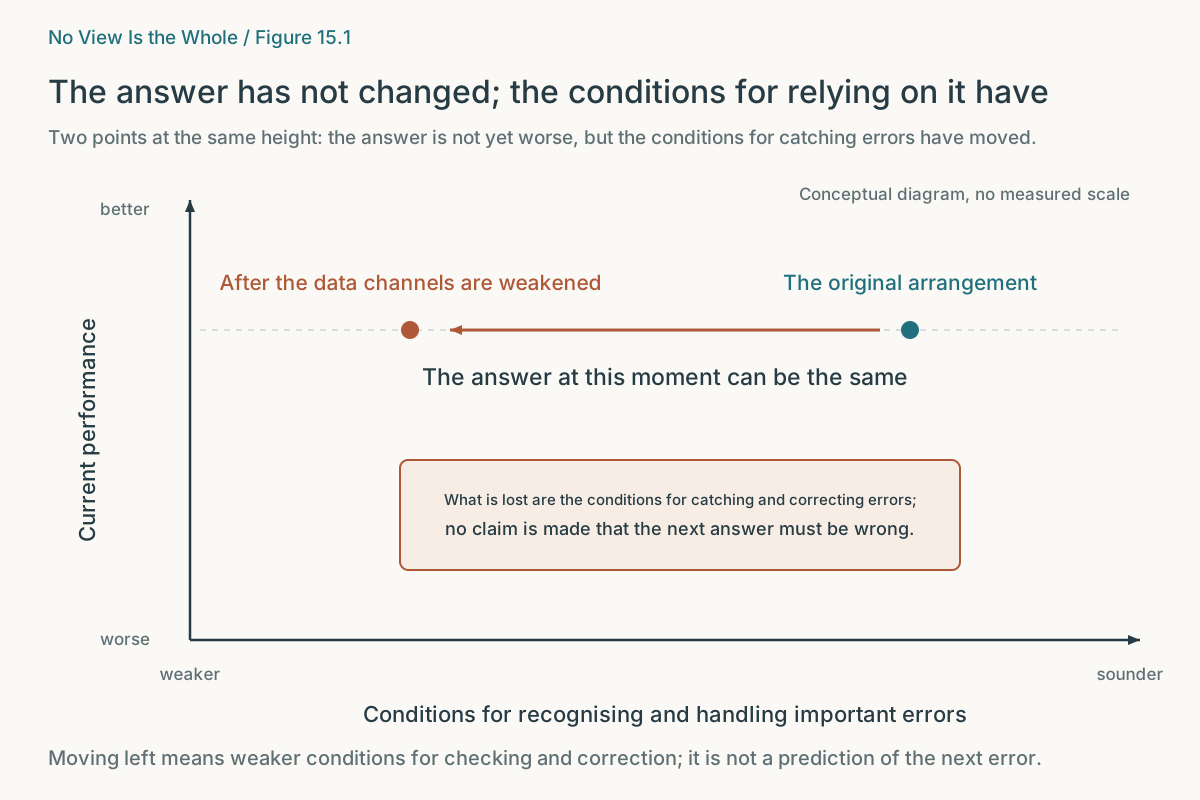
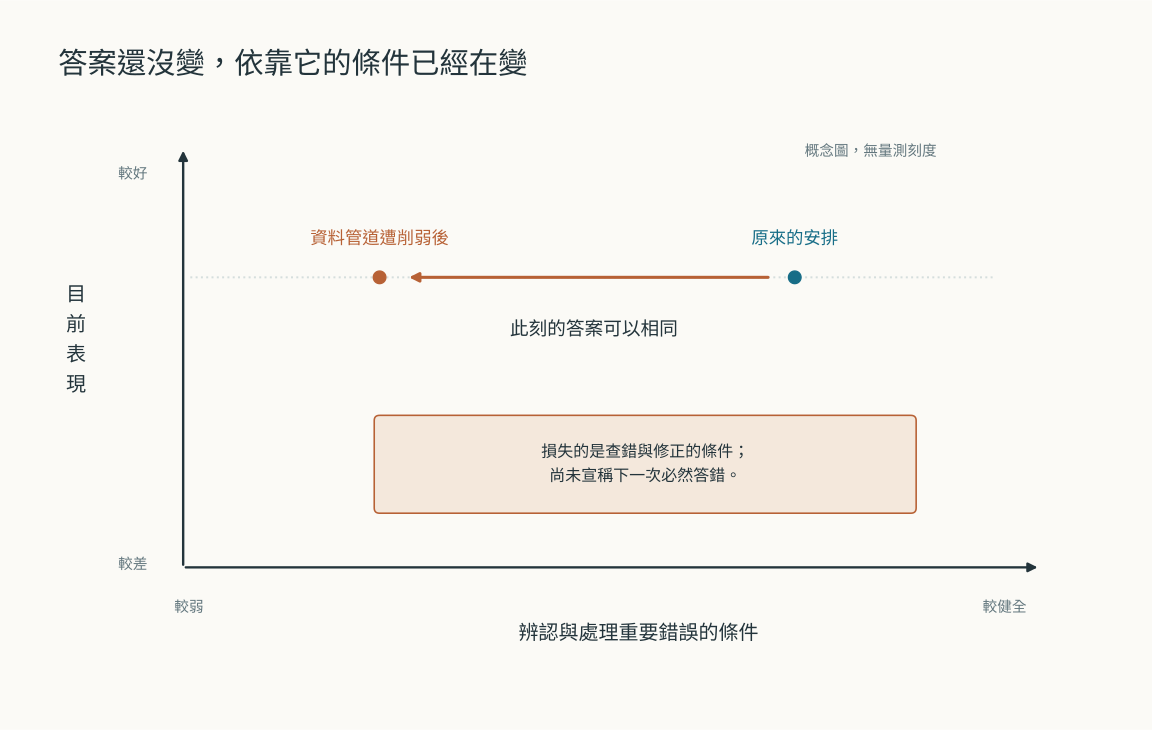
Conversely, adding an appeal channel that can actually overturn a determination, even before it has raised the average score, may allow people who previously had nowhere to appeal to point out omissions in the classification. Its effect still has to be checked and its cost assessed; but it cannot be concluded that the change has no value simply because the short-term score has not risen. What long-term reliance requires us to compare also includes which evidence can be obtained in future, and who is in a position to make that evidence change a decision.
反過來,新增一個能實際更正判定的申訴管道,即使還沒有提高平均分數,也可能讓原先無處申訴的人指出分類遺漏。成效仍須查驗,成本也須評估;但不能只因短期分數沒有上升,就認定這項變動沒有價值。長期依賴需要比較的,還包括未來能取得哪些證據、誰有辦法使證據改變決定。
Catching errors has costs too
查錯也有代價
Between services A and B, keeping more records is not always better either. More checking may lower efficiency, and it may intrude on privacy. Publishing certain data in full may expose vulnerable people to fresh harm. Allowing every objection to halt the work may leave an important service unable to run at all.
Preserving the capacity to catch errors has to be weighed together with cost, time limits and rights. Some information can be seen by independent examiners bound by obligations, without being opened to everyone; some exceptions are better reviewed at regular intervals than allowed to interrupt the work each time. The concrete arrangements have to be designed separately.
If an error-checking arrangement costs a great deal, adds almost nothing to what can actually be detected, or causes a graver loss that cannot reasonably be accepted, there may be no sufficient reason to keep it. Being given the name of oversight does not exempt it from a check on its costs.
There are also situations in which going on checking the same thing is simply not worth it. If we truly had a sufficient guarantee that a system must be correct under every relevant condition, and that it would never stray beyond those conditions, then checking the same thing over and over might do nothing except add cost. This is why the claim above was limited to cases where serious uncertainty remains and reliance will continue; for a result that is already guaranteed, the mere fact that it could be checked again is no ground for demanding more resources.
To apply such a guarantee to the system in front of us, its scope has to be established. Which premises does the formal proof use? Which inputs do the tests cover? Will actual use go beyond those conditions? So long as some part that could affect the outcome remains unconfirmed, the reason for catching errors has not entirely gone.
An opaque interior does not mean that every kind of reliable evidence is lacking. Performance records, external measurement and suitable comparison can sometimes supply sufficient reason for use. Whether the internal steps need to be understood depends on whether doing so would settle an important question still unconfirmed; transparency in itself cannot be treated as a necessary condition for all knowledge.
在甲乙兩套服務之間,保存更多紀錄也不總是比較好。增加查證可能降低效率,也可能侵害隱私。完整公開某些資料,可能讓弱勢者承受新的傷害。允許每一項異議暫停工作,則可能使重要服務無法運作。
保留查錯能力,需要與代價、時限及權利一起考慮。某些資訊可以由受約束的獨立檢查者接觸,不必向所有人公開;某些例外適合定期回看,不必每次立即中斷。具體制度需要另外設計。
如果一項查錯安排耗費巨大,實際提供的辨識能力微乎其微,或造成更嚴重且無法合理接受的損失,保留它便可能沒有充分理由。不能因為它被命名為監督,就免除成本檢查。
還有一些情況,繼續查同一件事根本不值得。假如我們真的已有充分保證,知道某個系統在全部相關條件下必然正確,又永遠不會超出那些條件,那麼為同一件事反覆查錯,可能只是增加成本。這也是前面把主張限於仍有重要不確定、而且會持續依賴的原因;對已獲保證的結果,不能僅憑「可以再檢查」就要求投入更多資源。
要把這種保證用於眼前系統,則需查明它的範圍。形式證明使用哪些前提?測試涵蓋哪些輸入?實際使用會不會超出那些條件?若仍有可能影響結果的部分沒有被確認,查錯的理由就尚未完全消失。
內部不透明,也不等於缺乏一切可靠證據。表現紀錄、外部量測與適當比較,有時已能提供充分的使用理由。是否需要了解內部步驟,要看它能否解決尚未確認的重要問題,不能把透明本身當成所有知識的必要條件。
Letting those who come after do more
讓後來的人能做得更多
Keeping data is useful because someone can take it and compare afresh; writing out reasons is useful because someone can learn them and point to a step that does not hold. If the data exist but no one has permission to read them, if the method is written down but practice and questioning are never allowed, what gets handed down may be nothing more than the name of an authority.
What we need to build together therefore includes data that can be obtained, practices that can be learnt, and openings through which new findings can enter decisions. These support one another. A new measurement may expose the inadequacy of an old classification; the account of someone directly affected may point to what ought to be measured; reasons made public allow people far away to redo the comparison. No single person has to know everything first, and other people's results can still become one's own new capacity.
More people able to take part does not make error disappear. A newly added examiner may also be swayed by interests, or may simply carry over the judgements of the original group. What is worth comparing is how much more the data and practices they bring can actually uncover.
The value of an added check can be relative and limited. Two checks that fail in different ways may expose problems better than one check repeated; making the source of the data traceable may be easier to verify than an authoritative signature alone; separating the authority to decide from certain interests may reduce particular distortions.
These comparisons do not have to wait for a final examiner who never errs. What they need are concrete reasons showing how the added arrangement changes risks already identified, and whether it is worth its cost. If a layer of oversight merely reproduces the blind spots already present, this book has no reason to count the added layer as progress.
Snow in Chapter 2 completed his comparison by relying on residents, landlords and water-supply records; the reader in Chapter 10 followed the reasons and learnt a method they had not known before; the service in Chapter 14 reconsidered what it offered, starting from difficulties the original form could not record. Together these pieces of work enlarged what later people could ask, check and do. Their value goes beyond making the old answers wrong a few times less often.
A coherent way of thinking can form through learning of this kind. Faced with different problems, it lets proof, interviewing, sensory practice or negotiation each do their own work; choosing among them in turn requires reasons that can be stated and that bear on the problem. One's own experience submits to the same demand. Even "this is how I usually check" can turn out to be a practice in need of revision.
This direction carries forward the thinking introduced earlier. Peirce and Dewey placed inquiry within difficulty, action and experience; bounded rationality brought time and ability into the explanation of judgement; Hutchins's research, together with Clark and Chalmers's argument for the extended mind, made arrangements beyond the individual harder to ignore. Putting these threads together, we can press the question: will the capacities we borrow today give the people of tomorrow a better chance to understand and change their own situation, or make it ever harder to see where something has gone wrong?
保留資料有用,是因為有人能拿它重新比較;寫出理由有用,是因為有人可以學會,指出其中一個不成立的步驟。若資料雖在卻沒人有權讀,方法雖寫下來卻從不容許練習和提問,傳下去的就可能只剩權威的名字。
我們需要一起建立的,因而包括能取得的資料、可學習的做法,以及使新發現進入決定的機會。這些事情互相支援。新的測量可能暴露舊分類的不足;當事人的說明可能指出該測什麼;公開的理由又能使遠方的人重做比較。沒有任何一個人需要先知道全部,別人的成果仍能成為自己的新能力。
能參與的人增加了,錯誤卻不會就此消失。新加入的檢查者也可能受到利益影響,或沿用原來那批人的判斷。值得比較的是,他帶來的資料和做法,究竟能多查出什麼。
新增檢查的價值可以是相對且有限的。兩種會以不同方式出錯的檢查,可能比重複一種檢查更能暴露問題;讓資料來源可追溯,可能比只有權威署名更容易核對;將決策權與某些利益分開,可能減少特定扭曲。
這些比較不必等待一個絕不犯錯的最終檢查者。它們需要的是具體理由,說明新增安排如何改變已辨認的風險,以及是否值得其代價。如果一層監督只是複製原有盲點,本書也沒有理由把層數增加當成進步。
第二章的史諾靠住戶、房東與供水紀錄完成比較,第十章的讀者沿著理由學會原先不會的方法,第十四章的服務則從原表單寫不出的困難重新考慮提供什麼。這些工作共同增加了後來能問、能查、能做的事情。它們的價值超過讓舊答案少錯幾次。
一套自洽的思考方式,可以在這樣的學習中形成。遇到不同問題,容許證明、訪問、感官練習或協商分別發揮作用;選用它們,又需要說得出與問題相關的理由。自己的經驗也接受同樣的要求。連「我習慣這樣查證」都可以成為需要修改的做法。
這個方向承接了前面介紹的思想。皮爾士與杜威把探究放在疑難、行動與經驗之中;有限理性使時間和能力進入對判斷的解釋;赫欽斯的研究,以及克拉克、查默斯對延伸心智的論證,則使個人以外的安排更難被忽略。把這些線索放在一起,我們可以追問:今天借助的能力,會讓明天的人更有機會了解和改變自己的處境,還是越來越難看見哪裡出了問題?
After seeing clearly, a commitment still has to be made
看清楚之後,仍要作出承諾
Yet those who come after becoming ever more able to achieve some purpose may also be the more worrying prospect. An oppressive institution can learn to recognise its own failures and maintain the oppression more effectively. Understanding how to get a thing done has not yet answered whether it is worth doing. Effectiveness in knowing cannot by itself manufacture ethical legitimacy. Whether those affected can make demands, and whether they have a right to be free of certain treatment, involves a normative position that has to be defended directly.
The position this book takes is that people should have a real opportunity to offer reasons, raise questions and seek suitable redress concerning arrangements that deeply affect their lives. How neural reflexes and control systems work has not chosen this position for us; a commitment to the standing of persons and to living together has to be defended with ethical and political reasons.
If the service system of Chapter 14 wants only to close cases faster, appeals may come to be treated as a number to be kept down. Giving those affected the right to question whether "closed" means the problem has been solved changes what the system ought to learn. Even so, once every party is able to give reasons, a choice everyone agrees on will not necessarily emerge.
In 2009, the breast cancer screening recommendation published by the U.S. Preventive Services Task Force provoked controversy. The recommendation of the time left the question of whether to begin regular mammography between the ages of forty and forty-nine as a decision that had to take account of individual circumstances and the weight given to benefits and harms; for ages fifty to seventy-four, it recommended screening every two years. What is discussed here is a historical document from that year, and it cannot serve as personal screening advice today.74
Screening looks, among people without relevant symptoms, for signs that may call for further examination. Finding certain cancers early can bring benefit, yet an abnormal result may in the end prove not to be cancer; and some cancers that are found and treated might never have caused symptoms or death within that person's lifetime. These different situations mean that "a few more cases found" cannot by itself answer the question of overall benefit and harm.
When comparing effects, the denominator also has to be known. Take first a set of hypothetical figures unrelated to any breast cancer screening data: some programme reduces a risk from four people in every hundred to two. To say "the risk is halved" is correct, and to say "two fewer people in every hundred" is also correct; the second lets the reader know at the same time how large the original risk was. When only the proportional reduction is reported, people readily form different pictures of the actual difference.
The controversy of that year concerned whether the evidence was sufficient, how the models estimated the effects, and how benefits and harms should be expressed. Even where some effects are estimated more clearly, it remains to be weighed how much expected benefit is worth how much additional examination, anxiety and cost of treatment. Where an individual has to decide, they also have to be given explanation and support they can understand; simply handing them the choice does nothing to lessen the difficulty.
Richard Rudner proposed in 1953 that how strong the evidence must be before a hypothesis is accepted may depend on the consequences of judging wrongly. Heather Douglas later went further, studying how such inductive risk bears on research methods, the reading of data and inference.75 A claim of this sort brings "how great a risk of misjudgement to bear" into the discussion; the evidence itself must still be handled truthfully.
For example, the grave consequences of failing to detect a harmful substance can lead us to demand different conditions of testing; they cannot lead us to rewrite a measured value because we hope the substance is harmless. That values take part in how uncertainty is borne does not mean the facts can be shaped at will.
Admitting that one may have seen wrongly does not require standing forever in the middle of every dispute. You can be willing to revise your judgement of an institution's effects while making clear that you will not support shifting heavy costs onto people who have no choice. The first concerns evidence; the second puts forward a position that has to be defended.
That position has a history of its own. Family, education and experience take part in what we care about, but finding the causes that formed a position is not the same as proving it wrong. What still has to be asked is this: knowing all that, are we now willing to go on owning it, can we explain our reasons to those it affects, and are we willing to face the consequences it brings about?
Reason, feeling and experience can all lead us to reassess a value. Coming to understand another person's situation may change the costs we were previously willing to accept; establishing the facts may take the ground from under an earlier anger. If we go further and want to turn our own commitment into a shared rule binding on others, we must also explain who can take part in the decision, and why those affected should accept such an arrangement.
然而,後來的人越來越能達成某個目的,也可能是更令人擔心的事。一套壓迫制度可以學會辨認自己的失誤,更有效地維持壓迫。了解怎樣把事做成,還沒有回答這件事是否值得做。認識上的效能不能自行製造倫理上的正當性。受影響者是否能提出要求、是否有免受某種對待的權利,包含需要直接辯護的規範立場。
本書採取的立場是:人應有實際機會對深刻影響自己生活的安排提出理由、質疑與適當的救濟要求。神經反射和控制系統怎樣運作,沒有替我們選定這個立場;對人的地位與共同生活的承諾,需要用倫理與政治的理由來辯護。
第十四章的服務系統若只想更快結案,申訴就可能被當成需要壓低的數字。讓當事人有權質疑「結案」是否等於問題已解決,會改變系統該學什麼。只是,等到各方都能提出理由,也不一定會出現大家同意的選擇。
二〇〇九年,美國預防服務工作小組公布的乳癌篩檢建議引起爭論。當時的建議,把四十至四十九歲是否開始定期乳房攝影,留作需要考慮個人情況與利弊權重的決定;對五十至七十四歲,則建議每兩年篩檢。這裡談的是當年的歷史文件,不能用作今天的個人篩檢建議。74
篩檢是在沒有相關症狀的人中,尋找可能需要進一步檢查的跡象。提早發現某些癌症可以帶來益處,異常結果卻也可能最後證實不是癌症;有些被發現並接受處理的癌症,在那個人的一生中原本可能不會造成症狀或死亡。這些不同情況,使「多找到幾例」不能獨自回答整體利弊。
比較效果時,還需要知道分母。先用一組與乳癌篩檢資料無關的假設數字:某方案把一項風險從每一百人四人降為兩人。說「風險減半」沒有錯,說「每一百人少兩人」也沒有錯;後者讓讀者同時知道原來的風險有多大。若只交代減少的比例,就容易使人對實際差額產生不同想像。
當年的爭論涉及證據是否充分、模型怎樣估計效果,以及如何表達利弊。即使某些效果估得更清楚,仍須比較多少預期益處值得承擔多少額外檢查、不安與治療代價。需要個人作決定時,也得提供他能理解的說明與支持;只把選擇交給他,沒有減少這份困難。
理查・魯德納在一九五三年提出:證據要多強才足以接受一項假設,可能與誤判的後果有關。海瑟・道格拉斯後來進一步研究,這類風險如何影響研究方法、資料判讀與推論。75這種主張把「要承擔多大的誤判風險」列入討論,證據本身仍須如實處理。
例如,漏檢有害物質的後果嚴重,可以使我們要求不同的檢查條件;不能因希望它無害,就改寫量測值。價值參與如何承擔不確定,不表示事實可以隨意塑造。
承認自己可能看錯,也不要求永遠站在爭議中間。你可以願意修正對制度效果的判斷,同時表明,不願支持把重大代價集中轉給沒有選擇的人。前者談證據,後者提出需要辯護的立場。
這份立場也有來歷。家庭、教育與經驗參與我們在意什麼,但找到形成原因,不等於證明它錯。還需要問的是:知道這些之後,現在願不願意繼續認領它,能不能向受影響的人說明理由,又願不願意面對它造成的後果。
理性、情感與經驗都可能使我們重新評估一項價值。聽懂別人的處境,可能改變原先願意接受的代價;查明事實,也可能使原來的憤怒失去理由。若進一步要把自己的承諾變成約束他人的共同規則,則還須說明誰能參與決定,以及為什麼受影響的人應接受這種安排。
From understanding back to action, and back again
從理解回到行動,再回來
The choosing, checking and practising discussed so far move in two kinds of loop. To get something clear, we form an interpretation from observation, state an expectation, and then revise it with new material. To get something done, we choose an action with a purpose in mind, and when the results arrive we check the method and may also change the original purpose.
The two loops can interleave. A trial run under suitable conditions can help identify a need that could not be articulated before; a research finding may strip an otherwise attractive goal of its justification. But action is not an all-purpose licence to experiment. When someone will be hurt, when rights and interests will change, when an opportunity may not be recoverable, a thing cannot be carried through simply because it would aid learning.
A single check may also change what was originally to be done. Recovering the record made on the spot may mean correcting only one number; hearing out the experience of someone never asked before may reveal that the scope of the problem needs to widen. There is no need at that point to run through every earlier chapter again; following the difficulty that has actually appeared is enough.
The stopping question of Chapter 11 still holds: what might the next step of analysis change, and how much time is it worth? Even so, that a question will not change the action in front of us for now does not mean it is never worth studying. You can complete the present decision first and set aside other time for the needs of learning and understanding for their own sake. The two pieces of work do not have to be settled on the same evening.
With time, some distinctions become second nature. You do not have to recite the definitions of observation and interpretation before noticing that an accusation carries an unproven guess inside it; nor do you have to draw the whole institutional map before knowing that the person in front of you lacks the authority to deal with a problem they have already seen. Once a method has been learnt, it can take up less of one's awareness, leaving attention for the differences that belong to this occasion alone.
前面談過的選擇、查證與練習,有兩種往返。為了弄清一件事,我們從觀察形成解釋,提出預期,再用新材料修正。為了做成一件事,我們帶著目的選擇行動,遇到結果以後,既檢查方法,也可能改變原先的目的。
兩種往返可以交錯。條件合宜的試行,可以幫助辨認原先說不清楚的需要;一項研究發現,也可能使某個本來有吸引力的目標失去理由。但行動不是萬用的實驗權。有人會受傷、權益會改變、機會可能無法追回時,不能只因有助學習,就把事情做下去。
一次查證也可能改變原先要做的事。找回現場紀錄,也許只需更正一個數字;聽完原先沒被詢問者的經驗,卻可能發現問題的範圍需要擴大。這時不必把前面每一章重新跑過,沿著實際出現的困難繼續就好。
第十一章的停止問題仍有效:下一步分析可能改變什麼,又值得多少時間?不過,暫時不會改變眼前行動,不等於一個疑問永遠不值得研究。你可以先完成當前決定,另留時間滿足學習與理解本身的需要。兩份工作不必在同一個晚上結清。
久了以後,有些區分會變得自然。你不必先背出觀察與解釋的定義,才發現一句指責裡多了一項尚未證實的猜測;也不必畫完整張制度圖,才知道眼前的人沒有權限處理他已經看見的問題。方法學會之後,可以少佔一點意識,把注意力留給這一次才有的差異。
One way of thinking, with room for different practices
同一套思考,容得下不同做法
The sentence from the preface, "I have thought about it carefully", now has a continuation. What information was to hand while thinking, whose methods were borrowed, what still remains undealt with? Only in answering these questions do we learn what that care accomplished.
Reflection itself has to submit to this kind of checking. Going back over one's reasons may turn up a contradiction, or it may amount to turning the same thoughts over and over, eating up time for observation, rest and action. If, because we advocate reflection, we no longer allow its effects and costs to be compared, we have made an exception for precisely the method we trust most.
Coherence has practical content here. If I hold that the origins of a view may shape other people's judgements, I cannot declare that a statement has no formation history worth studying merely because it came from me. If I say direct experience deserves weight, I must also allow other people's experience to raise difficulties for my classifications. The same reason can carry different weight on different occasions, but the difference has to be supported by the circumstances and cannot be settled by "this time it is me".
A familiar operation can rely on practice that has already received feedback; an unfamiliar choice may call for looking up more data; in an emergency, one must use whatever capacity is most reliable at that moment. These differences need not break the coherence; what has to be accounted for is why time, evidence and consequences led us to switch to another practice.
Consistency is still not enough to guarantee correctness. A whole set of ideas may rest on wrong data, or may never have counted in the needs of some group of people. So besides checking whether one's own statements are compatible with one another, they have to be compared against actual results, other people's experience and objections.
序裡那句「我已經認真想過了」,現在多了一段可以繼續的說明。想的時候拿到了哪些資訊,借了誰的方法,哪些事情仍未處理?回答這些問題,才知道這份認真完成了什麼。
反省本身也需要接受這種檢查。重看理由可能找出矛盾,也可能只是反覆想同樣的事,耗去觀察、休息與行動的時間。若我們因為提倡反省,就不再允許比較它的效果與成本,恰好又替自己最相信的方法設了例外。
自洽在這裡有實際內容。假如我認為來歷可能影響別人的判斷,便不能只因某句話出自自己,就宣布它沒有值得研究的形成條件。假如我說直接經驗值得重視,也應容許他人的經驗對我的分類提出困難。同一項理由可以在不同場合有不同分量,差別需要由情況支持,不能只由「這次是我」來決定。
熟悉的操作可以依靠已有回饋的練習,陌生的選擇可能需要多查一些資料,緊急時又得使用當下最可靠的能力。這些差異不必破壞連貫;需要交代的是,時間、證據和後果為什麼使我們改用另一種做法。
前後一致仍不足以保證正確:整套想法可能使用了錯誤資料,也可能始終沒有把某群人的需要算進去。因此,除了檢查自己的說法能否相容,還要與實際結果、他人經驗和反駁比較。
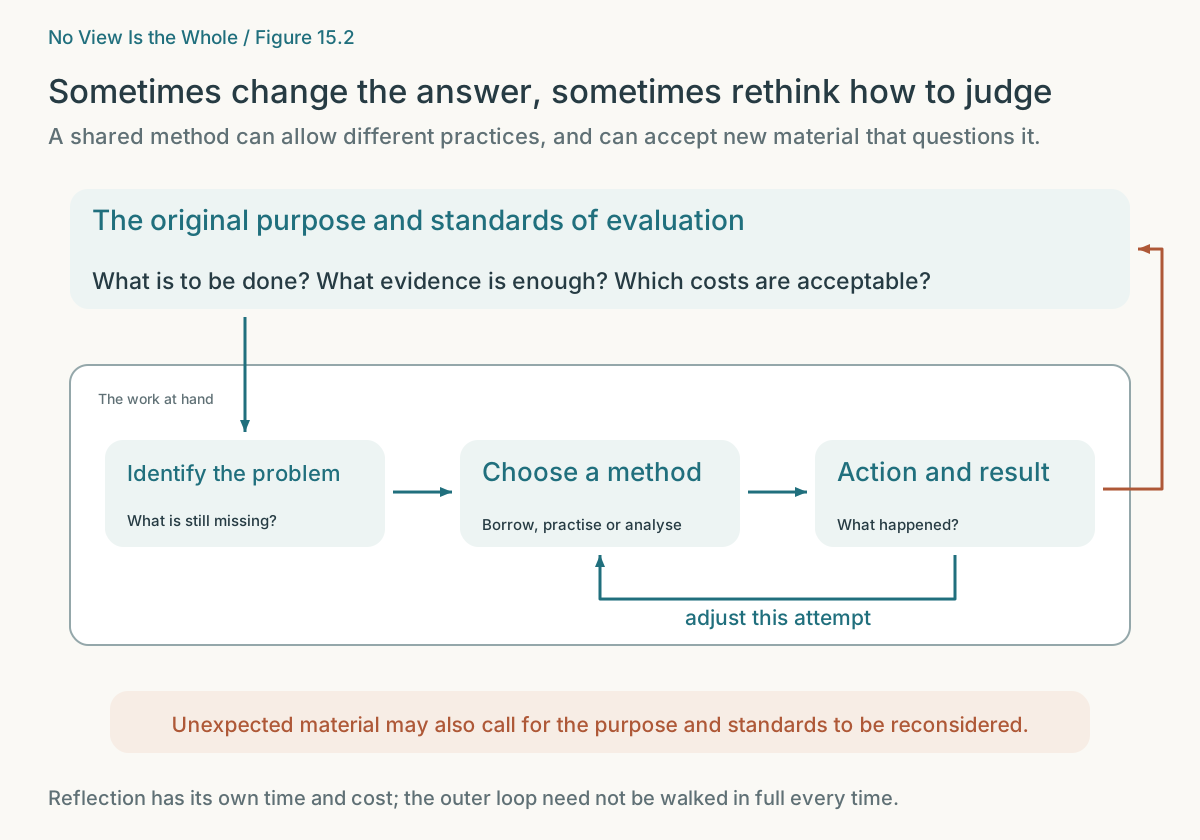
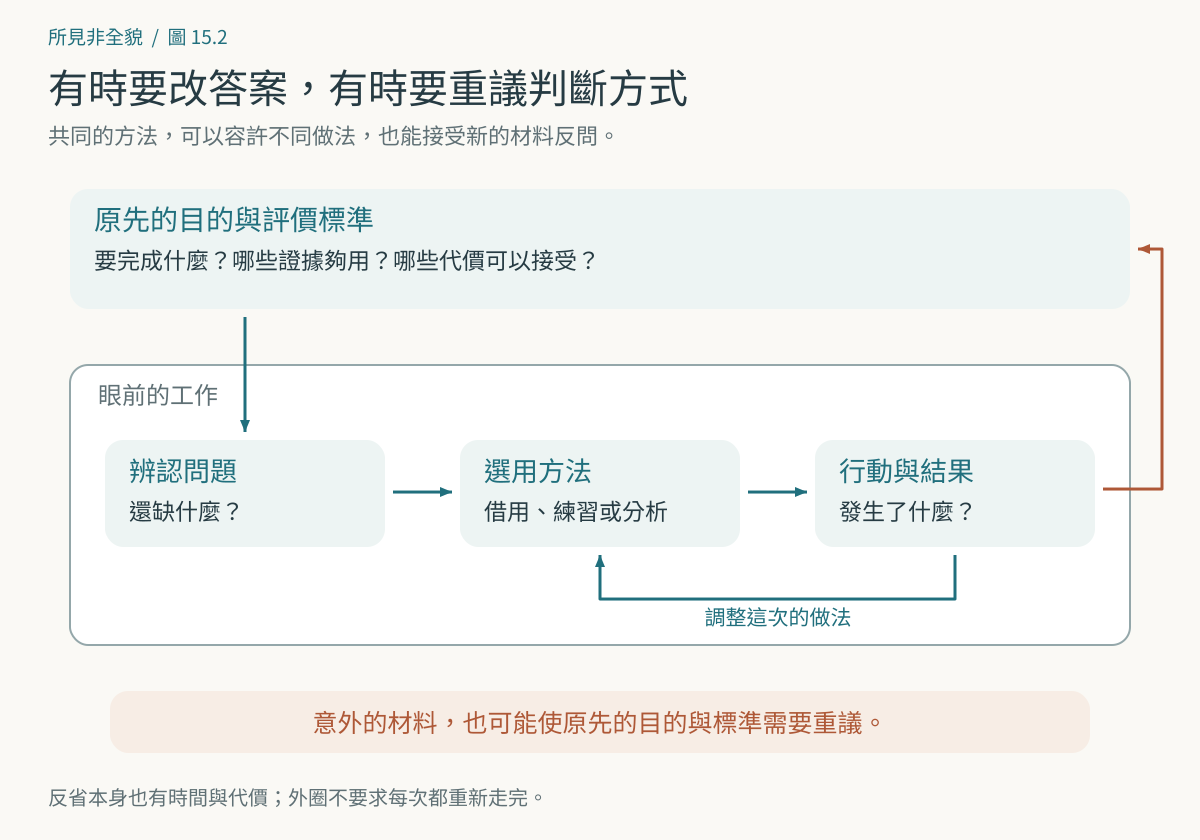
To demand, every time, that the criteria be proved infallible before one is permitted to begin is to fall back into the difficulty of Chapter 11. Judgement moves forward on the knowledge it already has, and leaves places where one can come back later and correct it.
Those who come after will do more than correct us. Given the reasons and the chances to practise that we leave behind, they may ask questions we have not yet thought of. Making that possible is one more reason an understanding deserves to be handed down.
如果要求每次都先證明判準絕不會錯,才准自己開始,就又回到了第十一章的困難。判斷依靠已有的知識往前走,也留下日後能回來更正的地方。
後來者不只會更正我們。他可能因為得到我們留下的理由與練習機會,問出我們還沒想到的問題。能使這件事發生,也是一種理解值得被傳下去的理由。
This book is in it too
本書也在其中
This book has chosen certain stories, materials and ways of putting things, and so it readily draws the reader's attention to some matters while passing over others. It spends many pages on method, but what a person sometimes truly lacks is time to rest, or someone willing to hear them tell the whole story through. To write all of that up as a failure of thinking would misread their situation just as badly.
If a reader finds that a distinction does not help, that an example does not match the data, or that following the analysis caused them to miss what ought to have been done, this book too needs to change. It cannot earn the standing of something worth relying on in advance, merely by advocating correction.
這本書選擇了某些故事、材料和說法,也因此容易使讀者注意到某些事,略過另一些事。它用許多篇幅談方法,但一個人有時真正缺的是可以休息的時間,或一個願意聽他把經過說完的人。把一切再寫成思考不足,同樣會誤解他的處境。
讀者若發現一項區分沒有幫助,某個例子與資料不符,或照著分析反而錯過了該做的事,本書也需要改。它不能只因為提倡修正,就先取得值得依靠的資格。
Afterword — After Understanding, Living Together
結語 理解之後,還要一起生活
When the priest handed the child to the woodcutter, the killing in the wood still had no answer. Nor did we find one for him in the chapters that followed. Whether the woodcutter stole the dagger, and how he will care for the child from now on, remain things that still have to be understood.
Yet the two men had already responded from within that incomplete understanding. The story did not wait for everything to be established before letting someone carry the child away in his arms. This has kept me attentive to one thing. We want to get matters clear, and often we want it because other people live inside those matters with us, waiting for an answer, or bearing the consequences of there being none yet.
Knowing this does not suddenly make judgement easy. Some harms have to be stopped at once, while some causes take a long time to trace; some people can state their reasons clearly, while others have not yet found the right words. We need knowledge, and we also need the time, the tools and the help from one another that let knowledge arrive.
To write down a reason is to hand one's own understanding to someone else. They may carry on using it, or they may point to what we failed to see. Someone is willing to leave a record of a failure; someone is willing to demonstrate a movement that cannot be put into words; someone brings into the discussion an experience that previously had nowhere to be voiced. Later understanding begins from concrete work of this kind.
We cannot decide for the next person what they ought to see. What we can do is make sure that today's understanding, useful as it already is, does not become the reason they can no longer ask tomorrow.
僧人把孩子交給樵夫時,林中的命案還沒有答案。我們也沒有在後面的章節替他找出答案。樵夫是否偷了短刀,與他往後會怎樣照顧孩子,仍然是需要繼續了解的事。
可是,兩個人已經在那份不完整的了解中作出回應。故事沒有等一切查清,才讓孩子有人抱著離開。這使我一直留意:我們想把事情弄清楚,往往也因為有人和我們一起活在其中,等著一個答覆,或承受還沒有答覆的後果。
知道這一點,並不會使判斷突然容易。有些傷害需要立即停止,有些原因要花很久才能查明;有些人能把理由說得清楚,有些人還找不到合適的字。我們需要知識,也需要讓知識能抵達的時間、工具和彼此的協助。
寫下一個理由,是把自己的理解交給別人。他可能接著用,也可能指出我們沒看見的地方。有人肯留下失敗的紀錄,有人願意示範一個說不清的動作,有人使原來沒有地方發聲的經驗進入討論。後來的了解,從這些具體的工作開始。
我們無法替下一個人決定他應當看見什麼。可以做的,是別讓今天這份已經很有用的理解,成為他明天無法再問的理由。
Coordinates and Sources
思想座標與資料來源
The historical facts, studies, interviews and retellings of literary works in the main text rest on the sources listed below. Images are credited separately in their captions and image-source notes; historical image files are kept apart from the diagrams drawn for this book. Literary works are kept for their narrative and intellectual value; interviews are kept as the experience of those interviewed and as reconstruction after the event. Cases explicitly marked as hypothetical are used to test reasoning and do not pose as actual events. The evaluative claims and institutional proposals in Chapter 15 are positions this book puts forward and defends; they should not be read as conclusions that the works below jointly endorse.
正文的史實、研究、訪談與文學轉述,以下列來源為依據。圖片另按各項圖說與圖像來源標示;歷史圖檔與本書自繪示意圖分開。文學作品保留其敘事與思想價值,訪談保留受訪經驗與事後重建的性質。明示為假設的案例用來檢查推論,不冒充實際事件。第十五章的評價主張與制度提議,是本書提出並辯護的立場,不應被讀成下列文獻共同認可的結論。
- Emily Pronin and Matthew B. Kugler (2007). “Valuing thoughts, ignoring behavior: The introspection illusion as a source of the bias blind spot.” Journal of Experimental Social Psychology 43: 565–578. Original paper. The study compares the different weight given to introspection, behaviour and other material when assessing one's own biases and those of others; it does not mean that every person in every judgement is necessarily like this, and whether a reason holds cannot be decided directly from how it came about. ↩
- Heinz Wimmer and Josef Perner (1983). “Beliefs about beliefs: Representation and constraining function of wrong beliefs in young children’s understanding of deception.” Cognition 13(1): 103–128. Original paper90004-5). The ball, the box and the drawer in the Preface are an illustration adapted from the false-belief task based on a change in an object's location, not a verbatim retelling of the original experimental scene. The book uses it to show how what different people know can be understood within one scene; passing one task is not equated with full self-awareness, and it is not claimed that everyone has the same moment of insight. What this book calls "the second realisation" is a metaphor the author uses to describe counting oneself in, not a further universal developmental stage confirmed by this research. Nor does the children's task on its own establish the normative demands this book makes of adult judgement. ↩
- Oskar Pfungst (1911). Clever Hans (The Horse of Mr. von Osten): A Contribution to Experimental Animal and Human Psychology. Translated by Carl L. Rahn. Henry Holt and Company; the German original was published in 1907. Full text of the original study. The whispered addition in Chapter 1 follows the book's experiments in which "the questioner does not know the answer": 3 correct out of 31 tests with unknown sums, 29 correct out of 31 tests with known sums. For the postural and head signals see the book's analysis of movements; these figures are limited to that set of tests. ↩
- Immanuel Kant, Critique of Pure Reason (1781/1787). Gutenberg English translation. Chapters 1 and 7 use it as the intellectual background on sensibility, concepts and the status of geometry; the bearing of non-Euclidean geometry on Kant's thought is still disputed among interpreters, and a brief case is not used to declare his whole epistemology void. The chapter discusses the problem that non-Euclidean geometry poses for Kant's argument about geometry, and does not use a spherical diagram or a single mathematical development to declare his whole epistemology overturned. ↩1 ↩2
- Elizabeth F. Loftus & John C. Palmer (1974). “Reconstruction of Automobile Destruction: An Example of the Interaction Between Language and Memory.” Journal of Verbal Learning and Verbal Behavior, 13, 585–589. Original paper. Chapter 1 keeps the two experiments separate, and does not write the speed estimates and the broken-glass question a week later as one test on the same group of people. The chapter's claim is limited to the difference between the question asked and the later answer that the study showed; it does not infer that memory can be rewritten at will, or that everyone is affected in the same way in every situation. ↩
- John Snow, the map recording the 1854 outbreak in On the Mode of Communication of Cholera. Image file and rights information. The original is in the public domain; this book uses the 3,840-pixel version provided with the file, with the content of the map unaltered. The clustering of deaths on the map cannot on its own replace the investigation of the water source. ↩
- John Snow (1855). On the Mode of Communication of Cholera, 2nd ed. John Churchill. Original text of the Broad Street investigation, original text of the water-company comparison, hosted by the UCLA John Snow site. Chapter 2 retells the workhouse, the brewery, the Hampstead case and the water-supply investigation from the book. The figure of 535 refers to the workhouse's resident population; the eight- to ninefold figure compares deaths per 10,000 supplied houses in the first seven weeks of the outbreak, not the risk per 10,000 people. The book also records supplies not yet identified and cases that were estimated. ↩1 ↩2
- Philip E. Tetlock (2005). Expert Political Judgment: How Good Is It? How Can We Know? Princeton University Press. Digital copy of the book. Chapter 2 adopts the research design of long-term tracking and comparison of forecasts; the weather figures for calibration and discrimination are this book's own example. The chapter does not use one general comparison to pass judgement on all experts, nor does it treat calibration as wholly unrelated to intelligence or professional knowledge; the research should be understood by its questions, its baselines and its scoring. ↩
- Lewis Carroll (1865). Alice's Adventures in Wonderland, Chapter III, “A Caucus-Race and a Long Tale”. Original text. Chapter 3 retells the episode in this book's own words; the reading of purpose, evaluation and the allocation of costs is this book's argument. ↩
- Underground Railways of London (1908). Image file and rights information. The file page lists the author as unknown and the work as public domain; the 1,932 × 1,530 pixel image supplied is used. It serves as a historical map from before Beck's design and is not treated as a controlled comparison of the same network. ↩
- Henry Charles Beck, London Underground Transport (1933), the second edition of that year; collection number 8727.003. David Rumsey collection record and licence details. Image credit: David Rumsey Map Collection, David Rumsey Map Center, Stanford Libraries. The image is used under the CC BY-NC-SA 3.0 licence listed by the collection; it has not been cropped, recoloured or redrawn. This licence for the digital file applies separately to the right-hand image of Figure 4.1. ↩
- Transport for London Corporate Archives. Research Guide No. 24: Harry Beck. Archive research guide; London Transport Museum, the 1933 pocket Underground map in the collection. Chapter 4 keeps the history of the design and its adoption, and does not merge the payments for different commissions into a single anecdote. ↩
- Jill H. Larkin & Herbert A. Simon (1987). “Why a Diagram Is (Sometimes) Worth Ten Thousand Words.” Cognitive Science, 11(1), 65–100. DOI of the original paper. Chapter 4 carries forward the distinction between informational and computational equivalence; the multiplication of numbers and the route diagram are this book's teaching constructions. ↩
- Bureau d'Enquêtes et d'Analyses (2012). Final Report on the Accident on 1st June 2009 to the Airbus A330-203 Registered F-GZCP Operated by Air France, Flight AF 447 Rio de Janeiro–Paris. Investigation report, preserved by the FAA. For the sequence of control inputs and warnings see pages 21–24 of the report; for the analysis and conclusions see sections 2 and 3. Chapter 5 uses it to distinguish the control inputs, the validity of the airspeed readings, the state of the aircraft and the crew's understanding; the problem of hand-over at the interface is the angle of analysis this book draws from it. ↩
- Joel Spolsky (2002-11-11). “The Law of Leaky Abstractions.” The author's original text. Chapter 5 keeps the name "leaky abstraction", separating the empirical generalisation from engineering from the cross-domain argument this book makes on its own account; the example of two sets of data with the same summary where a new question demands different answers offers a necessity argument with explicit premises, and does not claim that one engineering article proves every abstraction must be wrong for every use. ↩
- IETF (2022). RFC 9293: Transmission Control Protocol (TCP), in particular the description of the service in section 2.2 and the handling of connection failure in section 3.8.3. Formal specification. A reliable, ordered byte-stream service does not amount to delivery within a fixed time or a connection that never drops; the main text does not write failures the specification allows as violations of the specification by the protocol. ↩
- Lisanne Bainbridge (1983). “Ironies of Automation.” Automatica, 19(6), 775–779. PDF of the original paper. Chapter 5 adopts its analysis of the manual tasks, the skills and the difficulty of taking over that remain after automation. ↩
- Gregory A. Daddis (2011). No Sure Victory: Measuring U.S. Army Effectiveness and Progress in the Vietnam War. Oxford University Press. Publisher's record. Chapter 5 uses the many performance metrics and the difficulty of reading them to discuss strategic judgement; this analysis does not amount to a single cause of the war's outcome. ↩
- NASA Science, Building Blocks. Chapter 5 uses it only to distinguish dark matter, dark energy and their observational background, and does not claim that the ultimate physical nature of either is known. ↩
- Hans Christian Andersen, “The Little Match Girl”, in Andersen's Fairy Tales. Gutenberg English translation. Chapter 6 retells the story in this book's own words, keeping the sequence of the stove, the roast goose, the Christmas tree, the star and the grandmother, and the ending in which she is taken to God while what the street sees is a death. ↩
- Bertram R. Forer (1949). “The Fallacy of Personal Validation: A Classroom Demonstration of Gullibility.” The Journal of Abnormal and Social Psychology, 44(1), 118–123. DOI of the original paper. Chapter 6 keeps the classroom demonstration, distinguishing the rating of the diagnostic instrument from the rating of the descriptive content, and does not let satisfaction stand in for the ability to discriminate. ↩
- Ted J. Kaptchuk et al. (2010). “Placebos without Deception: A Randomized Controlled Trial in Irritable Bowel Syndrome.” PLOS ONE, 5(12), e15591. Full text of the study. Chapter 6 is limited to the study's short-term, self-reported symptom outcomes and its research conditions. ↩
- Thomas S. Kuhn (1957). The Copernican Revolution. Harvard University Press; NASA Science, Orbits and Kepler’s Laws. Chapter 6 keeps the comparison of calculation and theory in the history of astronomy apart from the basic account of modern orbits; it does not repeat the contrast of "degrees for the old tables, arcseconds for the new", which comes without the object, the period and the precision conditions attached. ↩
- Jon Kabat-Zinn (2003). “Mindfulness-Based Interventions in Context: Past, Present, and Future.” Clinical Psychology: Science and Practice, 10(2), 144–156. DOI of the original paper. Chapter 6 uses it for the formation of mindfulness-based stress reduction and its traditional background; it does not say that every ethical context has been removed by the course, nor does it claim in general that every use is effective. ↩
- Euclid, Elements, the Greek text of the geometry with mathematical commentary; Girolamo Saccheri, Euclides ab omni naevo vindicatus (1733); Bernhard Riemann, “Über die Hypothesen, welche der Geometrie zu Grunde liegen” (lecture 1854, published 1868). The spherical diagram in Chapter 7 is a mathematical illustration, not a complete proof of the independence of the postulate. ↩
- Neil Ashby (2003). “Relativity in the Global Positioning System.” Living Reviews in Relativity, 6, 1. Full text of the study. Chapter 7 adopts the explanation that comparing times requires relativistic correction; it does not treat one idealised conversion as a fixed daily positioning error for every receiver. The actual positioning error depends on the system's configuration and corrections, and cannot be obtained by simply multiplying a time difference by the speed of light and treating the result as a fixed daily position offset borne by every user. ↩
- Bertrand Russell (1912). The Problems of Philosophy, Chapter VI, “On Induction”. Original text. Chapter 7 keeps the chicken of the original and does not mix in the timing or the holiday of the later turkey version; this book's practical discussion of extrapolation does not claim to have solved the whole problem of induction. ↩
- IPCC (2021). Climate Change 2021: The Physical Science Basis, Chapter 1, Chapter 7. Chapter 7 distinguishes model ensembles, sensitivity ranges and emission scenarios. The assessed ranges carry their own confidence levels; the use of RCP8.5 does not automatically make it the most likely future, or a strict upper bound on all futures. ↩
- Abraham Wald (1943; reprinted 1980). A Method of Estimating Plane Vulnerability Based on Damage of Survivors. Center for Naval Analyses; originally a set of memoranda for the Statistical Research Group at Columbia. Reprint in the archive, transcription of the text. Chapter 8 follows its research question, estimating loss probabilities from survivor data, and does not add dramatised dialogue between officers and mathematicians. The popular version, "add armour only where the bullet holes are fewest", does not state the assumptions Wald's estimate relied on. The chapter keeps the distinction between the probability of being hit and the probability of surviving a hit, and does not treat the count of holes as a complete rule for armour design in itself. ↩
- Cardiac Arrhythmia Suppression Trial Investigators (1989). “Preliminary Report: Effect of Encainide and Flecainide on Mortality in a Randomized Trial of Arrhythmia Suppression after Myocardial Infarction.” New England Journal of Medicine, 321, 406–412. Record of the original paper, NHLBI study database description. Chapter 8 draws on the results of the specific treatment arms to discuss the difference between surrogate indicators and survival outcomes. ↩
- F. W. Dyson, A. S. Eddington & C. Davidson (1920). “A Determination of the Deflection of Light by the Sun’s Gravitational Field, from Observations Made at the Total Eclipse of May 29, 1919.” Philosophical Transactions of the Royal Society A, 220, 291–333. Original paper. Chapter 8 keeps the expeditions, the measurements and the test of the theory apart, and does not add inner monologue for the observers. The chapter does not treat every plate as equally clear and fully consistent with the others, nor does it equate one measurement with the sole verdict on an entire theory. ↩
- Karl R. Popper (1963). Conjectures and Refutations, Chapter 1; Popper (1978). “Natural Selection and the Emergence of Mind.” Dialectica, 32(3–4), 339–355. DOI of the 1978 article. Chapter 8 distinguishes the claim about testability, Popper's own account of himself and his revision regarding natural selection. ↩1 ↩2
- Peter T. Boag & Peter R. Grant (1981). “Intense Natural Selection in a Population of Darwin’s Finches (Geospizinae) in the Galápagos.” Science, 214(4516), 82–85. DOI of the original paper. Chapter 8 uses the comparison of specific traits, food and survival to illustrate testable content, and does not treat one observation as the sole verdict on the whole theory of evolution. ↩
- Albert A. Michelson & Edward W. Morley (1887). “On the Relative Motion of the Earth and the Luminiferous Æther.” Transcription of the original paper. Chapter 8 describes a fringe shift far smaller than expected; it does not write that the instrument produced no interference fringes, nor does it compress the whole later development of theory into a single overturning on the day. ↩
- Ignaz Semmelweis (1861). Die Aetiologie, der Begriff und die Prophylaxis des Kindbettfiebers. Record of the book, with images and partial translation. Chapter 8 follows his record for the comparison of the clinics, the contamination hypothesis and the washing measures; the professional and emotional cost that admitting error may involve is raised in the main text as a general analysis, and is not used to pronounce on the motives of each historical figure. ↩
- Akira Kurosawa (director), Shinobu Hashimoto and Akira Kurosawa (screenplay), Rashomon (1950), adapted from the work of Ryūnosuke Akutagawa. Criterion film record, Stephen Prince's review and structural analysis, plot summary of the film. What Chapter 9 retells is the film: the shelter from the rain under the gate, the differing causes of death in the testimonies, the woodcutter's changed account, the accusation over the dagger and the adoption of the child; the film's framing plot does not belong to the content of Akutagawa's original “In a Grove”. ↩
- Thomas S. Kuhn (1977). The Essential Tension: Selected Studies in Scientific Tradition and Change. University of Chicago Press, the preface's retrospective on reading Aristotle. Digital copy of the book. Chapter 9 treats it as the author's retrospective, distinguishing understanding the meaning of the words, accepting a historical theory and the formation of the later work. The recollection is used to show how the use of concepts is reconstructed in reading; it does not mean that all of Aristotle's claims in physics thereby hold, nor does it ascribe the formation of The Structure of Scientific Revolutions to a single moment of insight. ↩
- Jonathan Haidt (2012). The Righteous Mind: Why Good People Are Divided by Politics and Religion. Pantheon, his own account of fieldwork in India in 1993. The author's website for the book. Chapter 9 does not generalise a particular visitor's experience into the position of a whole culture, and it keeps the different consequences that people of different standing may bear. ↩
- Zhuangzi, “The Mountain Tree” and “The Secret of Caring for Life”. Chapter 9 retells the empty boat and Chapter 12 retells Cook Ding; the intellectual and literary context is kept, and this book's contemporary extension is kept apart from the physiological research. ↩1 ↩2
- Charles Darwin (1887). Autobiography, edited by Francis Darwin in The Life and Letters of Charles Darwin. Text of the autobiography. Chapter 10 follows his retrospective account of how reading Malthus in 1838 combined with his earlier observations. For the background on population and the means of subsistence see Thomas Malthus, Chapter 1 of An Essay on the Principle of Population (1798). After forming his preliminary explanation, Darwin went on gathering evidence and developing the theory. ↩
- Theorem Proving in Lean 4, Introduction and Axioms and Computation, official Lean documentation, checked on 2026-09-11. Formalisation requires that propositions be stated precisely, and proofs are checked against definitions, axioms and the rules of logic. Passing the check does not by itself guarantee that the formal model covers every relevant condition in reality. This book draws from it a discussion of the value of thinking that can be carried on by others; that extension is not a full philosophical claim made by the official documentation. ↩
- Charles S. Peirce (1877). “The Fixation of Belief.” Popular Science Monthly, 12, 1–15. Original text. Chapters 10 and 15 use it to locate the intellectual source of the discussion of belief and inquiry, and do not use it to reduce pragmatism to "whatever is useful is true". ↩
- John Dewey (1910). How We Think. D. C. Heath. Full text of the 1910 edition. Chapters 10 and 15 carry forward its discussion of reflection, concrete difficulties and checking; the promise case and the bounded analysis steps in the main text are this book's own construction. ↩
- Herbert H. Clark and Susan E. Brennan (1991). “Grounding in Communication.” The authors' public copy of the original chapter. Common ground and the mutual confirmation of understanding are updated as communication proceeds, and different media provide different conditions for this. The main text connects it to reading and the reconstruction of background, and does not equate the whole of empathic ability with this one model of communication. ↩
- Tal Eyal, Mary Steffel, and Nicholas Epley (2018). “Perspective Mistaking: Accurately Understanding the Mind of Another Requires Getting Perspective, Not Taking Perspective.” Journal of Personality and Social Psychology 114(4): 547–571. Original paper. The paper reports twenty-five experiments; imagining another person's perspective did not consistently improve the accuracy of judgement, while arrangements in which information was obtained through conversation did. Chapter 10 uses it to distinguish reconstructing thoughts from obtaining information; the conclusion is limited to the tasks tested and is not extended into a claim that empathy, imagination or historical understanding is generally ineffective. ↩
- The Yijing (Zhouyi): the hexagram statements, the line statements and the Ten Wings; text of the Zhouyi. Chapter 10 keeps apart the combinations of symbols, the textual layers and the interpretive traditions. This book's "using yin and yang as a way of asking questions" is a contemporary appropriation, not evidence of the predictive validity of divination. ↩
- Gottfried Wilhelm Leibniz (1703). “Explication de l’arithmétique binaire, qui se sert des seuls caractères 0 et 1, avec des remarques sur son utilité, et sur ce qu’elle donne le sens des anciennes figures chinoises de Fohy.” English translation of the original. Chapter 10 distinguishes the binary arithmetic already developed, the hexagram diagram obtained later and the attribution of historical intent. ↩
- Raymond Chen (2003). “What's the Deal with Those Reserved Filenames Like NUL and CON?” An engineer's historical explanation; Microsoft, Naming Files, Paths, and Namespaces. Chapter 10 distinguishes the historical explanation from the current rules of each interface; the documentation was checked on 8 September 2026. ↩
- Koichi Yasuoka & Motoko Yasuoka (2011). “On the Prehistory of QWERTY.” Original study in the Kyoto University repository. Chapter 10 uses it to examine the popular story that the layout was "designed to slow typists down", and does not declare one interpretation of the sources in it to be the undisputed and complete origin. ↩
- U.S. General Accounting Office (2000). Year 2000 Computing Challenge: Lessons Learned Can Be Applied to Other Management Challenges. GAO/AIMD-00-290. Official report. Chapter 10 keeps the inventory, the remediation, the testing and the contingency planning, and does not adopt global total-cost figures that have not been separately verified. ↩
- NASA, Apollo 11 Lunar Surface Journal, transcript of the descent and landing communications, in particular the report from mission time 102:38:26, the reply at 102:38:53 to continue the descent, and the repeated alarms that followed; Fred H. Martin (1994), a participant's retrospective on the program alarms. The exchanges between the astronauts and Duke in Chapter 11 are retold from the transcript; the division of engineering work on the ground and the search for the cause after landing also draw on the editors' notes and Martin's later recollection. ↩
- Herbert A. Simon (1978). “Rational Decision-Making in Business Organizations.” Nobel lecture and text; Simon (1990). “Invariants of Human Behavior.” Annual Review of Psychology, 41, 1–19. DOI of the original paper. The bounded rationality, satisficing and scissors metaphor of Chapter 11 follow, respectively, his decision research and his later synthesis, and do not pass off every sentence of the scissors metaphor as the words of the prize lecture. ↩
- Falk Lieder & Thomas L. Griffiths (2020). “Resource-rational Analysis: Understanding Human Cognition as the Optimal Use of Limited Computational Resources.” Behavioral and Brain Sciences, 43, e1. PDF of the paper and commentaries. Chapters 11 and 15 use it to describe a line of research that brings cognitive cost into the analysis. The forty-minute study arrangement in the main text is a hypothetical example for illustration, not an intervention this research has tested; nor does the resource-rational framework guarantee that people in fact always allocate their thinking optimally. ↩
- Gary Klein (1998). Sources of Power: How People Make Decisions. MIT Press, the interview narratives on intuition and fireground commanders. Publisher's record. Chapter 12 keeps the incidents the researcher recorded and his questioning after the event, kept apart from accident investigation and real-time measurement of the mind; for the conditions of professional reliability see also Kahneman and Klein (2009). ↩
- Wen Li, Isabel Moallem, Ken A. Paller & Jay A. Gottfried (2007). “Subliminal Smells Can Guide Social Preferences.” Psychological Science, 18(12), 1044–1049. PDF of the paper provided by the authors. Chapter 12 is limited to the effect of odours not consciously detected on specific evaluations, and does not use it to prove that intuition is generally accurate. ↩
- Michael K. McBeath, Dennis M. Shaffer & Mary K. Kaiser (1995). “How Baseball Outfielders Determine Where to Run to Catch Fly Balls.” Science, 268, 569–573. DOI of the original paper, the authors' public copy. Chapter 12 discusses continuous visual feedback; the study's model has its conditions and cannot be turned into "keep the angle of elevation constant and the catch is guaranteed". Carrying a bowl of water is an everyday example used to illustrate continuous adjustment, and it is not concluded from this that the two activities share the same neural mechanism. ↩
- Daniel Kahneman & Gary Klein (2009). “Conditions for Intuitive Expertise: A Failure to Disagree.” American Psychologist, 64(6), 515–526. DOI of the paper. Chapter 12 adopts the conditions of environmental regularity and learning feedback, and distinguishes subjective confidence from the reliability of judgement. ↩
- John R. Anderson (1982). “Acquisition of Cognitive Skill.” Psychological Review, 89(4), 369–406. DOI of the original paper. Chapter 12 uses it for explicit knowledge, practice and procedural ability; it does not assign every emotional change, tacit learning or intuition to the same compilation mechanism. ↩
- Baruch Fischhoff & Ruth Beyth (1975). “I Knew It Would Happen: Remembered Probabilities of Once-Future Things.” Organizational Behavior and Human Performance, 13, 1–16. PDF of the original paper. Chapter 12 distinguishes the drift of memory that a record of predictions can prevent from the gaps in choice, sampling and counterfactuals that a record cannot fill. ↩
- J. D. Cole & E. M. Sedgwick (1992). “The Perceptions of Force and of Movement in a Man without Large Myelinated Sensory Afferents below the Neck.” The Journal of Physiology, 449, 503–515. Abstract of the study. Chapter 13 is limited to this case's loss of sensation, visual feedback and motor performance, and does not extend the case's results into a condition shared by all sensory disorders. ↩
- National Heart, Lung, and Blood Institute. “How Blood Clots.” Official explanation. Chapter 13 uses it for the basic distinction between platelets, clotting proteins and the formation of a clot. ↩
- University of Hawaiʻi. “General Senses and Spinal Cord.” Anatomy and Physiology. Open textbook. The concepts of the reflex arc, the spinal cord and descending motor regulation that Chapter 13 needs can be found in the Motor Pathways and Reflexes sections of that chapter. ↩
- National Institute of Neurological Disorders and Stroke (2012). Brain Basics: Know Your Brain. PDF of the original NINDS booklet, preserved by UTHealth. Chapter 13 takes only the basic anatomical account of different brain regions taking part and working together, and does not treat the booklet's simplified introduction to their division of labour as a one-to-one system architecture. ↩
- Stuart B. Mazzone et al. (2011). “Investigation of the Neural Control of Cough and Cough Suppression in Humans Using Functional Brain Imaging.” Journal of Neuroscience, 31(8), 2948–2958. Study record and abstract. Chapter 13 cites the difference in activity between coughing and its suppression, and keeps the distinction between imaging correlations and a complete causal explanation. ↩
- Alyn H. Morice et al. (2007). “Opiate Therapy in Chronic Cough.” American Journal of Respiratory and Critical Care Medicine, 175(4), 312–315. Study record and abstract. Chapter 13 uses the finding that the symptom ratings and the citric acid challenge test did not show the same change, to make the point that different measurements cannot be merged into a single threshold narrative. ↩
- Consumer Financial Protection Bureau (2016), enforcement record for Wells Fargo Bank, N.A.. Chapter 14 draws on the regulatory record to discuss unauthorised accounts, sales incentives and the cost to customers, and does not invent month-by-month changes, the inner lives of individual employees or the effects of every reform since. ↩
- Michael G. Vann (2003). “Of Rats, Rice, and Race: The Great Hanoi Rat Massacre, an Episode in French Colonial History.” French Colonial History, 4, 191–203. DOI of the study. Chapter 14 retells the episode from this study of the historical archives, and does not add the names, dialogue or personal motives of the rat-catchers, or invented scenes of administrative decision-making. ↩
- Charles A. E. Goodhart (1975). “Problems of Monetary Management: The U.K. Experience”; Donald T. Campbell (1976). Assessing the Impact of Planned Social Change, original report; Marilyn Strathern (1997). “‘Improving Ratings’: Audit in the British University System.” European Review, 5(3), 305–321, publisher's page for the paper. Chapter 14 keeps the three authors and the background to their problems apart; the main text paraphrases rather than quotes. The wording now common, "when a measure becomes a target", is closely related to Strathern's text of 1997; the contexts and phrasing of Goodhart, Campbell and Strathern each differ, and they should not be treated as different signatures on the same sentence. ↩
- Ellen J. Weber, Suzanne Mason, Adrian Carter & Rachel L. Hew (2011). “Emptying the Corridors of Shame: Organizational Lessons from England’s 4-Hour Emergency Throughput Target.” Annals of Emergency Medicine, 57(2), 79–88.e1. Study record, DOI of the original paper. The study interviewed emergency-department leaders at nine hospitals between June and August 2008 and was published in 2011. It is an interview study of organisational experience; the changes reported by the interviewees must be distinguished from research that measures clinical outcomes directly. ↩
- American Psychiatric Association, DSM-5 explanation of autism spectrum disorder, care of LGBTQ patients and the historical background; U.S. Department of Veterans Affairs, PTSD History and Overview. Chapter 14 discusses the history of revisions and the social work that classifications do; it does not offer individual diagnosis, nor does it equate a classification with the benefits paid in each place. ↩
- Ian Hacking (2007). “Kinds of People: Moving Targets.” Proceedings of the British Academy, 151, 285–318. The author's lecture paper. Chapter 14 adopts the interaction between a classification and those classified, and does not infer from looping effects that illness or suffering is fictitious. ↩
- Edwin Hutchins (1995). “How a Cockpit Remembers Its Speeds.” Cognitive Science, 19(3), 265–288. PDF of the original paper. Chapters 14 and 15 adopt its analysis of speed markers and the distribution of cognitive work; it is not used to claim that a group necessarily has a single consciousness. ↩
- Andy Clark & David J. Chalmers (1998). “The Extended Mind.” Analysis, 58(1), 7–19. Original text provided by the authors. Chapters 14 and 15 list it as a philosophical claim about the boundary of the mind, kept apart from the more limited analysis of external dependence. ↩
- U.S. Preventive Services Task Force (2009). “Screening for Breast Cancer: Recommendation Statement.” Annals of Internal Medicine, 151, 716–726. Official text of the recommendation from that year. Chapter 15 treats this as a historical case, not as the current screening recommendation. The main text also states explicitly that it uses hypothetical numbers to explain the denominator, and does not treat them as medical risk estimates. ↩
- Richard Rudner (1953). “The Scientist Qua Scientist Makes Value Judgments.” Philosophy of Science, 20(1), 1–6, publisher's page for the paper; Heather Douglas (2000). “Inductive Risk and Values in Science.” Philosophy of Science, 67(4), 559–579, DOI of the original paper. Chapter 15 distinguishes the role of values in bearing the risk of error from rewriting facts at will according to values; this is an argued position, not an uncontested definition. ↩


- Emily Pronin and Matthew B. Kugler (2007). “Valuing thoughts, ignoring behavior: The introspection illusion as a source of the bias blind spot.” Journal of Experimental Social Psychology 43: 565–578. 原始論文。研究比較評估自己與他人偏誤時對內省、行為等材料的不同倚重;不表示每個人、每次判斷都必然如此,也不能由形成原因直接裁定一項理由是否成立。 ↩
- Heinz Wimmer and Josef Perner (1983). “Beliefs about beliefs: Representation and constraining function of wrong beliefs in young children’s understanding of deception.” Cognition 13(1): 103–128. 原始論文90004-5)。序的球、盒子與抽屜是依物品位置改變的錯誤信念作業改寫的示例,不是原實驗場景的逐字轉述。本書借此說明如何在同一情景內理解不同所知;沒有把通過一項作業等同完整自我意識,也未主張所有人有同一個頓悟時刻。 本書所稱「第二次頓悟」是作者用來描述自我納入的比喻,不是此研究證實的另一個普遍發展階段。兒童任務也不單獨證明本書對成人判斷提出的規範要求。 ↩
- Oskar Pfungst (1911). Clever Hans (The Horse of Mr. von Osten): A Contribution to Experimental Animal and Human Psychology. Carl L. Rahn 譯。Henry Holt and Company;德文原著出版於 1907 年。原始研究全文。第一章的耳語加法依原書「提問者不知答案」的實驗:31 次未知總和測試答對 3 次,31 次已知總和測試答對 29 次。姿態與頭部訊號另見原書的動作分析;這些數目限於該組測試。 ↩
- Immanuel Kant,Critique of Pure Reason(1781/1787)。古騰堡英譯本。第一、七章用於感性、概念與幾何地位的思想背景;非歐幾何對康德思想的影響仍有詮釋爭論,不以簡短案例宣布整套知識論失效。 本章討論非歐幾何對康德幾何論證提出的問題,不以球面示意或一項數學發展宣告其整套知識論已被推翻。 ↩1 ↩2
- Elizabeth F. Loftus & John C. Palmer (1974). “Reconstruction of Automobile Destruction: An Example of the Interaction Between Language and Memory.” Journal of Verbal Learning and Verbal Behavior, 13, 585–589。論文原文。第一章分開兩個實驗,不把速度估計與隔週碎玻璃問題寫成對同一組人的同一項測試。 本章主張限於研究所顯示的提問與事後回答差異;沒有推論記憶可任意改寫,或所有人在各種情境下受相同影響。 ↩
- John Snow,On the Mode of Communication of Cholera 中記錄一八五四年疫情的地圖。圖檔與權利資訊。原作公有領域;本稿使用檔案提供的 3,840 像素版本,未改動地圖內容。圖上的死亡聚集不能單獨代替飲水來源的調查。 ↩
- John Snow (1855). On the Mode of Communication of Cholera, 2nd ed. John Churchill。布洛德街調查原文、供水公司比較原文,由 UCLA 史諾專題網站收錄。第二章依原書的救濟院、釀酒廠、漢普斯特德個案與供水調查轉述。535 人指救濟院原有住民;八至九倍以疫情最初七週、每一萬供水戶的死亡數比較,不是每一萬人的風險。原書也記錄部分供水尚未查明及推算情況。 ↩1 ↩2
- Philip E. Tetlock (2005). Expert Political Judgment: How Good Is It? How Can We Know? Princeton University Press。原書數位本。第二章採用長期追蹤與比較預測的研究設計;校準與區辨能力的天氣數字是本書自製例子。 本章不以一項概括比較裁定所有專家,也不將校準與智力或專業知識視為完全無關;應依題目、基準與評分方式理解研究。 ↩
- Lewis Carroll (1865). Alice's Adventures in Wonderland, Chapter III, “A Caucus-Race and a Long Tale”。原文。第三章為本書自行轉述;關於目的、評價與費用分配的解讀,是本書的論證。 ↩
- Underground Railways of London(1908)。圖檔與權利資訊。檔案頁標示作者未詳與公有領域;使用所提供的 1,932 × 1,530 像素圖檔。它作為貝克設計以前的歷史圖面,不視為同一路網的受控比較。 ↩
- Henry Charles Beck,London Underground Transport(1933),該年第二版;館藏編號 8727.003。David Rumsey 館藏與授權資料。圖像署名:David Rumsey Map Collection, David Rumsey Map Center, Stanford Libraries。該圖像依館藏所列 CC BY-NC-SA 3.0 使用;未裁切、改色或重繪。數位圖檔的這項授權單獨適用於圖 4.1 右圖。 ↩
- Transport for London Corporate Archives. Research Guide No. 24: Harry Beck。檔案研究指南;London Transport Museum,一九三三年口袋地鐵圖館藏。第四章保留設計與採用歷程,不把不同委託的報酬混成一項傳聞。 ↩
- Jill H. Larkin & Herbert A. Simon (1987). “Why a Diagram Is (Sometimes) Worth Ten Thousand Words.” Cognitive Science, 11(1), 65–100。原論文 DOI。第四章承接資訊等價與計算等價的區分,數字乘法與通路圖為本書的教學構造。 ↩
- Bureau d'Enquêtes et d'Analyses (2012). Final Report on the Accident on 1st June 2009 to the Airbus A330-203 Registered F-GZCP Operated by Air France, Flight AF 447 Rio de Janeiro–Paris。調查報告,由 FAA 保存。操縱與警報時序見報告正文第 21–24 頁;分析與結論見第 2、3 節。第五章依此區分操縱動作、空速讀值有效性、飛機狀態與機組理解,介面交接問題則是本書據此提出的分析角度。 ↩
- Joel Spolsky (2002-11-11). “The Law of Leaky Abstractions.” 作者原文。第五章沿用「抽象洩漏」的名稱,分清工程中的經驗概括與本書自行提出的跨領域論證;兩組資料有相同摘要、但新問題要求不同答案的例子,提供的是前提明確的必要性論證,未宣稱由一篇工程文章證明所有抽象在每個用途上都必然錯誤。 ↩
- IETF (2022). RFC 9293: Transmission Control Protocol (TCP),尤其第 2.2 節的服務說明及第 3.8.3 節的連線失敗處理。正式規範。可靠、有順序的位元組串流服務,不等於固定時間內送達或永遠不會斷線;正文沒有把規範容許的失敗寫成協定違反規範。 ↩
- Lisanne Bainbridge (1983). “Ironies of Automation.” Automatica, 19(6), 775–779. 原論文 PDF。第五章採用其對自動化後人工任務、技能與接手困難的分析。 ↩
- Gregory A. Daddis (2011). No Sure Victory: Measuring U.S. Army Effectiveness and Progress in the Vietnam War. Oxford University Press。出版社資料。第五章以多種績效指標及其解讀困難討論戰略判斷,這項分析不構成越戰成敗的單一原因。 ↩
- NASA Science,Building Blocks。第五章僅用於區分暗物質、暗能量及其觀測背景,不宣稱已知兩者的最終物理本性。 ↩
- Hans Christian Andersen,〈The Little Match Girl〉,收入 Andersen's Fairy Tales。古騰堡英譯本。第六章為自行轉述,保留暖爐、烤鵝、聖誕樹、星星與祖母的先後銜接,以及來到上帝身邊和街上所見死亡的結尾。 ↩
- Bertram R. Forer (1949). “The Fallacy of Personal Validation: A Classroom Demonstration of Gullibility.” The Journal of Abnormal and Social Psychology, 44(1), 118–123。原論文 DOI。第六章保留課堂示範,區分對診斷工具的評分與對描述內容的評分,不以滿意度取代鑑別能力。 ↩
- Ted J. Kaptchuk et al. (2010). “Placebos without Deception: A Randomized Controlled Trial in Irritable Bowel Syndrome.” PLOS ONE, 5(12), e15591. 研究全文。第六章限於該研究的短期、自陳症狀結果與研究條件。 ↩
- Thomas S. Kuhn (1957). The Copernican Revolution. Harvard University Press;NASA Science,Orbits and Kepler’s Laws。第六章分開天文史中的計算與理論比較,以及現代軌道的基本說明;不沿用未附對象、時期與精度條件的「舊表幾度、新表角秒」對比。 ↩
- Jon Kabat-Zinn (2003). “Mindfulness-Based Interventions in Context: Past, Present, and Future.” Clinical Psychology: Science and Practice, 10(2), 144–156。原論文 DOI。第六章用於正念減壓的形成與傳統背景,不將所有倫理脈絡說成已被課程消除,也不概括宣稱所有用途都有效。 ↩
- Euclid,Elements,希臘幾何原典與數學註解;Girolamo Saccheri,Euclides ab omni naevo vindicatus(1733);Bernhard Riemann,〈Über die Hypothesen, welche der Geometrie zu Grunde liegen〉(1854 演講,1868 刊行)。第七章的球面圖是數學例示,不是公設獨立性的完整證明。 ↩
- Neil Ashby (2003). “Relativity in the Global Positioning System.” Living Reviews in Relativity, 6, 1。研究全文。第七章採用時間比較需要相對論修正的說明;不把一項理想化換算當成所有接收機固定的每日定位誤差。 具體定位誤差取決於系統配置與修正,不能只用某一時間差乘光速,便當成每位使用者固定承受的每日位置偏移。 ↩
- Bertrand Russell (1912). The Problems of Philosophy, Chapter VI, “On Induction”。原文。第七章保留原作的雞,不混入後來火雞版本的時間或節日;本書對外推的實務討論並非宣稱解決了全部歸納問題。 ↩
- IPCC (2021). Climate Change 2021: The Physical Science Basis,第一章、第七章。第七章區分模型集合、敏感度區間與排放情境。評估的區間有其信心水準;RCP8.5 的使用也不使它自動成為最可能未來,或所有未來的嚴格上界。 ↩
- Abraham Wald (1943; reprinted 1980). A Method of Estimating Plane Vulnerability Based on Damage of Survivors. Center for Naval Analyses;原為哥倫比亞大學統計研究組的一組備忘錄。重印本館藏、原文轉錄。第八章依其從倖存資料推估損失機率的研究問題,不添加軍官與數學家的戲劇化對話。 流行的「只在彈孔最少處加裝甲」沒有交代沃德估計所用的假設。本章保留受擊機率與受擊後存活機率的區分,不把彈孔數直接當成完整的裝甲設計規則。 ↩
- Cardiac Arrhythmia Suppression Trial Investigators (1989). “Preliminary Report: Effect of Encainide and Flecainide on Mortality in a Randomized Trial of Arrhythmia Suppression after Myocardial Infarction.” New England Journal of Medicine, 321, 406–412. 原論文紀錄、NHLBI 研究資料庫說明。第八章依據特定治療組的結果討論替代指標與存活結果的區別。 ↩
- F. W. Dyson, A. S. Eddington & C. Davidson (1920). “A Determination of the Deflection of Light by the Sun’s Gravitational Field, from Observations Made at the Total Eclipse of May 29, 1919.” Philosophical Transactions of the Royal Society A, 220, 291–333。原論文。第八章分開觀測隊、量測與理論檢驗,不添加觀測者內心獨白。 本章不將每張照片視為同樣清楚、彼此完全一致,也不把一次量測直接等同對整套理論的唯一裁決。 ↩
- Karl R. Popper (1963). Conjectures and Refutations,第一章;Popper (1978). “Natural Selection and the Emergence of Mind.” Dialectica, 32(3–4), 339–355。一九七八年文章 DOI。第八章區分可檢驗性主張、波普爾的自述與他對自然選擇的修正。 ↩1 ↩2
- Peter T. Boag & Peter R. Grant (1981). “Intense Natural Selection in a Population of Darwin’s Finches (Geospizinae) in the Galápagos.” Science, 214(4516), 82–85。原論文 DOI。第八章用具體性狀、食物與存活的比較說明可檢驗內容,不把一次觀察當作全部演化理論的單一裁決。 ↩
- Albert A. Michelson & Edward W. Morley (1887). “On the Relative Motion of the Earth and the Luminiferous Æther.” 原論文轉錄。第八章說明遠小於預期的條紋位移,不寫成儀器未產生干涉條紋,亦不把整段後續理論發展壓成當天的一次推翻。 ↩
- Ignaz Semmelweis (1861). Die Aetiologie, der Begriff und die Prophylaxis des Kindbettfiebers. 原書資料、影像與節譯。第八章依其記錄交代診所比較、污染假說及洗滌措施;對承認錯誤可能涉及的專業與情感代價,正文另以一般性分析提出,沒有據此斷定每位歷史人物的動機。 ↩
- 黑澤明(導演)、橋本忍與黑澤明(編劇),《羅生門》(1950),改編自芥川龍之介作品。Criterion 作品資料、Stephen Prince 的影評與結構分析、電影情節摘要。第九章轉述的是電影:門下避雨、證詞的不同死因、樵夫改口、短刀指控與收養孩子;電影框架情節不屬於芥川〈竹林中〉的全部原作內容。 ↩
- Thomas S. Kuhn (1977). The Essential Tension: Selected Studies in Scientific Tradition and Change. University of Chicago Press,序言對閱讀亞里斯多德的回顧。原書數位本。第九章把它視為作者回顧,區分理解詞義、接受歷史理論與後來著作的形成。 此回憶用於說明閱讀時如何重建概念用法,不代表亞里斯多德全部物理主張因此成立,也不把《科學革命的結構》的形成歸為一次頓悟。 ↩
- Jonathan Haidt (2012). The Righteous Mind: Why Good People Are Divided by Politics and Religion. Pantheon,關於一九九三年印度田野經驗的自述。作者的原書網站。第九章不把特定訪客的經驗推廣為整個文化的立場,也保留不同地位者可能承擔的不同後果。 ↩
- 《莊子》,〈山木〉與〈養生主〉。第九章轉述空船,第十二章轉述庖丁;保留思想與文學語境,並將本書的當代引申和生理研究分開。 ↩1 ↩2
- Charles Darwin (1887). Autobiography, edited by Francis Darwin in The Life and Letters of Charles Darwin。自傳原文。第十章依其回顧,交代 1838 年閱讀馬爾薩斯與先前觀察如何結合。人口與生活資源的背景可參照 Thomas Malthus,1798 年《人口論》第一章。形成初步解釋以後,達爾文仍繼續蒐集證據與發展理論。 ↩
- Theorem Proving in Lean 4,Introduction 與 Axioms and Computation,Lean 官方文件,核對於 2026-09-11。形式化要求精確表達命題,證明依定義、公理與邏輯規則接受檢查。通過檢查不自行保證形式模型涵蓋現實中的所有相關條件。本書由此討論思考可接續的價值;此延伸不是官方文件提出的完整哲學主張。 ↩
- Charles S. Peirce (1877). “The Fixation of Belief.” Popular Science Monthly, 12, 1–15. 原文。第十、十五章用於定位關於信念與探究的思想來源,不以此將實用主義概括成「有用就是真」。 ↩
- John Dewey (1910). How We Think. D. C. Heath. 一九一〇年版本全文。第十、十五章承接其對反省、具體疑難與查驗的討論;正文的承諾案例及有限分析步驟為本書自行組織。 ↩
- Herbert H. Clark and Susan E. Brennan (1991). “Grounding in Communication.” 作者公開的原始章節。共同背景與對理解的相互確認會隨溝通更新,不同媒介提供的條件也不同。正文將此接到閱讀與背景重建,沒有把全部同理能力等同這一項溝通模型。 ↩
- Tal Eyal, Mary Steffel, and Nicholas Epley (2018). “Perspective Mistaking: Accurately Understanding the Mind of Another Requires Getting Perspective, Not Taking Perspective.” Journal of Personality and Social Psychology 114(4): 547–571. 原始論文。論文報告二十五項實驗;想像他人視角未一致提升判斷準確度,其中透過對話取得資訊的安排有改善。第十章用於區分重建想法與取得資訊,結論限於受測任務,不擴張為同理、想像或歷史理解普遍無效。 ↩
- 《周易》卦爻辭及《易傳》;《周易》原文。第十章分開符號組合、文本層次與解釋傳統。本書「把陰陽用作提問」屬當代取用,不是占筮預測效度的證據。 ↩
- Gottfried Wilhelm Leibniz (1703). “Explication de l’arithmétique binaire, qui se sert des seuls caractères 0 et 1, avec des remarques sur son utilité, et sur ce qu’elle donne le sens des anciennes figures chinoises de Fohy.” 原文英譯。第十章區分已發展的二進位算術、後來取得的卦圖及歷史意圖的歸屬。 ↩
- Raymond Chen (2003). “What's the Deal with Those Reserved Filenames Like NUL and CON?” 工程師的歷史說明;Microsoft,Naming Files, Paths, and Namespaces。第十章區分歷史解釋與目前各介面的規則;文件於 2026 年 9 月 8 日核對。 ↩
- Koichi Yasuoka & Motoko Yasuoka (2011). “On the Prehistory of QWERTY.” 京都大學原研究典藏。第十章用於檢查流行的「為了使人打慢」故事,不把其中一條史料解釋宣告為毫無爭議的完整起源。 ↩
- U.S. General Accounting Office (2000). Year 2000 Computing Challenge: Lessons Learned Can Be Applied to Other Management Challenges. GAO/AIMD-00-290。官方報告。第十章保留盤點、修補、測試與應變,不採未另核實的全球總成本數字。 ↩
- NASA,Apollo 11 Lunar Surface Journal,下降與降落通訊記錄,特別是任務時間 102:38:26 起的回報、102:38:53 的續降答覆及後續重複警報;Fred H. Martin (1994),參與者對程式警報的回顧。第十一章中太空人與杜克的通訊依記錄轉述;地面工程分工及降落後查因另參照編者註與馬丁的事後回憶。 ↩
- Herbert A. Simon (1978). “Rational Decision-Making in Business Organizations.” 諾貝爾獎演講與原文;Simon (1990). “Invariants of Human Behavior.” Annual Review of Psychology, 41, 1–19。原論文 DOI。第十一章的有限理性、滿意化與剪刀比喻,分別依其決策研究與後來的綜合討論,不把剪刀比喻的每句話都冒充獲獎演講原句。 ↩
- Falk Lieder & Thomas L. Griffiths (2020). “Resource-rational Analysis: Understanding Human Cognition as the Optimal Use of Limited Computational Resources.” Behavioral and Brain Sciences, 43, e1. 論文及評論 PDF。第十一、十五章用於說明將認知成本納入分析的研究方向。 正文的四十分鐘學習安排是說明用的假設例子,不是這篇研究驗證過的介入方案;資源理性框架也不保證人實際上總能最佳分配思考。 ↩
- Gary Klein (1998). Sources of Power: How People Make Decisions. MIT Press,關於直覺與消防指揮者的訪談敘事。出版資料。第十二章保留研究者記錄的事件及其事後追問,與事故調查、即時心智測量分開;專業可靠性的條件另參見 Kahneman 與 Klein(2009)。 ↩
- Wen Li, Isabel Moallem, Ken A. Paller & Jay A. Gottfried (2007). “Subliminal Smells Can Guide Social Preferences.” Psychological Science, 18(12), 1044–1049. 作者提供的論文 PDF。第十二章限於未被明確察覺的氣味對特定評價的影響,不以此證明直覺普遍準確。 ↩
- Michael K. McBeath, Dennis M. Shaffer & Mary K. Kaiser (1995). “How Baseball Outfielders Determine Where to Run to Catch Fly Balls.” Science, 268, 569–573。原論文 DOI、作者公開稿。第十二章討論持續視覺回饋;研究模型有其條件,不能改成「仰角不變便保證接到球」。端水是用來說明持續調整的日常例子,並未由此認定兩種活動共享同一神經機制。 ↩
- Daniel Kahneman & Gary Klein (2009). “Conditions for Intuitive Expertise: A Failure to Disagree.” American Psychologist, 64(6), 515–526. 論文 DOI。第十二章採用環境規律與學習回饋的條件,並區分主觀信心與判斷可靠性。 ↩
- John R. Anderson (1982). “Acquisition of Cognitive Skill.” Psychological Review, 89(4), 369–406。原論文 DOI。第十二章用於明確知識、練習與程序能力;不把所有情緒改變、默會學習或直覺歸為同一種編譯機制。 ↩
- Baruch Fischhoff & Ruth Beyth (1975). “I Knew It Would Happen: Remembered Probabilities of Once-Future Things.” Organizational Behavior and Human Performance, 13, 1–16。原論文 PDF。第十二章區分預測紀錄能防止的記憶偏移,與紀錄無法補回的選擇、取樣及反事實缺口。 ↩
- J. D. Cole & E. M. Sedgwick (1992). “The Perceptions of Force and of Movement in a Man without Large Myelinated Sensory Afferents below the Neck.” The Journal of Physiology, 449, 503–515。研究摘要。第十三章限於該個案的感覺缺失、視覺回饋與動作表現,不把個案結果擴大為所有感覺障礙的共同情況。 ↩
- National Heart, Lung, and Blood Institute. “How Blood Clots.” 官方說明。第十三章用於血小板、凝血蛋白與血塊形成的基本區分。 ↩
- University of Hawaiʻi. “General Senses and Spinal Cord.” Anatomy and Physiology. 開放教材。第十三章所需的反射弧、脊髓與下行運動調節概念,可見該章的 Motor Pathways 與 Reflexes 相關段落。 ↩
- National Institute of Neurological Disorders and Stroke (2012). Brain Basics: Know Your Brain. NINDS 原冊 PDF,由 UTHealth 保存。第十三章只採用不同腦區參與並共同運作的基本解剖說明,不把冊中簡化的分工介紹當成一對一的系統架構。 ↩
- Stuart B. Mazzone et al. (2011). “Investigation of the Neural Control of Cough and Cough Suppression in Humans Using Functional Brain Imaging.” Journal of Neuroscience, 31(8), 2948–2958. 研究紀錄與摘要。第十三章引用咳嗽與抑制的活動差異,並保留影像關聯與完整因果解釋之間的區分。 ↩
- Alyn H. Morice et al. (2007). “Opiate Therapy in Chronic Cough.” American Journal of Respiratory and Critical Care Medicine, 175(4), 312–315. 研究紀錄與摘要。第十三章使用症狀評量與檸檬酸誘發測試未呈現相同變化的結果,說明不能把不同測量合成單一閾值敘事。 ↩
- Consumer Financial Protection Bureau (2016), Wells Fargo Bank, N.A. 執法紀錄。第十四章依監管記錄談未授權開戶、銷售激勵與客戶代價,不補造逐月變化、個別員工的內心或此後所有改革的效果。 ↩
- Michael G. Vann (2003). “Of Rats, Rice, and Race: The Great Hanoi Rat Massacre, an Episode in French Colonial History.” French Colonial History, 4, 191–203。研究 DOI。第十四章依歷史檔案研究轉述,不添加捕鼠人的姓名、對話、個人動機或行政決策的虛構場面。 ↩
- Charles A. E. Goodhart (1975). “Problems of Monetary Management: The U.K. Experience”;Donald T. Campbell (1976). Assessing the Impact of Planned Social Change,原報告;Marilyn Strathern (1997). “‘Improving Ratings’: Audit in the British University System.” European Review, 5(3), 305–321,原論文出版頁。第十四章分開三位作者及其問題背景,中文為轉述。 今日常見的「量尺變成目標」表述與斯特拉森一九九七年的文字關係密切;顧德哈特、坎伯與斯特拉森的論述背景和措辭各有差異,不宜作為同一句話的不同署名。 ↩
- Ellen J. Weber, Suzanne Mason, Adrian Carter & Rachel L. Hew (2011). “Emptying the Corridors of Shame: Organizational Lessons from England’s 4-Hour Emergency Throughput Target.” Annals of Emergency Medicine, 57(2), 79–88.e1。研究紀錄、原論文 DOI。研究於 2008 年 6–8 月訪談九間醫院的急診領導者,2011 年發表。這是組織經驗的訪談研究,受訪者報告的改變須與直接衡量臨床結果的研究區分。 ↩
- American Psychiatric Association,DSM-5 自閉症類群障礙說明、LGBTQ 病人照護與歷史背景;U.S. Department of Veterans Affairs,PTSD History and Overview。第十四章談歷史改版與分類的社會作用,不提供個人診斷,也不把分類與各地給付直接畫成等號。 ↩
- Ian Hacking (2007). “Kinds of People: Moving Targets.” Proceedings of the British Academy, 151, 285–318。作者演講論文。第十四章採用分類與被分類者之間的互動,不由迴圈效應推出疾病或痛苦皆為虛構。 ↩
- Edwin Hutchins (1995). “How a Cockpit Remembers Its Speeds.” Cognitive Science, 19(3), 265–288. 原論文 PDF。第十四、十五章採用速度標記與認知工作分配的分析;不據此主張群體必然具有單一意識。 ↩
- Andy Clark & David J. Chalmers (1998). “The Extended Mind.” Analysis, 58(1), 7–19. 作者提供的原文。第十四、十五章將其列為心智邊界的哲學主張,與較有限的外部依賴分析分開。 ↩
- U.S. Preventive Services Task Force (2009). “Screening for Breast Cancer: Recommendation Statement.” Annals of Internal Medicine, 151, 716–726。當年的官方建議原文。第十五章是歷史案例,並非現行篩檢建議。正文另明示使用假設數字解釋分母,不把它們當成醫學風險估計。 ↩
- Richard Rudner (1953). “The Scientist Qua Scientist Makes Value Judgments.” Philosophy of Science, 20(1), 1–6,原論文出版頁;Heather Douglas (2000). “Inductive Risk and Values in Science.” Philosophy of Science, 67(4), 559–579,原論文 DOI。第十五章區分價值對承擔錯誤風險的作用,與以價值任意改寫事實;這是一項論證立場,不是無爭議的定義。 ↩